
Stellarium 26.3 tells you what is visible tonight
Summary
Stellarium 26.3 adds a visibility plugin mapping how much of the sky survives twilight, plus the Potawatomi sky culture and TCP transport for telescope mounts.
Recommend- Name
- Stellarium
- Version
- 26.3
- Pricing
- Free
- Open source
- Open source
- Operating system
- WindowsmacOSLinux
- Website
- https://stellarium.org/
- Updated
- 2026-11-19 16:42
Stellarium is a free, open-source planetarium tool that recomputes the sky for any date and any place from real star catalogues and lays the result over the screen in 3D, so what you see matches the naked eye, a pair of binoculars or a telescope eyepiece. It runs on Windows, macOS and Linux, and 26.3, published on 2026-09-28, is the third build the project has shipped this year.
A very thick catalogue underneath
The default catalogue holds more than 600,000 stars, and an extension pushes past 220 million. For deep sky objects the standard set covers more than 80,000 entries, with over a million in the extra library. The Milky Way, nebulae, atmospheric scattering and sunrise are computed from physical models instead of being pasted on as textures.
Constellations are not limited to one drawing. More than 40 sky cultures ship with the program, together with more than 35 calendars, from the Greco-Roman charts to Central Asian, East Asian and Native American divisions. For a lesson on how the same patch of sky carries different names in different civilisations, that is the cheapest teaching aid available.
26.3 adds a visibility plugin
The headline addition answers the question an observer asks first: can this object be seen tonight. The plugin has two tabs, one painting the sky by how much of a region survives twilight, the other giving a boundary computed from the altitude of the sun, which tells you when the sky is dark enough.
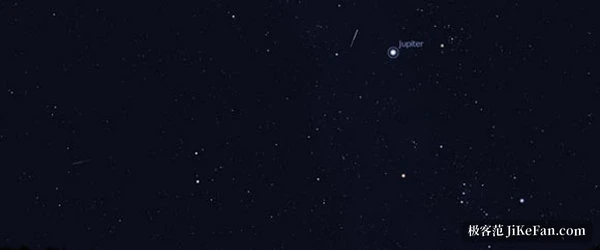
The eclipse tool inside AstroCalc adopts the terminology used by NASA and by Espenak, and it can jump straight to the key moment of a planetary transit or of a local eclipse instead of dragging the time slider by hand.
One more sky culture
26.3 adds the Potawatomi sky culture. Stars in this Native American tradition are grouped in a way that differs sharply from the 88 constellations most readers know, and putting it in the library amounts to one more way of looking at the night sky. Corrections to spelling, transliteration and phonetic notation also reached the Tibetan sky culture, so names written in non-Latin scripts display properly at last.
Catalogue work did not stop there. This build includes the nova and the supernova SN 2026sqf that appeared in Taurus during 2026, and an observer can locate either of them by name.
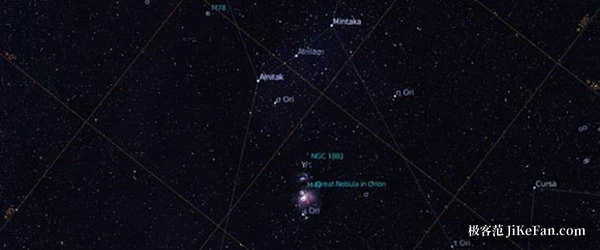
Telescopes, domes and remote control
Watching the real sky means leaving the screen behind at some point. The telescope control plugin speaks the LX200 protocol, and 26.3 adds TCP transport to it, so driving a mount across the network is less trouble than a serial cable. The same plugin now publishes OpenAPI documentation, and with an HTTP interface a script or a web page can drive the view without guesswork.
People who run a planetarium care about projection. Fisheye and spherical mirror projections are available, and with replaceable landscapes the image can go straight onto a dome. The scripting engine improved in this release, so a show can be scheduled ahead of time and scenes no longer need a hand on the mouse.
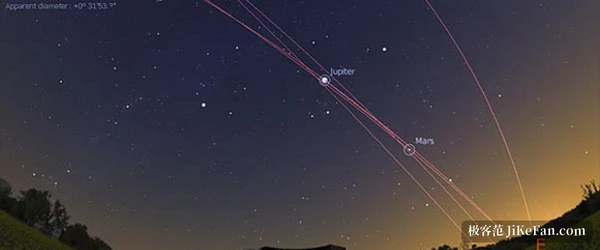
Small things that add up
Toolbars can be dragged to other corners of the screen, which owners of several monitors or of a wide panel notice at once. Satellite data in the Alpha-5 TLE format is accepted now, so older catalogue numbers still reach the right orbit. Oculars can hide the CCD centre marker inside the eyepiece field, and the sky HiPS layers gained display controls, so loading a large survey no longer consumes the graphics memory in one go.
Hardware demands stay modest: a 64-bit system, a graphics card with OpenGL 3.3, 4GB of memory and 10GB of disk space, and an older laptop runs it with the quality turned down. Stellarium ships under the GPL with its code in a public repository, so a school lab can deploy it in bulk without licence worries.
- Current release
- 26.3 from 2026-09-28
- Default catalogue
- more than 600,000 stars
- Deep sky objects
- more than 80,000 by default
- Sky cultures
- more than 40
- Licence
- GPL; free and open source
Whether to upgrade
Users of the previous branch can move to 26.3 without much thought, because this release is mostly new plugins and repairs and leaves the data structures alone. Check for updates inside the program; configuration files and custom landscapes stay where they are.
If all you want is to name a few bright stars, an app on the phone is enough. For a lesson, for a deep sky session planned in advance, or for a show in a planetarium, the desktop program offers what a phone cannot: catalogues that keep growing, projection onto a dome, and a time line that runs back two thousand years.
Stellarium 26.3 does not pile on features for their own sake. It settles whether a target is visible tonight, and for an observer that is worth more than a handful of flashy effects.