
Devin Desktop: after the Windsurf rename, an AI editor built as an agent control room
Version 2
Summary
Devin Desktop is Cognition's AI coding environment, renamed from Windsurf in 2026, where a board called Agent Command Center supervises local and cloud agents side by side.
Recommend- Name
- Devin Desktop
- Version
- 2
- Open source
- Proprietary
- Operating system
- WindowsmacOSLinux
- Website
- https://devin.ai/
- Updated
- 2026-10-06 22:26
An editor that opens on a board instead of a file
Devin Desktop is an AI coding environment from Cognition, and the first screen it shows is not a source file. It is a board called Agent Command Center, where every running session, whether it lives on the machine or in the cloud, sits in one of three columns: in progress, blocked, or waiting for review. The product is the continuation of Windsurf, the AI editor that a good number of developers had already adopted. On 2026-06-02 it was renamed through an ordinary over-the-air update, and the change went past the label on the window.
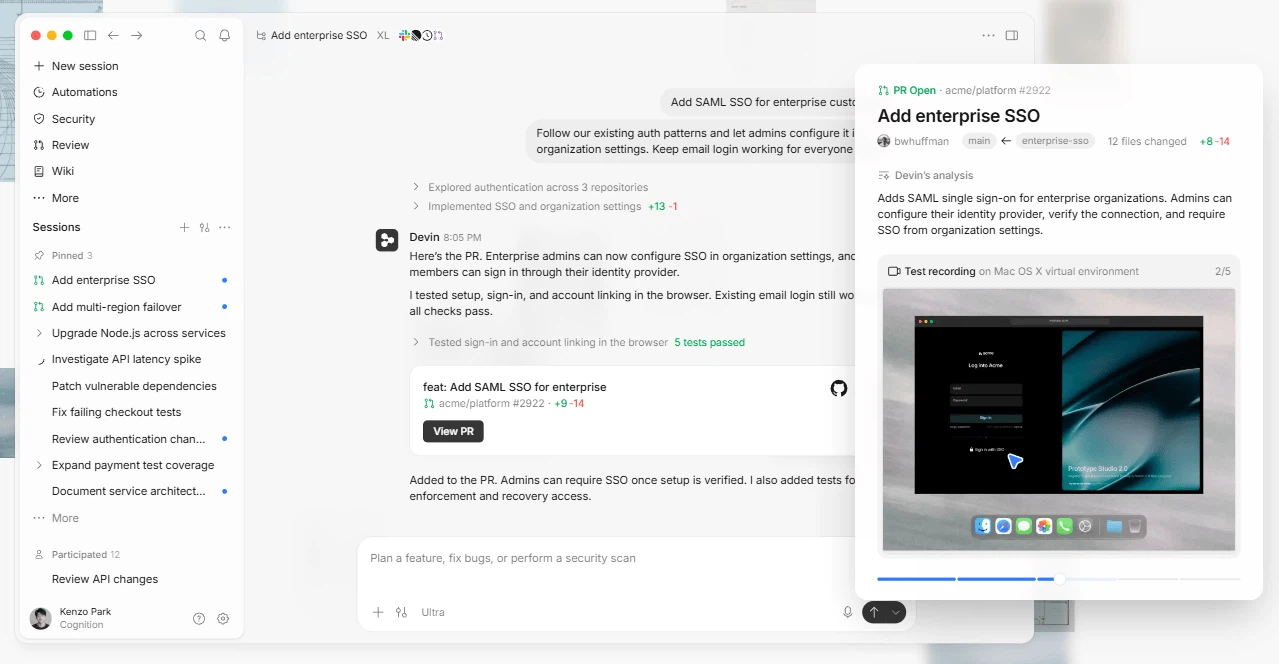
The reasoning behind the layout is easy to follow. A completion assistant serves one person writing one function, so the editor is the right frame for it. A handful of agents working at the same time need somewhere to be supervised, and a stack of chat windows is a poor place to keep track of which one is stuck. Putting them in columns answers the question that matters at that point: what needs my attention right now.
The editor is still there, one click away
Nothing has been thrown out. The editor, the extension support, the keyboard shortcuts and the language server plumbing all remain, and the environment stays compatible with the Windsurf and VSCode ecosystem, so existing themes and plugins continue to work. Any session on the board can be opened to land in the full editor, which means the board is a starting point rather than a replacement for the place where code is actually read and written.
Spaces is the other new idea. Related sessions, pull requests, files and context are gathered into one space, and the agents inside it share the same background information. Work that belongs to a single feature therefore stops being scattered across unrelated conversations, and the context a second agent needs is already present when it starts.
Devin Local, rewritten in Rust
The local agent has been rebuilt rather than patched. Devin Local was written from scratch in Rust and takes over from Cascade as the agent that ships inside the environment. The rewrite was aimed at efficiency, and the company reports up to thirty percent better token efficiency along with support for sub-agents, which lets one task be split into smaller pieces that run under the same supervision.
A more open step is support for the ACP protocol. Agents from other vendors, among them Codex, Claude Agent and OpenCode, can be placed on the same board and scheduled alongside the built-in ones. That turns the board from a view of one product into a single place where several different agents are dispatched, which is the more useful reading of the command center idea.
What the rename means for existing users
For anyone already working in Windsurf, the transition is close to painless. Settings, plugins and the subscription plan carry over unchanged, the free tier is still available, and paid plans start at 20 dollars per month. There is no second installation to maintain and no migration project to schedule.
The product line around it is coherent as well. The desktop environment handles supervision, the cloud version of Devin runs long tasks on its own, a command line client covers the terminal, and Devin Review looks over each commit. The same set of agent capabilities is spread across the whole chain rather than concentrated in one window.
Who should try it
Someone who writes code in a single window will need a few days to get used to the rhythm of a board, because the habit of watching one cursor is strong. The return appears once several tasks run at the same time: two agents on separate features, a third reviewing a pull request, and no need to hold all of that in your head. That is the case the interface was designed for.
The direction is clear enough. In this way of working a person hands out tasks and reviews the results from a control room, while the editor becomes a desk that can be walked up to at any moment. For anyone already running three or four agents at once, the rename is worth a look.