
Anki: open source spaced repetition cards with FSRS built in
Summary
Anki is an open source flashcard program for spaced repetition that hands the timing of reviews to the FSRS scheduler built into it, and includes a free service for syncing between devices. It suits learners who need to hold a large mass of small facts over the long run.
Recommend- Name
- Anki
- Version
- 26.09.3
- Open source
- Open source
- Operating system
- WindowsmacOSLinuxiOSAndroidWeb
- Website
- https://apps.ankiweb.net/
- Updated
- 2026-10-16 22:48
Learning vocabulary, memorising anatomical terms, preparing for a certificate: what these share is the need to keep a large number of scattered facts in memory over the long term, and forgetting does not stop just because something has been repeated often enough. Anki hands the question of when to review to an algorithm, so that reviews land at the moment a memory is about to loosen.
Why reviews should follow the rhythm of forgetting
Memory fades on a schedule of its own. What was just learned drains quickly over the first days and then the curve flattens out. If a review happens at the point where recall is about to fail, the attention spent buys a clear strengthening; repeat something already solid, by contrast, and the return is thin. The heart of spaced repetition is exactly this, placing the next review where the memory is about to give way, so fewer passes hold a firmer retention.
The method suits a large body of small facts that must stay for years. Medical terms, foreign words, chemical formulas, clauses of a statute: each carries little information, they are not linked by reasoning that would let you derive one from another, and understanding them once will not keep them. Only repeated contact will. Spaced repetition arranges that contact with restraint and avoids the pile it all up and cram approach.
Cards, notes and decks, each with a job
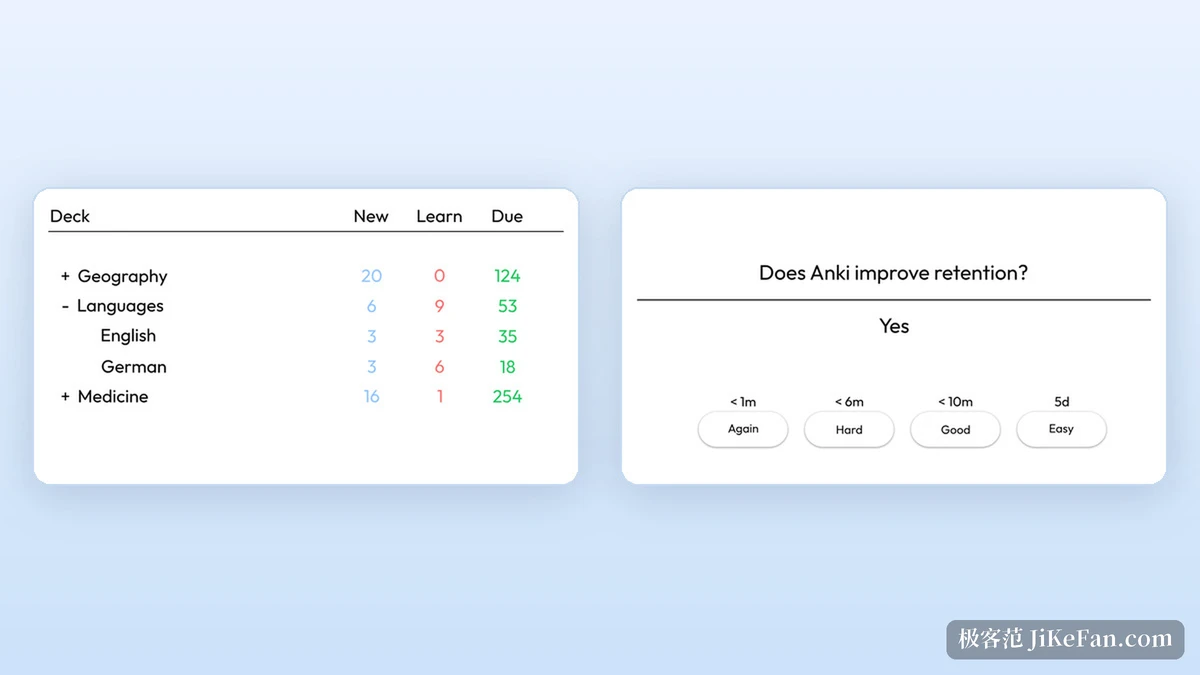
The basic unit is the card: a question on the front, an answer on the back, and during review you recall first and then turn it over to compare. Cards are generated from notes, and a single note can give rise to several. Take the note asking which city is the capital of a given country: it can produce both the country to capital direction and the capital to country direction, and the review progress of each is recorded separately.
Decks organise the cards. Splitting them by subject, textbook or exam narrows the scope of a session to what you need now, instead of facing the whole collection at once. Decks can hold subdecks, forming a hierarchy, which makes it easy to move between a full review and a focused one. The examples on the official site show geography, language and medicine decks sitting side by side.
How the scheduler evolved
The early scheduling followed the SM-2 algorithm, working out intervals from a single difficulty factor. Once a collection runs into the tens of thousands of cards, so crude a model struggles to fit how differently each person remembers each subject. Anki has since built in FSRS, a free spaced repetition scheduler, which derives estimates of difficulty, memory stability and retrievability for every card from its review history, and from those works out when the card should come back. FSRS is offered as an alternative to SM-2, has to be switched on in the deck options, and its parameters can be fitted once against your own review records.
Sync between devices, and where it runs
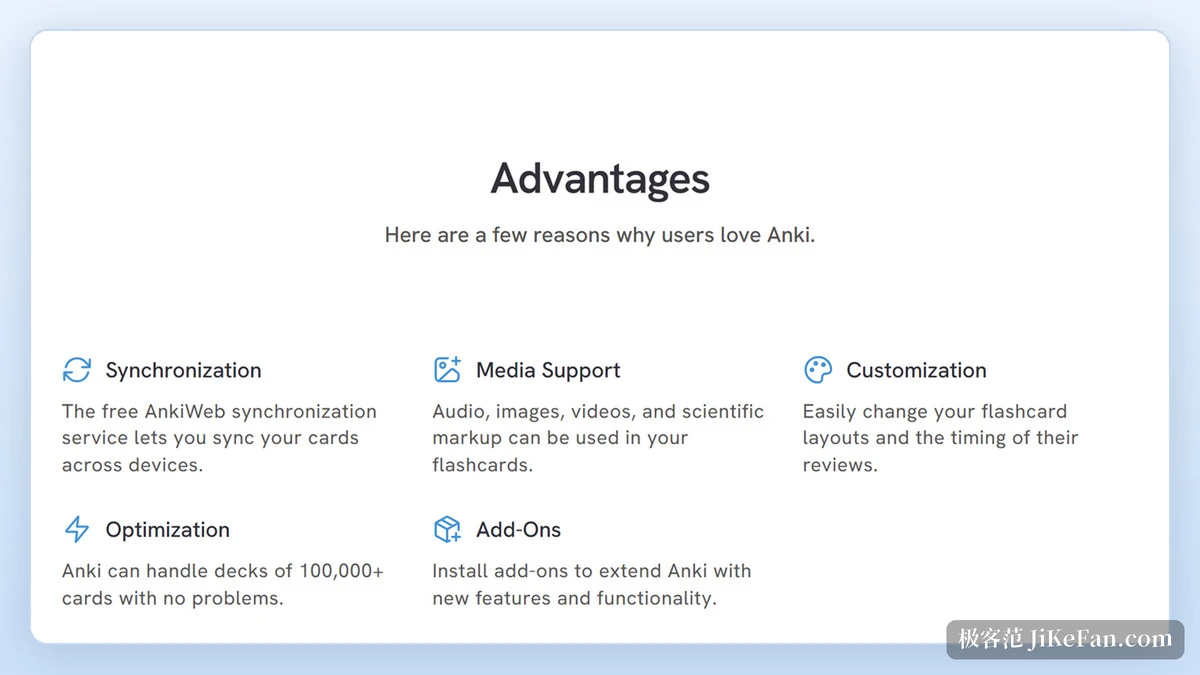
The official AnkiWeb service synchronises cards and review progress across several devices, and it costs nothing. The desktop build covers Windows, macOS and Linux; AnkiDroid on Android comes from community contributors, and AnkiMobile on iOS is the official app, with the proceeds supporting the project. A review finished on one device appears on the others, so time spent with cards on a phone does not have to be repeated at the desk.
Templates and add ons
Card layout and fields are yours to change, with a template for the front and one for the back that can hold text, images, audio and video. The timing is adjustable as well, including how many new cards enter each day and the daily ceiling on reviews. Add ons push the edges further out, since plugins written by the community fill in statistical reports, bulk editing, automatic sync and similar gaps.
The project and who maintains it
Anki is an open source project with the code public, and for a long time it was developed and maintained by its author Damien Elmes alone, a pattern that ran for close to twenty years. In February 2026 he posted an announcement on the official forum handing the open source maintenance to the AnkiHub team, which would organise developers to take over day to day upkeep and releases, and noted that the core maintainer of AnkiDroid would join and take part in governance. The announcement said plainly that carrying development, support and decisions alone had become unsustainable, and that handing maintenance to a team was meant to let the project continue on steadier footing.
Who it suits
Any setting that calls for keeping many small facts over the long run can gain from this mechanism. Medical and nursing students use it for anatomy, pharmacology and clinical points; language learners build vocabulary, sentence patterns and pronunciation with it; candidates for broad, long running certificate exams use it to cover the ground. The precondition is continuity, because a stop and start rhythm lets due cards pile up and turns the tool into a burden.
Item | Official information |
|---|---|
Type | A spaced repetition flashcard program |
Desktop version | 26.09.3 |
Platforms | Windows, macOS, Linux, iOS, Android and web |
Scheduler | FSRS built in, with the older SM-2 still present |
Sync service | AnkiWeb, provided free of charge |
Licence | Open source, with the iOS client a paid app |
From card templates to the scheduler, Anki splits long term memory into two things: content you can arrange freely on one side, an algorithm that works out when to review on the other. All the user has to do is open it once a day and let it arrange the rest.