
Pale Moon: an independent browser that keeps its own engine and its own rules
Summary
Pale Moon is an independently maintained browser with its own Goanna engine, no telemetry and a surviving XUL extension system that lets add-ons reshape the interface.
Recommend- Name
- Pale Moon
- Version
- 34.3.2
- Pricing
- Free
- Open source
- Open source
- Operating system
- WindowsmacOSLinux
- Website
- https://www.palemoon.org/
- Updated
- 2026-10-06 10:01
A browser that the big vendors do not decide for
Mainstream browsers have converged. The same interface logic, the same account layer, the same direction chosen on the user s behalf. Pale Moon takes the opposite route. It began as a hard fork of an established open-source browser and now runs on Goanna, a rendering engine maintained by the project itself rather than by a platform company. There is no advertising, no telemetry and no data collection, and the default search engine is DuckDuckGo. The goal was never a better mainstream browser but a browser the user actually controls.
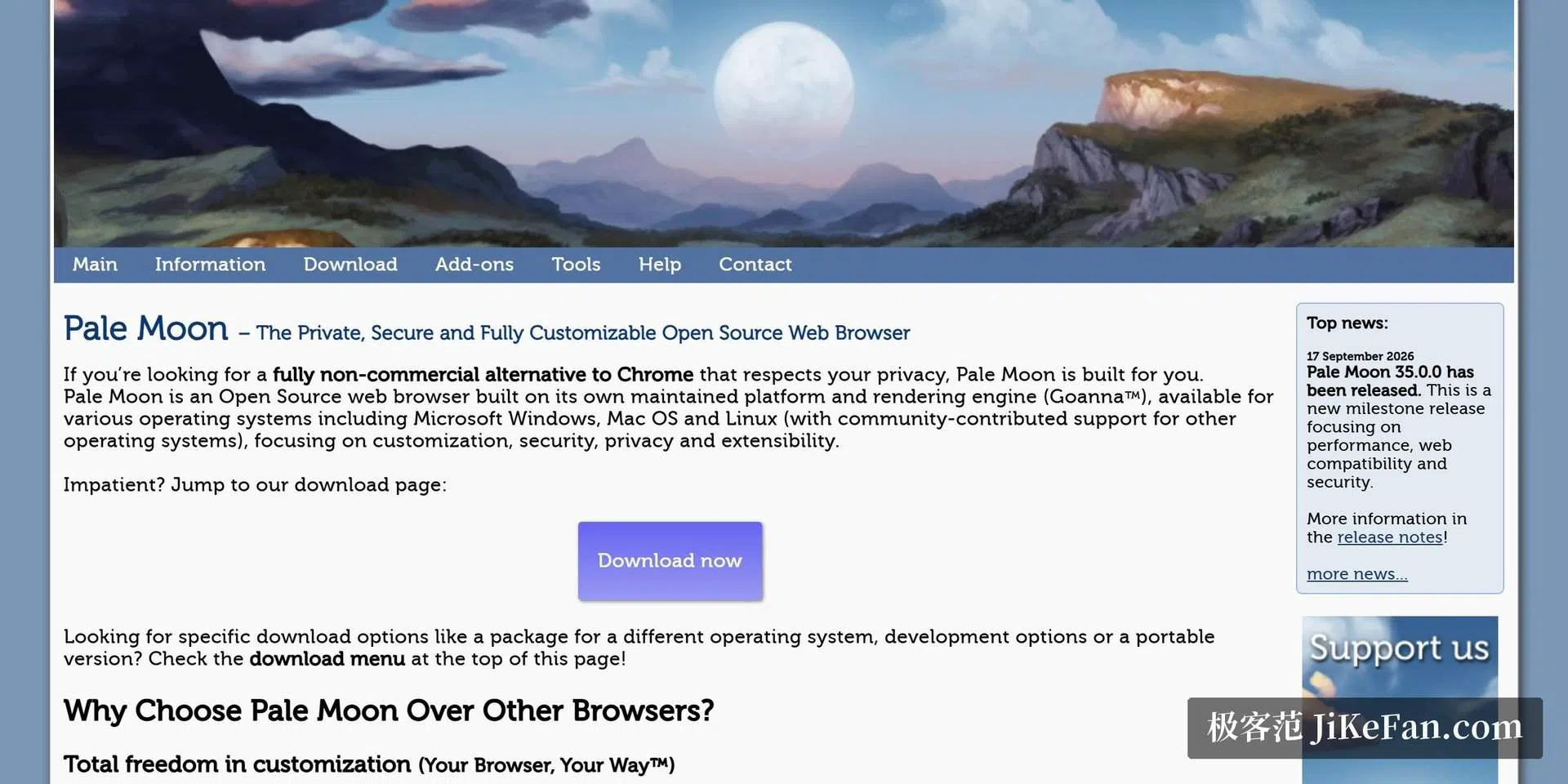
That word, control, is doing specific work here. It refers to decisions about what gets rendered, what gets reported back, and what an add-on is allowed to touch, and those three questions are answered inside the project instead of in a product meeting elsewhere.
XUL extensions: old, and free
When the Firefox lineage moved to a new extension model, a generation of deeply customising add-ons stopped working. Keeping the classic XUL system alive is one of the main reasons this browser exists. Extensions can modify and even redefine core behaviour, from the layout of the interface to the logic underneath it, and a complete theming system sits alongside them.
The architecture is single process, which makes the result unusually light. Opening the task manager does not reveal a dozen copies of the same program competing for memory, and on a machine that is already busy that difference is felt rather than measured.
What an independent engine costs
Maintaining an engine alone is not easy. With the mainstream rendering cores setting the expectations of site authors, some pages designed around the Chromium family need extra work, and the project says so plainly, recommending that users keep a second browser available for those cases. That advice is worth taking seriously rather than reading as a weakness.
The project has not stood still either. Through 2026 the 34 series has continued security auditing and standards work, the 34.3.2 update brought a new version of the network security services library and a batch of security fixes, and CSS features and support for the ES2024 language revision have arrived along the way.
Who it is for
Anyone who cares about privacy first, because there is nothing to switch off: the reporting simply does not exist. Anyone who enjoys adjusting software second, because the extension system is a workshop rather than a shelf of approved gadgets. Anyone tired of being arranged third, because the default settings are not a negotiation.
It is a poor fit for someone who wants every site to work without thinking about it. That is a real cost, and it is the same cost that comes with any browser built outside the mainstream: the web is written for the majority, and the minority has to adapt at the edges.
A browser as a long term arrangement
It helps to think of this as a relationship rather than a purchase. A browser built by a large vendor changes under its users on a schedule they do not control, and the changes are usually reasonable for the average person. A browser built outside that system changes slowly and predicts badly, but it also tends to keep the shape its users chose years ago. Which of those two is better depends entirely on how much you rely on things staying the same.
For a work machine where a particular extension does a particular job, the second arrangement is worth the friction. For a machine that has to open whatever the web sends this week, it is not, and there is no shame in running both.
The value here is not speed, it is the completeness of the choice: an engine kept alive by its own project, extensions that can be rewritten at will, and no telemetry at all. It resembles an older car with a manual gearbox. It takes time to get used to, but the wheel is entirely in your hands.