
Calibre: the housekeeper for a library that outgrew a folder
Summary
A few hundred ebooks scattered across a download folder, with mismatched names and formats, is where management stops being optional. Calibre reads metadata on import, fills in covers and series, and converts between formats almost freely.
Recommend- Name
- Calibre
- Version
- 9.15
- Pricing
- Free
- Open source
- Open source
- Operating system
- WindowsmacOSLinux
- Website
- https://calibre-ebook.com/
- Updated
- 2026-10-07 18:37
A shelf is not the same thing as a folder
There is a moment in every reading life when the collection stops being an accumulation and becomes a problem. It arrives quietly: a few hundred books in a download folder, some named after the file that was shared, some with the publisher's internal code, formats split across three incompatible families, and no way to answer the simple question of which book in the series you have already read. At that point a folder is no longer a shelf, and management stops being optional.
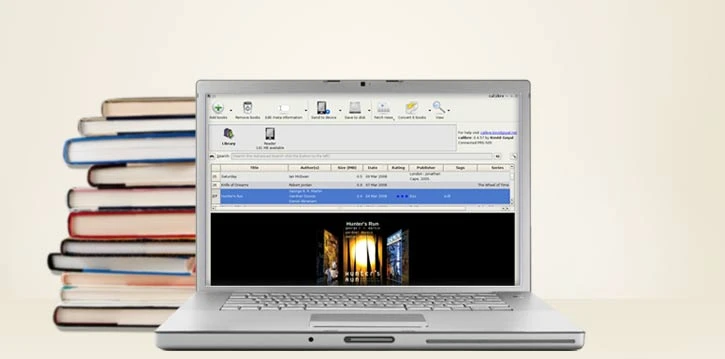
Calibre takes the role of housekeeper. On import it reads the metadata already inside the file, then goes online to fill in what is missing: the cover, the author's full name, the description, the series and the position within it. The shelf itself is organised along several axes at once, by author, publisher and tag, so searching is immediate and sorting does what you ask. None of this is glamorous work, and that is precisely the point: a library earns its value through the order imposed on it, not through the shelf it sits on.
The conversion engine is the piece that changes what is possible. Almost any mainstream ebook format can be turned into almost any other, with the parameters available at a level of detail that matters when the source was typeset badly. A book bought for a device that no longer exists, or downloaded in a format the current reader refuses, stops being a dead file and becomes readable again. That single capability quietly retires a whole category of frustration.
From managing to actually reading
Its range does not end at the shelf. A built-in reader opens the book directly, with reading progress and annotations kept in sync, so a book started on the desktop continues on the same page elsewhere. A news feature fetches sources on a schedule and assembles them into a periodical, which turns a set of sites you check every morning into something that arrives like a magazine. Connect a reading device and a selected set of titles can be pushed across in one action, with automatic conversion to whatever format the device prefers.
The plugin ecosystem extends the edges: exporting annotations, syncing to a cloud drive, and a long tail of smaller conveniences contributed by people who wanted one specific thing. It is open source, free, runs on the three desktop platforms, and has been updated for so many years that the release rhythm is simply a fact of life rather than a promise. New versions still add capabilities, and that level of activity is rare among projects of this age.
It demonstrates something worth remembering: the tools you cannot do without are often heavy and total rather than light and focused, like a study that never complains about how many books you own. The books are yours, and so is the order.
Getting the library right the first time
Fill in the metadata before the collection grows. The order of the shelf determines the experience from then on, and repairing a thousand records after the fact costs an order of magnitude more than fixing twenty at import. Do it in batches, one author or one series at a time, and the work turns into a pleasant half hour rather than a project.
Before converting, preview the layout. Simple text converts without drama; anything with tables, footnotes, poetry or carefully placed images can come out rearranged, and the answer is to change the engine parameters and try again rather than to accept the first result. When pushing to a device, choose the target format deliberately: a book converted to the right family reads properly, and one converted to the wrong one wastes battery and patience in equal measure.
For a heavy reader this is the first piece of equipment to install, and it costs nothing. It is not elegant, it does not try to be a social network, and the interface shows its age in places. But it holds ten years of reading without complaint, and that is a longer commitment than most software makes.