
Prime95: the stress test that settles whether a build is stable
Version 30.19b20
Summary
Prime95 is the official stress tool of the GIMPS prime search: Small FFTs pushes cores and cache to the limit, Large FFTs leans on the memory controller, and a portable cross-platform build makes it the shared yardstick for overclock stability, cooling and power checks.
Recommend- Name
- Prime95
- Version
- 30.19b20
- Pricing
- Free
- Open source
- Proprietary
- Operating system
- WindowsmacOSLinuxFreeBSD
- Updated
- 2026-10-06 23:15
A maths project side job that turned into a shared yardstick
Prime95 has a day job that is hard not to admire. It is the official software of GIMPS, the Great Internet Mersenne Prime Search, and for more than twenty years it has carried that project while mathematicians used the results to break one world record after another. What made the program famous, though, is the side effect. The arithmetic behind a prime test happens to sit close to the most hostile workload a processor can be handed, so the overclocking and system-building crowds adopted it as a shared reference point: a machine that survives Prime95 is a machine that may be called stable. Nobody planned that reputation, which is part of why people trust it.
Why this particular arithmetic bites so hard
There is nothing exotic in the code path. The point is that it keeps the floating point units busy with work that can neither be predicted nor short-circuited, cycle after cycle, without the idle gaps ordinary software leaves behind. A game, a video export, a compression run: every one of them pauses somewhere, waiting on storage, on memory, on a person. A prime search does not wait. It simply keeps computing, and heat and current draw climb with it until the cooling and the power delivery have to answer for themselves. That is why a single run exposes an overclock with no margin left, a cooler that was never adequate, and a case that looks good while moving no air.
Three modes, three different questions
The Torture Test ships with several classic modes, and they do not substitute for one another. Small FFTs keeps the working set small enough to sit inside the cache, so the load stays on the cores and their logic circuits; when the question is whether an overclock holds, this is where you start. Large FFTs works with data sets that spill out of the cache and shifts the emphasis onto the memory controller and the memory sticks themselves. Blend mixes the two into a full-scenario pass that touches both sides. A routine many builders follow after assembling a machine is half an hour of Small FFTs and then an hour of Blend: whether the heatsink can absorb the heat, whether the power supply holds its rails, whether the airflow actually reaches the parts that need it, all of it becomes visible inside those ninety minutes.
A failure is an answer, not a mystery
When the run reports a rounding error, or a worker stops and never comes back, the machine has told you something specific: some link in the chain cannot reproduce its own arithmetic under load. From there you narrow it down by changing one variable at a time. Compare that with the alternative most people live with, where a machine behaves for weeks and then drops out mid-task without leaving a single clue. One deliberate hour of pressure is cheaper than a month of guessing.
Practical notes before you start
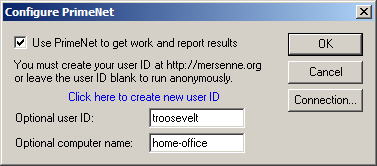
Prime95 is a portable program. Unpack it and it runs, with no installer to manage and nothing added to the system. On first start you can choose the stress-testing path and leave the distributed computing half of the project alone, which is what most hardware checks actually want. Beyond Windows there are builds for macOS, Linux and FreeBSD, so the same yardstick works in a household with mixed machines. Releases are slow here: the current build, 30.19b20, dates from the middle of 2024. That is not neglect. A workload that settled years ago is exactly what a reference should offer, because an older build still measures the same thing. Keep an eye on temperatures while it runs; a processor reaching thermal protection is normal behaviour rather than a fault, and leaving a chip at extreme voltage for days on end serves no purpose at all.
The standing of Prime95 comes from being blunt. Nothing decorative, nothing to buy, and a load that is fierce for a reason that can be explained. Whether a processor is stable is not settled by opinion. It is settled by one round of Small FFTs, and that sentence survives because the program keeps earning it.