
Prime95 30.19: a load test that doubles as a stability check
Version 30.19
Summary
Prime95 began as the client for a distributed prime search and became the reference load for overclocking and cooling. Several test sizes decide whether the processor alone or the whole memory path is put under strain, and it runs free on three systems.
Recommend- Name
- Prime95
- Version
- 30.19
- Pricing
- Free
- Open source
- Proprietary
- Operating system
- WindowsmacOSLinux
- Updated
- 2026-10-06 08:42
What it was built for, and what it became
Prime95 started as the client of a distributed prime search: a project that hands the enormous computation mathematicians need to volunteers' computers, which look for Mersenne primes in the background while their owners do something else. That is still what it is, and it is still free.
What made it famous is a side effect. The arithmetic it performs is unusually demanding on the processor, and running it stably for a long stretch is itself a threshold. So the question "can this machine survive Prime95" became a shorthand for whether an overclock and a cooling setup are actually reliable. The tool did not change; the use changed.
What the different test sizes are for
It offers several test types, and the difference between them is where the strain lands. Smaller transform sizes mostly load the processor itself, which makes them the right choice for watching core stability at a high clock and the temperature that goes with it. Larger sizes and the mixed mode pull the memory channels in as well, and that is where timing or voltage problems in memory tend to surface.
The choice therefore follows the question. If the thing you changed is the processor multiplier or its voltage, a small-size run answers it. If what you changed is the memory — its speed, its timings, its voltage — a run that includes memory traffic is the only one that can find the fault, because a test that never touches the memory path cannot fail because of it.
Reading the outcome
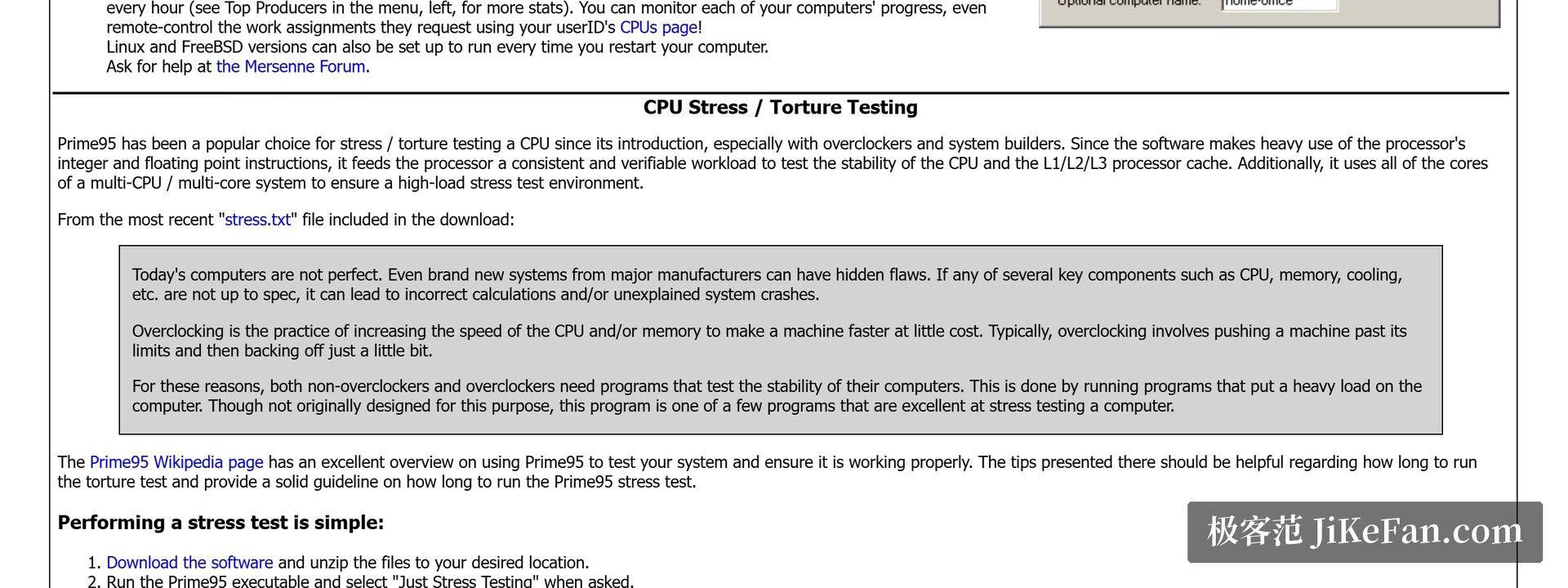
The criterion is blunt: over a run long enough to mean something, no calculation error and no interruption. When an error occurs it says so and records it in the log, and hardware instability at this level usually announces itself in a specific way — one core's thread falls behind the others first, which points at that core rather than at the machine as a whole.
A word of caution that belongs before the test rather than after it: this kind of load raises power draw and temperature sharply. Confirm the cooling capacity and the power headroom first, and on a laptop watch the thermal limit and the clock reduction that follows it. A test that overheats the machine has measured the cooling, not the stability, and the two conclusions are easy to confuse when the screen is showing a failure.
Cost, platforms, and how much testing is enough
It is free software and runs on Windows, macOS and Linux. Used for the prime search, an account and a place in the project are what start the work; used as a test, the stress options are available without any of that. Those are two different intentions sharing one program, and it is worth being clear about which one you have.
For testing, the sensible sequence is short and boring: run the default settings for a while, watch the temperature curve, and only extend the duration once the cooling is confirmed to be under control. A machine that is not overclocked has little reason to be burned in for hours on end; an occasional check that it still starts and computes cleanly from cold is enough for most people.
What passing means
Passing is evidence, not proof. The load is narrow by design — it does not simulate daily use, it pushes the computing units to their limit — so a clean run says the machine can do this particular hard thing without arithmetic going wrong. It does not say the graphics card is stable, the storage is healthy or the machine will never crash.
Failing, on the other hand, is informative in a way that few tests are. If this load produces errors, something in the current configuration cannot be sustained, and the next step is specific: reduce the clock, raise the voltage, relax the memory timings or improve the cooling, then run it again. That is the whole value of an unsparing benchmark — it produces a clear question with a small number of answers.
Prime95's point is to provide a load that makes no concessions: it does not imitate daily work, it drives the computing units to the ceiling. Passing it does not prove the machine is sound, but failing it proves that something still needs adjusting.