
NipaPlay Puts the Danmaku Track Back on Local Video
Summary
An open-source player built for watching a series rather than opening a single file: local video plays with a danmaku track overlaid, subtitles load alongside, the interface stays out of the way, and it runs on five platforms.
Recommend- Name
- NipaPlay
- Version
- 1.11.7
- Pricing
- Free
- Open source
- Open source
- Operating system
- WindowsmacOSLinuxAndroidiOS
- Updated
- 2026-10-16 22:00
A player built around watching a season, not opening a file
A general-purpose media player is designed for a single event: you have a file, you open it, it plays, you close it. Watching a series is a different activity with different requirements. Files come in a folder rather than one at a time, they run in a fixed order, the session lasts for hours rather than minutes, subtitles matter more than they do for a clipped video, and the thing that makes the experience feel complete — the running commentary that a streaming site provides — is exactly what a local file does not have. NipaPlay is designed against that second situation rather than the first, which is why it looks like a player and behaves like something built for the habit of following a show.
Two tracks at once: picture and commentary
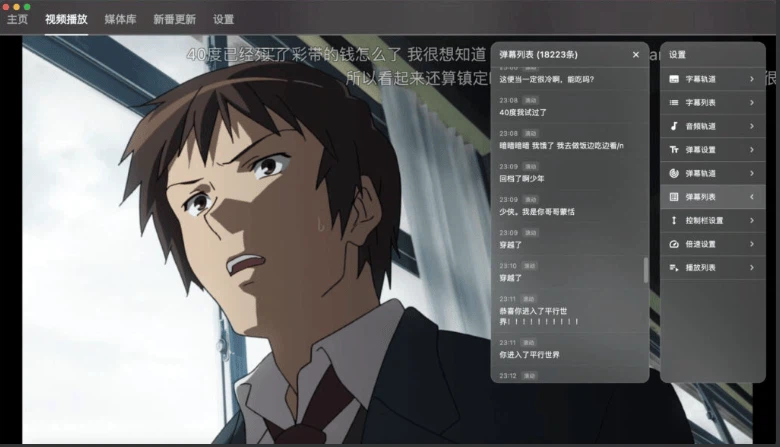
The central idea is that playback and the comment layer are not separate features bolted onto each other but a single composite experience. Local video plays in the usual way, and over it the danmaku track scrolls as it would on a streaming site, so a file sitting on a disk gets the one thing a disk cannot provide: the sense that other people are watching at the same time. For anyone who has watched a favourite episode twice, the second pass is usually about the comments rather than the plot, and this is the feature that makes a local collection behave like a place where that second pass is possible.
The controls stay out of the way
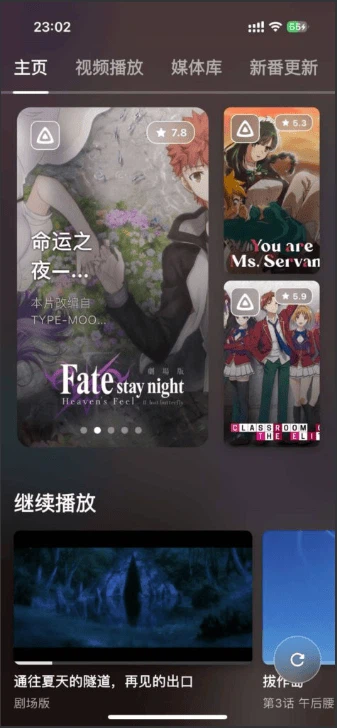
The rest of the design is deliberately unremarkable, and that is a compliment. Play, pause, scrubbing, volume and full screen all work the way fingers already expect, with no scheme to learn and no menu tree to descend. The interface is kept visually sparse, on the argument that a viewer's attention belongs on the picture and that a crowded toolbar is a cost paid every episode rather than once. Subtitles load alongside the video and playback is managed in one place, so the parts that would otherwise be three small chores — finding the file, matching the subtitle, remembering where the last episode stopped — do not interrupt the session.
What open source actually buys here
The project is open, and the practical consequences are more specific than the word usually suggests. The first is transparency: anyone can read what the program does, which matters for software that is asked to open arbitrary files from arbitrary places. The second is direction: the roadmap and the changes between versions are visible, so a user can judge whether the project is heading somewhere they want to go instead of discovering it after an update. The third is durability, the least discussed and the most valuable over years — a player is infrastructure for a library, and infrastructure that can be maintained by more than one party is infrastructure that will still open your files later.
The other half of openness is freedom from the surrounding apparatus. No advertising, no membership tier, no closed ecosystem deciding what can be played on what. For someone assembling a personal library of animation, that freedom is not an ideological point but a practical one: the collection is the point of the exercise, and a player that stays a player is the right size for it.
Where it earns its place in the daily routine
The needs of someone following a show are consistent enough to list. Many files, in order, watched consecutively. Subtitles that must be right, because a mis-timed line ruins a scene. Comments that carry part of the value. And stability over a long stretch, because a marathon is not the moment to discover that the software gets tired after two hours. Those four needs are what the design answers, and the answer is not a longer feature list but a smaller number of things going wrong.
It also suits the long session better than a general player does. A sparse interface, clear controls and a comment layer that can be read at a glance let a viewer settle into the story quickly and stay there, instead of navigating menus between episodes. Late at night, across a weekend, or while reorganising a collection, the useful quality is the absence of friction rather than the presence of capability.
Atmosphere, with the control still in your hands
The value of a comment track is participation, and participation is only pleasant when it can be governed. Because playback is local, the rhythm belongs to the viewer: what to watch, when to stop, whether to rewind a scene to read what passed too quickly. Nothing is removed because a platform delisted it, nothing is reduced in quality because of a connection, and the picture is whatever the file actually contains. That combination — the atmosphere of a shared viewing and the authority of a local file — is the specific thing this kind of player exists to provide, and it is not something a streaming site can offer by design.
Who it is for
Animation viewers first, then anyone who keeps a local collection of series and wants it to feel less like archiving and more like watching. People who already have many episodes on disk and no pleasant way to move through them. People who want the comment layer without the rest of the platform that comes with it. People who care what a program does to their machine and prefer to be able to check. What these users share is not a preference for the technical but a preference for a tool that does one job and then disappears, which is a harder thing to build than a tool that does everything and stays in the way.
NipaPlay is worth recommending for one specific combination: high-quality local playback and a danmaku track, held together in something open, plain and light. It does not stop at the question of whether a file can be played. It takes seriously the parts of following a series that are about atmosphere, continuity and settling in — and it does that without asking the viewer to give up control of their own library.
A clear position, honestly held
Most players try to be neutral, and neutrality is why they feel like utilities. This one takes a side: that watching a series locally should not mean watching it alone, and that a collection deserves an entrance designed for it rather than a file dialog. Whether that matters depends entirely on how you watch. For someone who opens one video a month, a general player is enough and this is unnecessary. For someone who follows several shows and keeps them, the difference is felt on the first evening and every evening after, which is the only test a tool of this kind should be asked to pass.