
LMMS 1.3.0-alpha.2 arrives with 932 commits piled up over five years
Summary
After six quiet years LMMS shipped 1.3.0-alpha.2 in September 2026: 932 commits, 65 contributors and 8 new plugins, plus microtonal tuning, detachable windows and ARM64 builds. The stable release is still the one from July 2020.
Recommend- Name
- LMMS
- Version
- 1.3.0-alpha.2
- Pricing
- Free
- Open source
- Open source
- Operating system
- WindowsmacOSLinux
- Website
- https://lmms.io/
- Updated
- 2026-10-21 16:04
LMMS is a free, open source, cross platform music production workstation that keeps the layout of a classic sequencer: instruments and effects down the left, clips laid out on the right, and the mixer in its own column. Its previous release was in 2020. On 6 September 2026 the development branch put out 1.3.0-alpha.2.
Five years and ten months, for a second alpha
Set the timeline out first. The previous pre-release was the first alpha of this same line, dated 9 November 2020; this one is 1.3.0-alpha.2, dated 6 September 2026, with five years and ten months in between. The stable version available to everyone is still the build from 4 July 2020.
So the backlog in the title is the project's own accounting, not rhetoric. The release note is specific: between the two alphas came 932 commits, 3,457 changed files and 65 contributors, along with 8 new native plugins and ARM64 builds. That volume would fund a mid-sized refactor in any active project, and it was packed into one version number labelled second alpha.
The repository never stalled: GPL-2.0 licence, C++ as the main language, about ten and a half thousand stars and twelve hundred forks, created in January 2014, most recent push on 19 October 2026. Code kept merging; only the version number refused to close.
Eight new instruments and a queue of overdue changes
The most visible of the new features is that set of 8 native plugins, named individually as SlicerT, the LOMM multiband compressor, a granular pitch shifter, a frequency shifter, the Dispersion effect and SlewDistortion. The slicer deals with where a sample loop gets cut, while multiband compression and granular shifting fill in a stage of mixing and sound design that long relied on outside plugins.
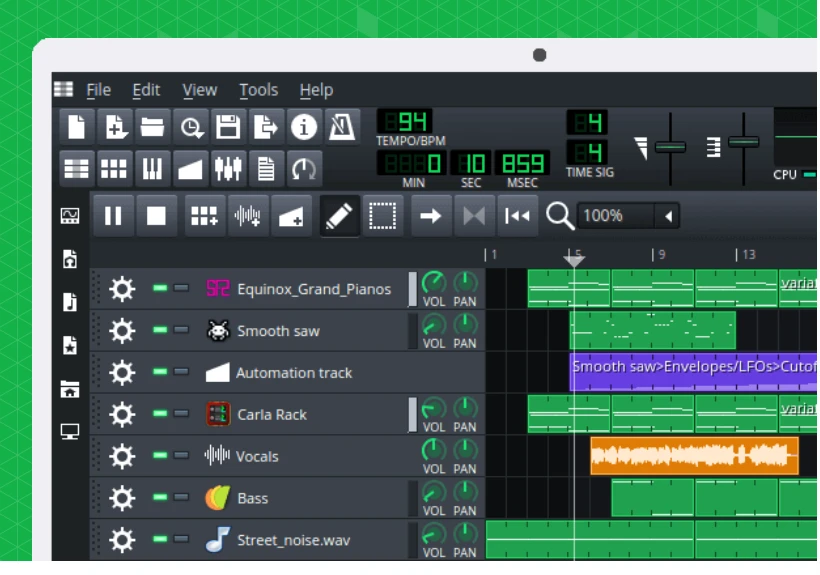
Interface changes sit closer to daily work: windows can be detached, so the piano roll or the mixer moves to a second screen; clips can be cut and resized; the workspace pans by dragging instead of hunting for a scrollbar; pitch bends draw straight into the piano roll; and an oscilloscope plus tap tempo join the set. None of these is large alone. Together they change one kind of feel, that the thing in hand no longer requires switching somewhere else to finish.
One item is easy to overlook and carries weight: microtonal tuning and alternative temperaments, with keyboard mapping alongside. A traditional sequencer assumes twelve tone equal temperament by default, and non Western scales or historical tunings take long detours; this makes them native, and with microtonal support in SF2Player the sample instruments follow.
Another item is what Linux users waited longest for: native LinuxVST support. Running VST on Linux used to need a bridge, and every layer adds latency and compatibility trouble; this reads the native format directly. A secondary list adds an alias free oscillator, MP3 import, peak meters on the mixer strips, SDL configuration for input and output devices, and Wayland support in the AppImage, all details whose difference shows the moment you use them.
The foundation never moved: sixteen synths and three sample formats
What lets this software work on its own is the foundation that stayed put. The site counts 16 built-in synths, and by the official list they include emulations of the Roland TB-303, the SID chip in the Commodore 64, the sound chips of the NES and GameBoy, and the Yamaha OPL2; ZynAddSubFX is embedded, and SF2, GIG and GUS multisample formats are native.
The plugin side is not closed either: LADSPA loads directly, and VST effects load directly on Linux and Windows. For anyone used to buying sound libraries in sets, the point is not having to buy everything at once; for anyone who just wants a beat, it works the moment it is installed.
The floor has risen
This update is not friendly to old machines, and that should be said early. 32-bit builds are no longer offered on this line, and the official environment is Windows 10 or 11 with a CPU supporting x86_64-v2 or better; macOS High Sierra and later, with macOS 11 or later on Apple Silicon; and Linux with glibc 2.35 or newer, where the newest builds ask for 2.39.
What that buys is wider coverage: this release adds ARM64 builds, with arm64 packages for Windows, macOS and Linux. The x86_64-v2 line also shuts out processors from a decade and more ago, since it requires instructions such as SSE4.2, and that is the unavoidable price of turning compiler optimisation up.
Whether to switch now
The project states the position of this build in the body of the release note, in plain words: it comes from the development branch, sits somewhere between a nightly build and a stable release, may crash, may produce project files that do not match, may leave a saved project unable to return to the old version once upgraded, and some new features will be adjusted or removed later. That is not boilerplate, it is the real cost of a development branch.
The choice is clear cut. With a project under delivery, the safe landing is still the stable build from July 2020, the only one currently marked as the latest stable release. To try any of those dozen or so major features, alpha.2 is the only entrance right now, provided the project file is saved under another name and the machine carrying delivery pressure is not the one running it.
The rhythm deserves attention too: no beta or stable has appeared since, and with five years of backlog released at once, several more rounds from alpha to beta are likely. People in a hurry go first, people waiting for stability wait, and the two do not conflict.
A project that went six years without a stable release has now handed in five years and ten months of accounts through one alpha: 932 commits, 65 contributors, 8 new plugins, plus microtonal tuning, detachable windows and ARM64, all long overdue. It is several rounds short of being a daily driver, but the restart itself is real this time.