
llama.cpp: the engine that runs a model on a bare processor
Summary
Written in plain C with no dependencies, it set the file format that made quantised models small enough for ordinary laptops, and it is the layer several familiar desktop tools quietly build on.
Recommend- Name
- llama.cpp
- Version
- 0.4.1
- Pricing
- Free
- Open source
- Open source
- Operating system
- WindowsmacOSLinux
- Updated
- 2026-10-06 09:29
Trace the local-model story far enough back and almost every name leads to the same project. In March 2023 one developer carried a freshly published open model onto ordinary consumer hardware in plain C and C++, and what began as a port became the foundation the whole field stands on: maintained today by a small organisation, past 128,000 stars, and the same lineage of inference code that several familiar desktop apps quietly use underneath their buttons. The current stable release arrived on 14 September 2026 and still ships prebuilt binaries for the three desktop systems.
Its best-known contribution is the GGUF file format. Before it, the raw weights of an open model ran to tens of gigabytes and put consumer hardware out of the running; GGUF packs weights, tokeniser and metadata into a single file, and with the k-quants family of quantisation levels - Q4_K_M and its neighbours - the memory a model occupies drops by roughly 60 to 75 percent with very little loss of quality. A seven-billion-parameter model then shrinks to a few GB and fits in the memory of an ordinary laptop, and the thousands of quantised files that circulate publicly grew up around this format. Put differently: the easy experience of downloading one file and running a model rests on rules this project wrote.
Inference on the processor was never a stopgap here but a first-class citizen. The engine is optimised deeply for the vector instruction sets of x86-64 and for the equivalent extensions on the low-power chip family, and in community measurements a quantised model of seven to eight billion parameters reaches 10 to 30 tokens per second on a modern laptop processor with no discrete card - enough for ordinary conversation. For the old desktop without a separate card, the office laptop with integrated graphics, or the home server where a card is awkward, it is often the only thing left that will still run this year's models. That is where the phrase last insurance comes from: when everything else balks at the hardware, this usually holds one more line.
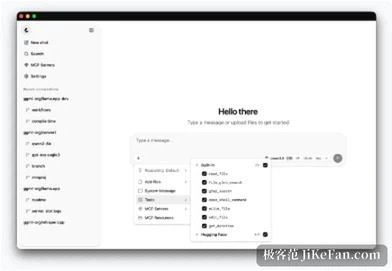
Machines with a card gain too, and flexibly. Whole layers of a model can be pushed onto the card while the rest stays on the processor, so a device short of video memory trades speed against capacity layer by layer; behind that sit dedicated kernels for one vendor's cards, first-class support for in-house silicon, and portable compute paths for the other two. The project also ships llama-server, which starts a local HTTP service that speaks the request format of the large hosted providers and brings its own web page; clients that accept a custom endpoint can point straight at it, and features such as continuous batching switch on in server mode.
Four kinds of people end up here. The enthusiast who wants to see the knobs; the developer who embeds an engine inside a product rather than shipping a chat window; the owner of a machine with no separate card, for whom every other road is closed; and the person running a small home server who wants an endpoint on the network and nothing more. None of them is looking for a polished interface, and all of them are better served by a chassis than by a car.
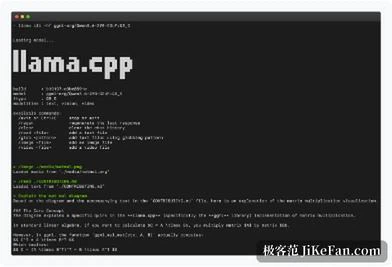
Its orientation deserves plain words. There is no official graphical interface; the command line is the only sanctioned entrance, and every parameter - context length, how many layers move to the card, thread count, quantisation level - has to be stated or accepted as a default. What that buys is control and embeddability: this is a zero-dependency engine rather than a finished product, so developers fold it into their own applications, administrators run it headless as a service, and enthusiasts script it into automation. The licence is permissive enough that commercial use and derivative work raise no obstacle. If the friendlier tools are cars delivered ready to drive, this is the bare chassis with the bonnet open - not for everybody, but for anyone willing to get their hands dirty it sets how far a local deployment can go.