
GPT4All: a local model on a computer without a graphics card
Summary
No discrete card, no account, no command line: a quantised open model runs on an ordinary processor, and a folder of your own paperwork becomes a question-answering collection that never leaves the machine.
- Name
- GPT4All
- Version
- 3.10
- Pricing
- Free
- Open source
- Open source
- Operating system
- WindowsmacOSLinux
- Website
- https://gpt4all.io
- Updated
- 2026-10-06 22:23
Ask people why they never tried a model on their own machine and the answer is rarely the sign-up or the price. It is the hardware list: so many gigabytes of video memory, this or that class of card, as if without a decent discrete chip you had no business entering. The reality is that most computers are an ordinary office laptop - integrated graphics, 16 GB of memory, a plain solid-state drive. Unless the ticket comes down to that level, a local model for everyone stays a slogan.
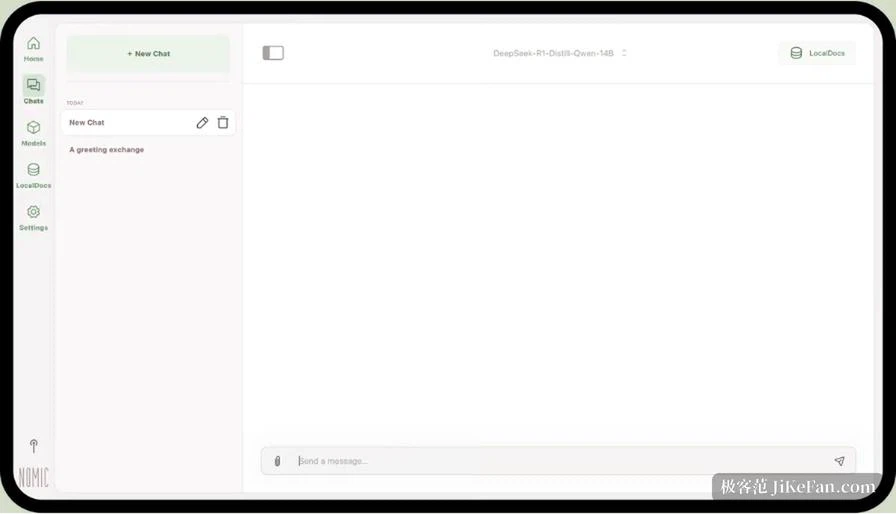
GPT4All is the project that turned the slogan into a room you can walk into. It appeared in 2023 under a very permissive open licence, has collected more than seventy thousand stars, and was among the first programs to run a language model on hardware ordinary people actually own. The decision at its centre has not changed: a graphics card is optional, the processor comes first. A quantised open model runs on an ordinary CPU, 8 GB of memory carries a model of the seven-billion-parameter class, and laptops with integrated graphics and older desktops are squarely in scope. Owners of a discrete card from either of the two big vendors get acceleration through a cross-platform graphics interface, machines with in-house silicon take that vendor's own path, and without any of it the experience is slower rather than impossible.
After installation there is almost nothing to learn. Pick a model from the built-in library, where each entry is labelled with its size and its appetite for memory, wait for the download, start typing. The real headline is LocalDocs, which turns question answering over your own documents from an engineering project into a tick box. Point the program at a folder, it builds the index on the spot, and afterwards a question is answered with the most relevant passages pulled in as context - with the cited sources listed under the reply. The files never touch a server: PDFs, word-processor documents and plain text all work.
Privacy follows the same restraint. Out of the box the transcript stays on the machine, no usage measurements are taken, no account is required, and the optional data-sharing programme is strictly opt-in - leave the box clear and nothing is uploaded. The program covers the three desktop systems, and recent builds also look after portable machines built on the frugal chip design.
Developers are not forgotten: a Python package installs from the usual index and two lines of code call a local model from inside a script, while a container-based local service exposes an endpoint that speaks the same request format as the large hosted providers, so an existing toolchain can be pointed at local inference by changing one address. There is also a code interpreter inside the application, walled off in a sandbox, which runs the simple snippets a model writes.
The weak spots deserve plain language too. Processor inference has a ceiling, and on a machine without a graphics card the writing speed is adequate rather than comfortable; loading a larger model takes patience. The curated model list has been refreshed more slowly of late, so the newest open releases usually have to be imported by hand in a standard model file format. The intelligence of a local model sits an honest distance below the hosted flagships, and hard reasoning shows it. Indexing a big document collection is slow on modest hardware, and pushing the context setting too high can make things unstable.
In this corner of computing the tools keep getting stronger while the ticket quietly climbs. The value of GPT4All is that it has held the bottom step: no graphics card, no account, no command line, just an ordinary computer and a model file of a few gigabytes, talking to your own paperwork with the network switched off. For a first attempt at local AI it is not the destination, but it is the start least likely to be abandoned halfway.
A technology spreads from the easiest entry, not the strongest one. The day the graphics card came off the list of requirements was the day local AI stopped being a hobby for specialists.