
LibreChat: one self-hosted chat layer turns model bills into metered usage
Summary
Free software you run yourself: one window for several model providers, agents assembled without code, a sandboxed interpreter and MCP connectors, with cost per team member visible instead of dissolving into a fixed subscription.
Recommend- Name
- LibreChat
- Version
- 0.8.7
- Pricing
- Free
- Open source
- Open source
- Operating system
- Web
- Website
- https://www.librechat.ai
- Updated
- 2026-10-28 22:00
Three or four AI subscriptions every month buy you three or four separate histories that never talk to each other. LibreChat takes the other route. It does not sell a subscription, and it does not host a model either: you put the software on a machine you control, point it at the model interfaces you already pay for, and the bill starts following actual usage instead of a fixed monthly line.
The starting situation is easy to recognise. One paid plan for the assistant you use daily, a second because another vendor handles long documents better, a third because its image work is good enough to keep. Each amount is survivable on its own; together they approach three digits, and none of them can be dropped without losing something specific. The conversations, meanwhile, stay in three separate silos.
The project itself is under the MIT licence, the source sits on a public code hosting platform, and it has collected roughly forty-three thousand stars, more than fifty million container image pulls and four hundred contributors. Those numbers carry a practical meaning rather than a marketing one: running your own chat layer only makes sense if the layer keeps being maintained after you install it.
What the software actually is deserves saying early, because it decides what you are signing up for. It does not run inference. It is a self-hosted orchestration layer wrapped around a conversation interface: a server-side JavaScript runtime behind it, a component framework in front, and its own document database holding sessions and user records. You bring credentials for the model side. If you would rather not pay per token at all, it can also talk to a model runner sitting on the same machine, which keeps everything local.
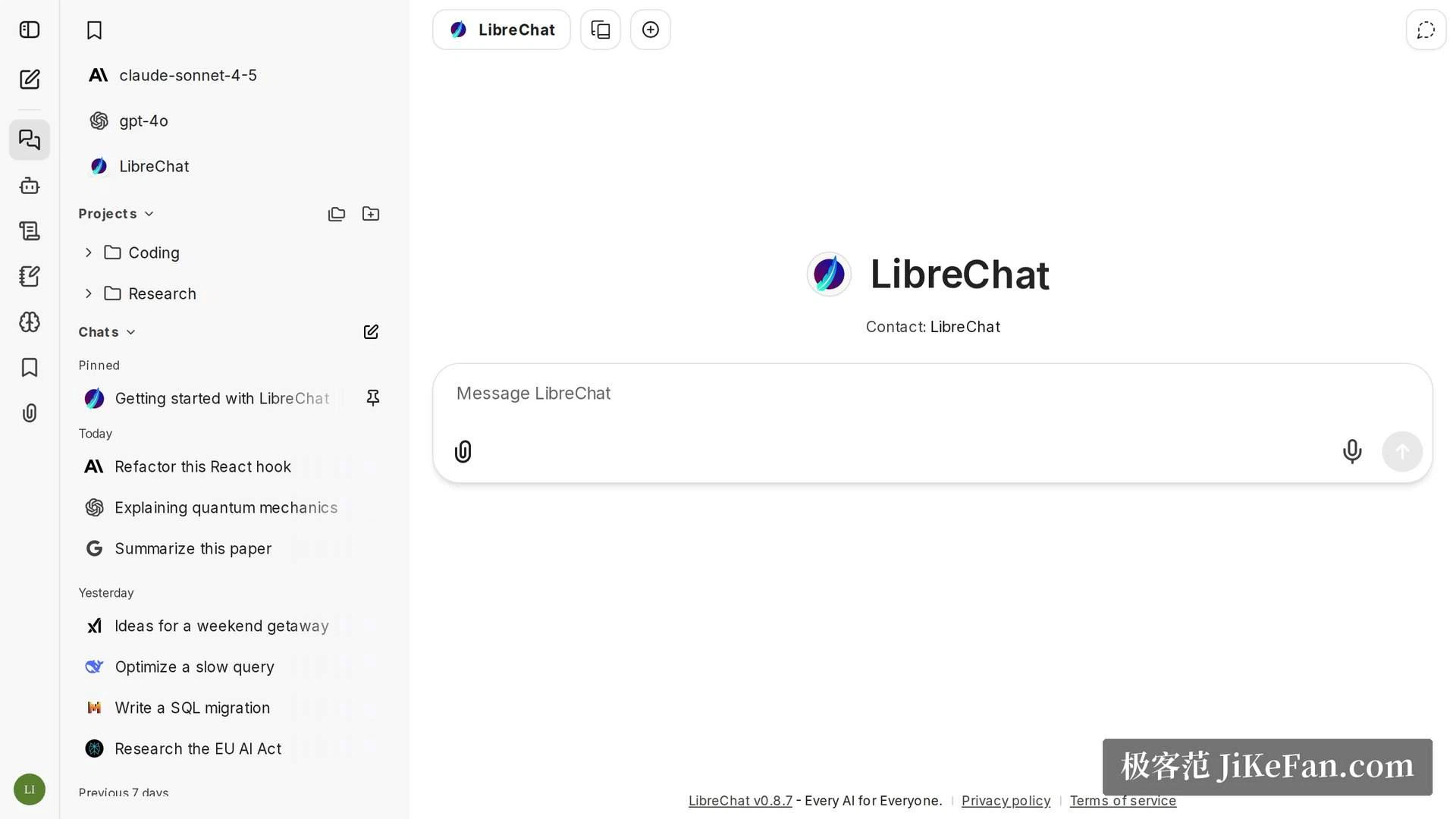
Every vendor inside one window
The breadth of connections is the most concrete part of the offer. Hosted services from the large cloud providers are covered, as are a long list of mid-size inference providers, aggregator routing services, and any custom endpoint that speaks the common chat-completion format. The practical effect is switching model inside one thread: the first half has one model sketch the approach, the second half has another write the code, and the context carries over without anyone re-explaining the problem. The interface ships in more than thirty languages, with translations kept current by the community.
For a team the arithmetic changes shape. Instead of one subscription per head, a key is configured once and the whole group shares a single front end, with consumption per person visible in the admin view. Rate limits can be set per model, balances can be assigned per account, and cost stops dissolving into one opaque line.
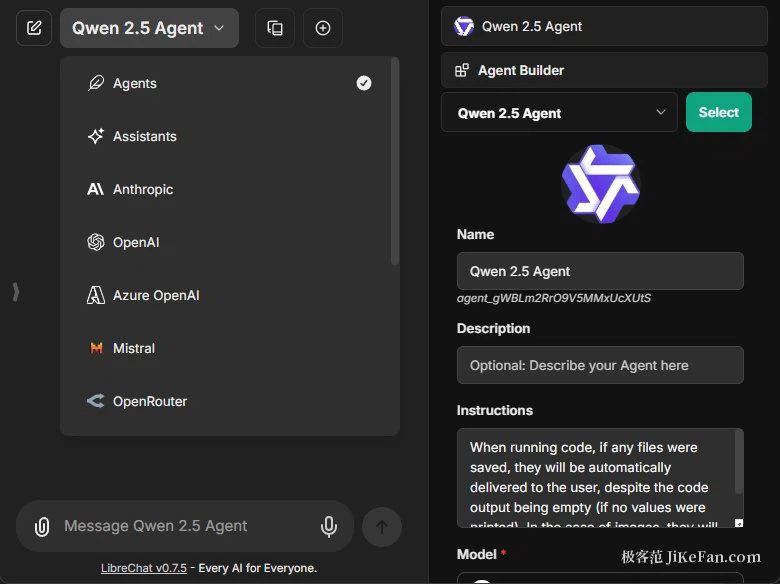
Agents, code execution and rendered surfaces
If it were only a chat window it would be indistinguishable from a hosted web page. Agents are where the difference lives. You assemble an assistant without writing code: attach file handling, code execution and outbound API calls, add a system prompt, and the result is a specialist for one kind of work. Finished agents can be published to a shared gallery or handed to named colleagues. One layer below, skills and sub-agents split a large job into separate tasks with separate context, so a detour in one thread cannot contaminate the reasoning in another.
The code interpreter is the feature most often underestimated. It runs Python, JavaScript, TypeScript, Go, C, C++, Java, PHP, Rust and even Fortran inside an isolated sandbox, so nothing has to be installed on the machine you are sitting at. Upload a table, ask for a result, download the output, and the whole loop stays inside a single conversation. When the data is sensitive, that execution happens on hardware you own, which is often the actual reason people move.
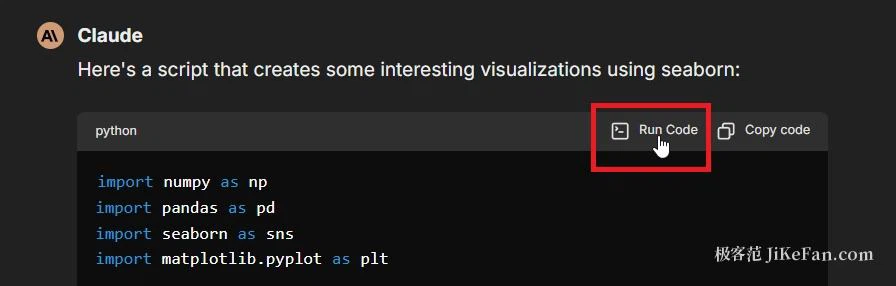
Rendered artefacts cover the visible half of the work. Ask for a component, a page or a flow chart described in a few lines of text and the result appears beside the conversation; change one line and the change shows immediately. Sketching a layout or checking a diagram this way is faster than carrying code into an editor and back.
Reaching the systems you already run
A strong model still cannot see your internal database. MCP covers that gap: it is an open standard for connecting a model to outside tools, and this software can attach any MCP server. Once configured, the model queries data, calls internal endpoints and walks a file tree, which turns it from something that answers into something that acts. One company wired more than thirty internal MCP servers into it so staff could ask questions in plain language instead of filing requests.
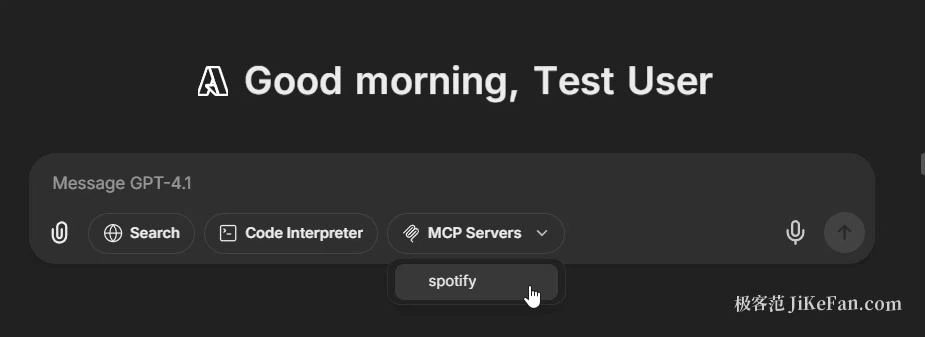
Several smaller decisions matter in daily use. Memory keeps preferences across conversations, so nothing gets restated every morning. Web search can be attached to any model, and results are re-ranked before they enter the context, which keeps a pile of irrelevant pages from crowding out the question. Full-text search across messages and attachments is handled by a dedicated search engine, making an archive of several hundred threads navigable. Conversations can branch, so an experiment never pollutes the main line.
The team-facing side was not left for later either. Authentication covers email and password, OAuth2, SAML, LDAP and two-factor codes; administrators manage users, roles and permissions in the browser instead of editing a configuration file and restarting a service. Sessions can be shared by link, exported and imported, which makes handing a workflow to a colleague a short conversation.
| Aspect | Situation |
| Licence | MIT; the software is free and carries no subscription |
| Current stable release | 0.8.7, shipped in June 2026 |
| Deployment shape | self-hosted web application, via container, package manager or cluster manifests |
| Interface languages | more than thirty, translated by the community |
| Model sources | hosted provider APIs plus a local runner |
| Data storage | its own document database; sessions never leave your server |
| Team features | multiple users, single sign-on, quotas and rate limits |
The ownership question deserves an honest answer. In November 2025 a vendor of real-time analytics databases announced that it had acquired the project, with the founder and the whole team joining. The announcement was unusually explicit that it stays fully open source under the same MIT terms and that existing deployments are unaffected. Releases continued on schedule: 0.8.7 brought conversation projects, a context-usage gauge and a hardened interpreter, and a preview of the following version is already testing a new way of assembling agents.
There is a threshold, and it is not a financial one. This is not software you install and forget. No desktop installer is offered, it is a web application reached through a browser, so you need a server or a machine that stays on, and a container runtime prepared in advance. Backups and version upgrades become your problem from that day on. What comes back is a bill you can read line by line, data that stays where you put it, and no exposure to another vendor's product decisions.
If you ask a handful of questions a month, the free tiers of the hosted assistants are enough and this is over-engineering. Once several subscriptions are running and the history has value, the offer is unusually clear: free software, your own hardware, payment per call. The bill moves from a fixed monthly charge to a metered one, and that arithmetic is worth doing before the next renewal notice arrives.