
Koyfin: institutional-grade market research in a browser tab
Summary
A professional terminal costs more per year than most people save, which is why individual research often stops at a spreadsheet. Koyfin puts the dashboard, the filings and the peer comparison in a browser, and the free tier covers the core work.
Recommend- Name
- Koyfin
- Version
- 20260922
- Pricing
- Free
- Open source
- Proprietary
- Operating system
- Web
- Website
- https://www.koyfin.com/
- Updated
- 2026-10-07 17:47
Research was never supposed to be a subscription tier
A professional financial terminal costs tens of thousands per year. That price is not a mistake: it buys licensed data, decades of history, and a support line for people whose job is to be right. But it also means that anyone investing their own savings is priced out of doing homework properly, and homework is the part that should never have a paywall in front of it. The usual substitute is a spreadsheet, a few free sites, and an evening spent copying numbers that already exist somewhere in a structured form.
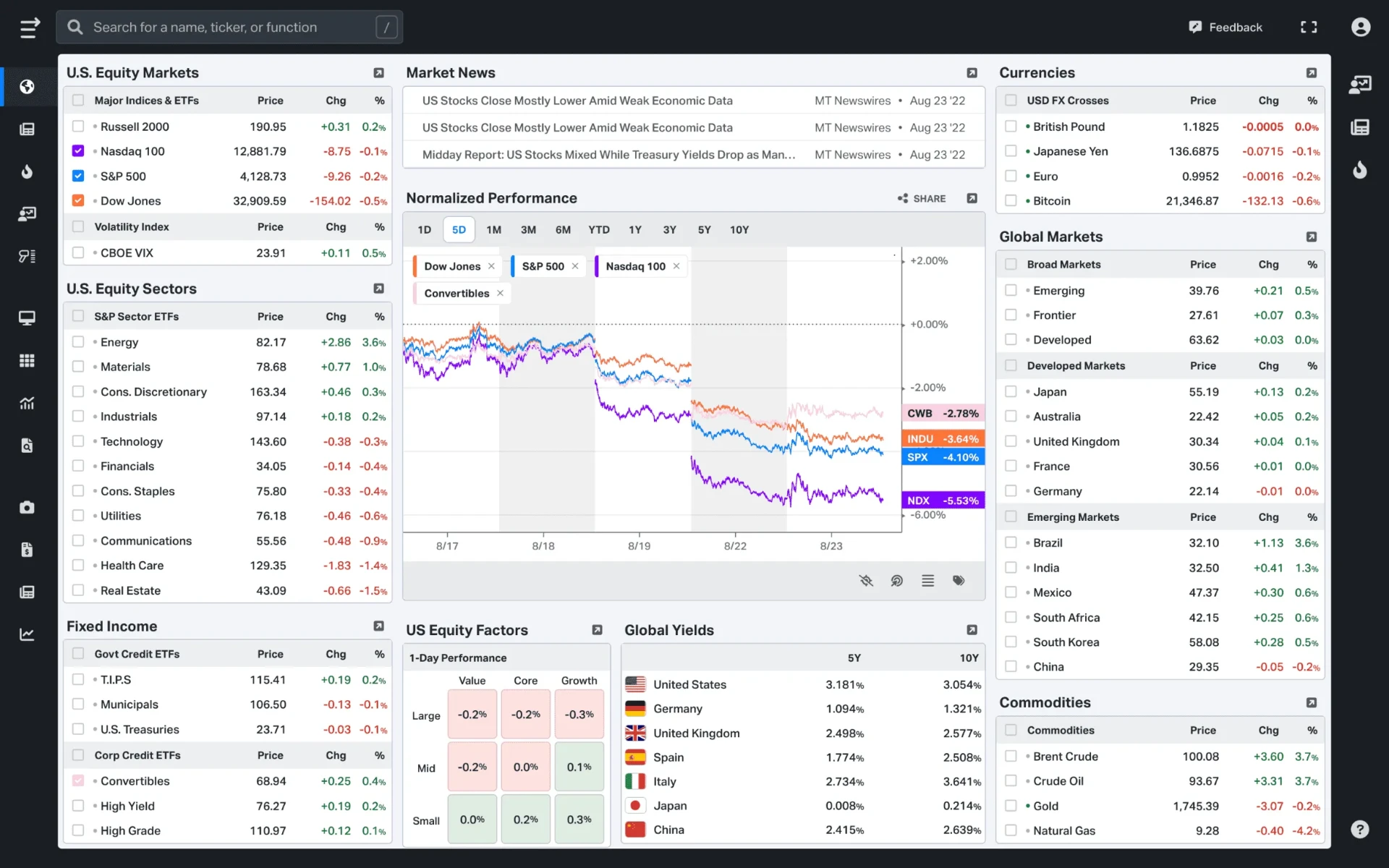
Koyfin puts the institutional research experience into a browser tab. Open it and the first thing you see is a market dashboard you assemble yourself, global indices, commodities, currency rates and bond yields laid out side by side, so the state of the world is one glance rather than five tabs. Click into a single company and the work that used to eat an evening is already drawn: revenue and profit trends across many years, how margins moved, where the valuation sat within its own range. The filing data is charted instead of sitting in a table waiting for you to chart it.
The chain from macro to a single name
The analysis chain is complete, which is rarer than it sounds. At the macro layer you read interest rates and economic indicators to establish the environment you are operating in. At the middle layer you use screening and comparison to narrow a universe down to a handful of candidates worth the time. At the single-name layer you place a company beside its peers using relative valuation, and the comparison charts for revenue growth, margins and valuation multiples generate themselves rather than being assembled by hand.
Watchlists and portfolio tracking keep both the holdings and the candidates on the dashboard, so a move in something you own is noticed the same day rather than at the end of the quarter. The free tier is unusually generous with the core functions, and the paid tier unlocks deeper data and export capability for people who need to take the numbers somewhere else. Upgrading is a decision you make when the work demands it, not a condition of entry.
The interface is modern and smooth in a way that traditional terminals are not, and the learning cost is far lower. This matters more than aesthetics: a tool you can use on the first afternoon gets used, and a tool that requires a training course gets opened once.
The value is not the data itself. It is the way the data is organised into the shape of a judgment: see enough charts and the instinct for trend and for froth is fed by the research rather than by the mood of the day.
How to actually use it
Start by building a home dashboard of your own and fixing three zones on it: macro, watchlist, portfolio. Then scan it once before the market opens, every day, for two weeks. That ritual does more for your reading of a market than any single indicator, because it forces you to notice when something has changed rather than when something has been explained to you.
When comparing peers on valuation, keep the basis consistent. A multiple computed on one definition of earnings set beside a multiple computed on another is not a comparison, it is a coincidence, and it will look convincing enough to act on. The tool will happily draw whatever you ask; the discipline of asking the same question of every company is yours to supply.
One honest limit: the data leans toward overseas markets, and coverage of mainland Chinese listings is thin. For domestic names, cross-check against a local source rather than trusting a single screen. The tool is an eye, and the judgment behind it remains your own work.