
AccuWeather: global forecasts down to the minute, with feels-like readings
Summary
AccuWeather offers precipitation forecasts minute by minute, a feels-like temperature index and air quality tracking, alongside health and lifestyle indices covering allergies and more. A Premium+ subscription extends the forecast range, and both a web version and mobile apps are available.
Recommend- Name
- AccuWeather
- Version
- 21.0.27
- Open source
- Proprietary
- Operating system
- WebiOSAndroid
- Website
- https://www.accuweather.com/
- Updated
- 2026-10-16 22:35
A forecast has long stopped being the sentence rain tomorrow. It has to answer finer questions: when does this rain start and when does it stop, what does the same temperature feel like in sun and in shade, and will air quality get in the way of the plan for today. AccuWeather puts those refined answers into one app and keeps the wording consistent between web and phone.
Shrinking the forecast to a single street
Traditional weather services treat a city as the smallest unit, and a city can span tens of kilometres, enough for the centre and the outskirts to differ noticeably. AccuWeather pushes the resolution further down: the official description says forecasts can be aligned to a specific street address, across two hundred and ten countries and regions. For anyone whose commute crosses a city, the difference is immediate, because what you see before leaving is the weather on your own stretch of road.
What holds that resolution up is a weather data system the company runs itself. On the developer pages it says the platform covers more than 3.5 million locations worldwide, handles tens of billions of interface calls a day, and exposes over 250 weather parameters to explore. The grain of the data sets a ceiling on what any app above it can do; this layer is never shown to ordinary users, yet it decides whether a minute by minute forecast is even possible.
Precipitation, minute by minute
MinuteCast is the most recognisable piece of that system. It gives the type and intensity of precipitation over the next four hours and marks when rain or snow begins and ends. Not rain today, but starting in about forty minutes and lasting around an hour. The company describes it as a precipitation forecast advancing by the minute, pinned to a street address or a GPS coordinate.
The feature answers one very concrete question: should I go out now. Judging after the first drops have landed is usually too late to save the washing or change the route, whereas knowing the start and stop forty minutes ahead leaves room to decide.
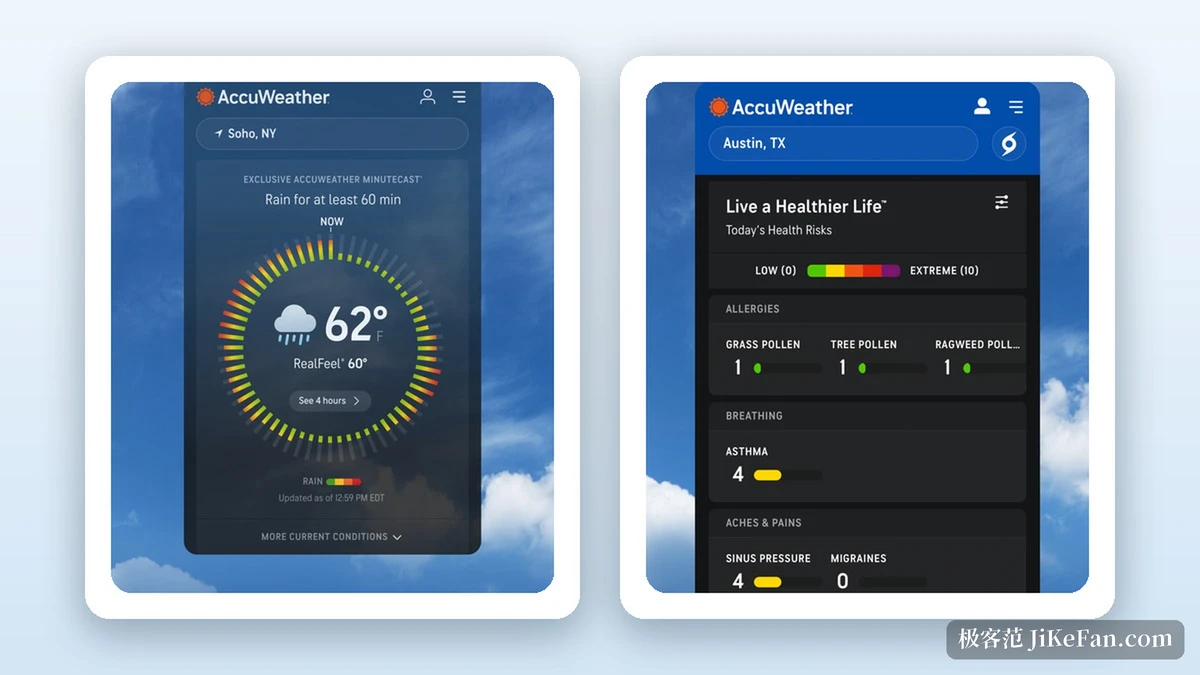
Feels-like temperature, and the difference shade makes
A thermometer reading and a person sensation often disagree. The same number feels different with wind, direct sun or heavy humidity. The RealFeel index exists for that: the company says it combines more than ten factors, among them sun intensity, wind speed, humidity and air density, into a temperature closer to what the body registers. On top of it sits RealFeel Shade, describing the difference in a sheltered spot, summed up officially as the gap between sun and shade.
For anyone planning time outdoors, those two figures are more useful than the raw temperature. On a summer afternoon, thirty degrees on the gauge and thirty eight as felt call for quite different effort and quite different amounts of water.
Hourly charts and air quality
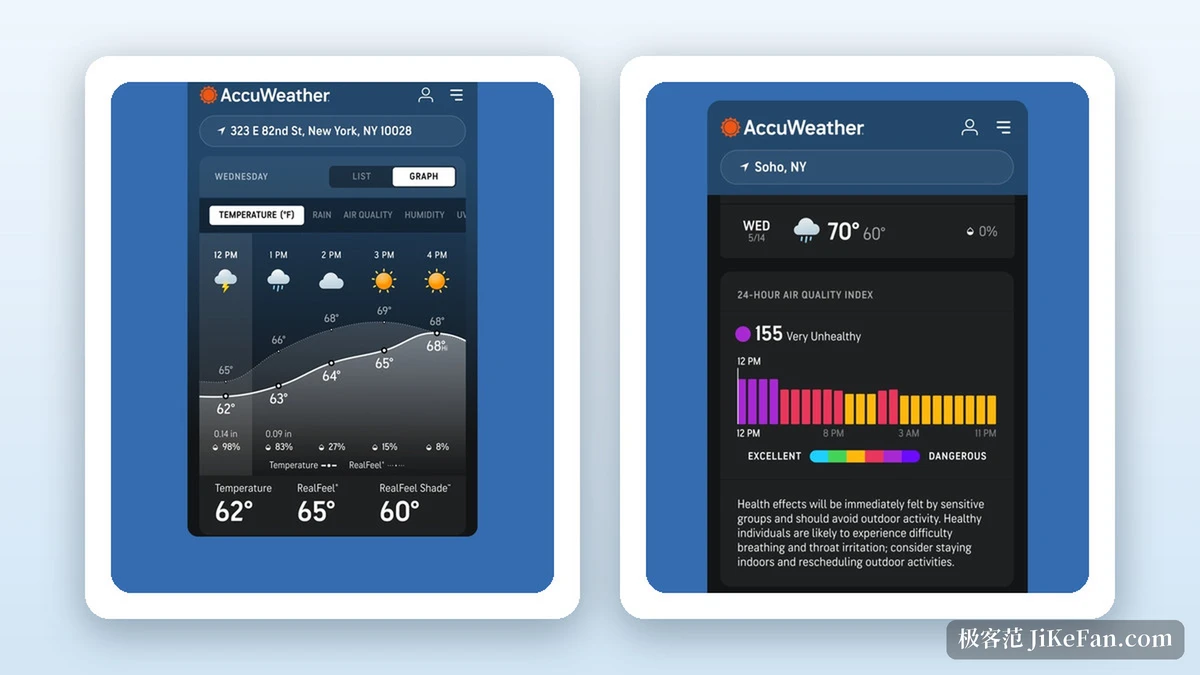
How a forecast is presented is part of the product too. The official hourly chart lays temperature, precipitation, air quality and humidity out as several curves at once, so a trend can be read in one screen instead of switching between them. Air quality is given as an index with a map view for seeing how far an episode reaches.
The air quality index is framed officially as a tool for planning outdoor activity and how long to stay out. Sensitive groups need more than the figure for today, they need the next few hours, and the chart takes that on.
Live layers such as radar and lightning sit inside the app as well. There is a lightning locator for tracking strikes as they happen, used together with the radar layer.
Lifestyle indices and health prompts
Translating weather data into everyday decisions is the other direction these apps take. The official list of lifestyle indices runs past fifty, covering allergens, skin care and ultraviolet levels; inside the app the health and activity views can be arranged to taste, with allergies, asthma and migraine each viewable on their own. For time outdoors there are also risk notices for insects and pollen.
The arithmetic behind those indices still takes weather data as input and returns a graded warning. For someone with allergies, pollen concentration read together with wind strength and direction says more than the weather alone.
Alerts, and what the subscription adds
Severe weather notices come from official channels. On the developer pages AccuWeather says its alert data is drawn from national meteorological agencies and global alert providers, covering many countries; in the app those notices reach the device as notifications.
The base version is free to use and supported by advertising. With Premium+ the ads go away, the forecast range extends, and finer personalisation opens up. A family plan lets you create up to six separate profiles for household members, each receiving notices for its own location. On range, Premium+ offers a ninety day daily forecast and a ten day hourly forecast, and works on watches, tablets and televisions.
Data interfaces for developers
Ordinary users see an app; business customers meet interfaces. The developer platform splits weather capability into modules covering minute by minute precipitation, forecasts, current and historical observations, location lookup, alerts, lifestyle indices and tropical cyclone information, with location search by keyword or by latitude and longitude. A trial entry point is provided for evaluation.
Item | Official information |
|---|---|
Form | A web service and mobile apps |
Core functions | Minute precipitation, feels-like index, air quality tracking |
Lifestyle indices | Over fifty, covering allergies, asthma, migraine, skin care |
Alert sources | National weather agencies and global alert providers |
Data coverage | More than 3.5 million locations worldwide |
Subscription | Base free with ads, Premium+ removes them and extends range |
Cutting a forecast to the minute, converting temperature into a felt value, translating weather data into everyday advice: the worth of AccuWeather rests on how well those three are done, not on how much a forecast page displays.
A sensible order: pin your usual places first and let minute precipitation and the feels-like index become the default check before going out. Then arrange the lifestyle views around what you care about, putting allergies or ultraviolet where your hand falls. And when you need the same data across devices, weigh what a subscription adds in range and personalisation.