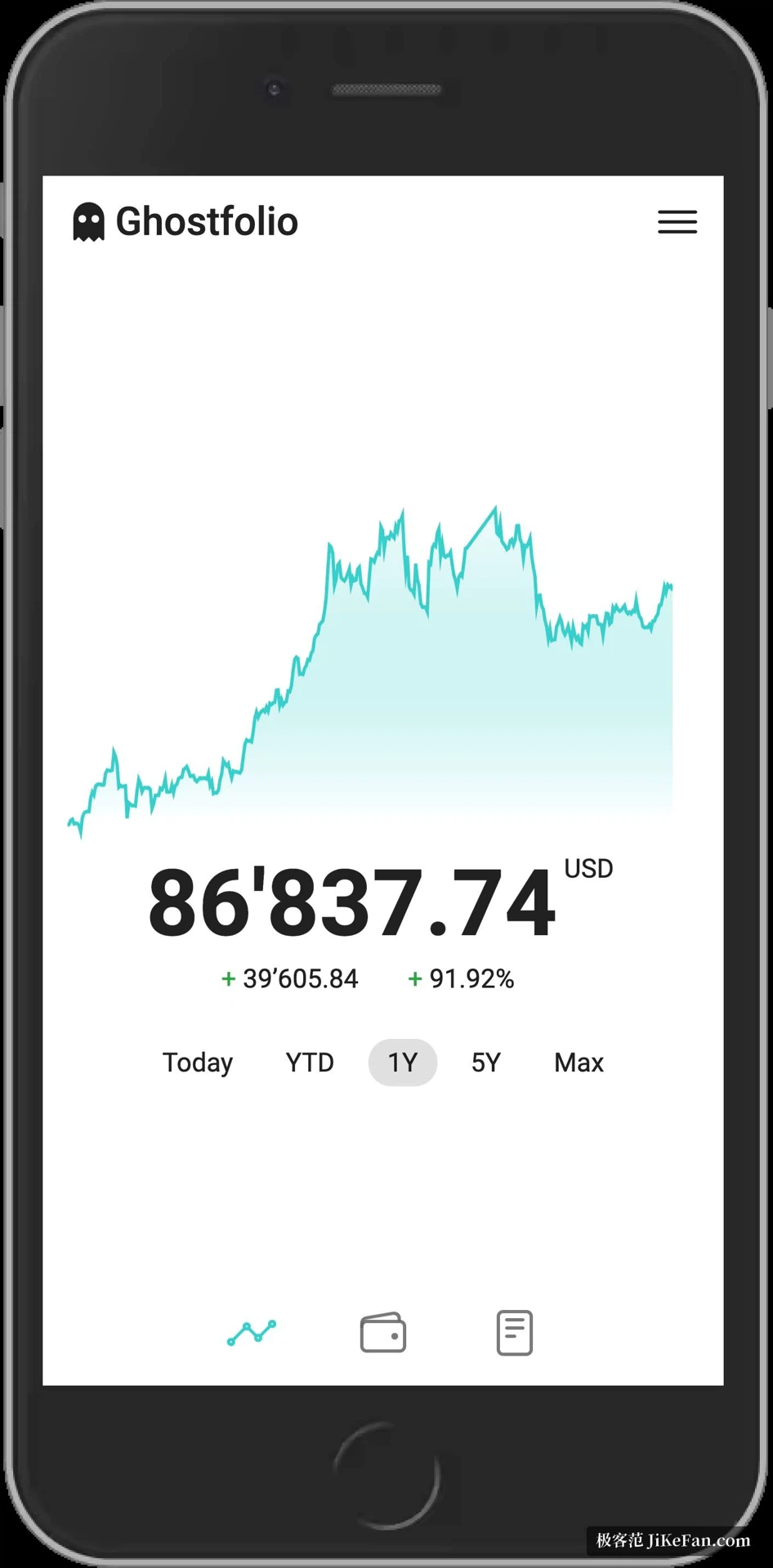
Ghostfolio pulls every brokerage, wallet and bank balance onto one dashboard you host yourself
Summary
A privacy first dashboard that folds stocks, ETFs, crypto and cash into a single net worth curve, with allocation, performance and benchmark views, spreadsheet import and a self-hosted option. Current release 3.71.
Recommend- Name
- Ghostfolio
- Version
- 3.71
- Open source
- Open source
- Operating system
- WindowsmacOSLinux
- Website
- https://ghostfol.io/
- Updated
- 2026-10-06 14:33
One board for money that lives in four different places
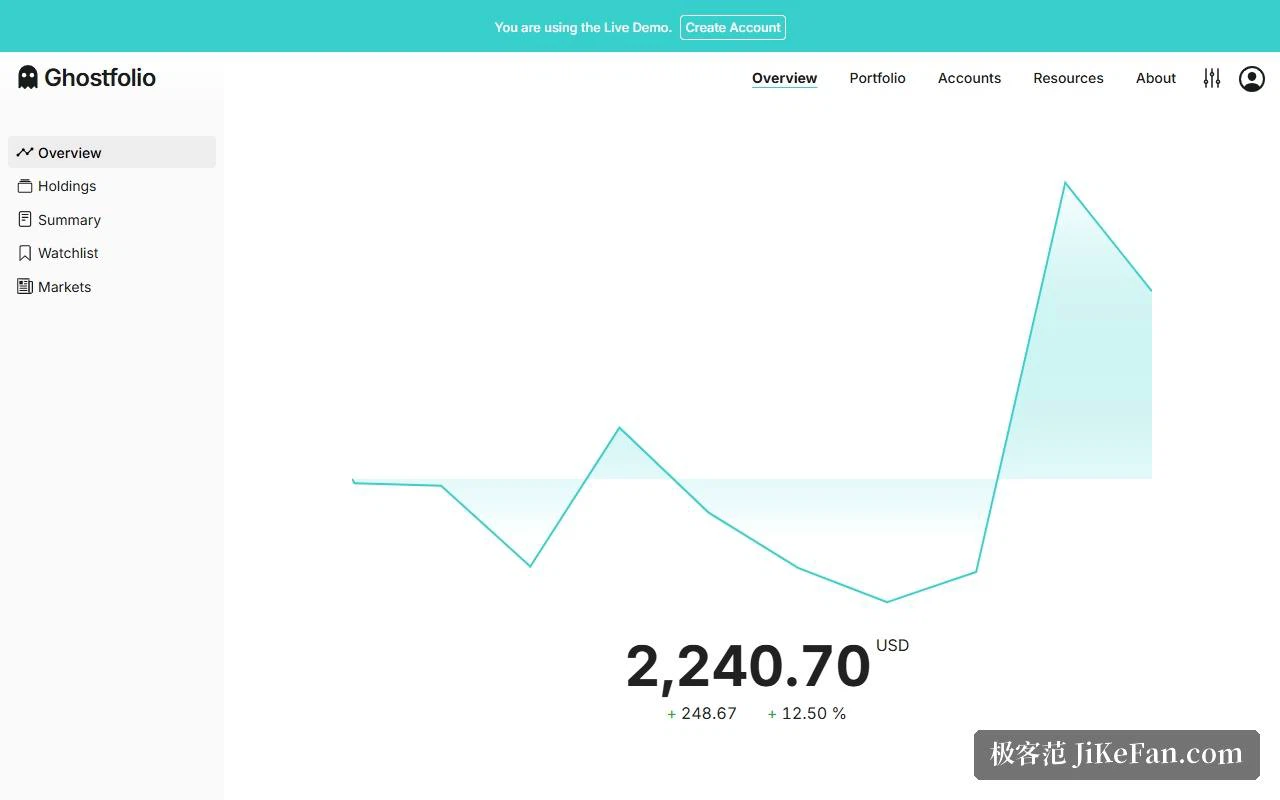
Most people end up with assets spread across a brokerage, a couple of bank accounts and at least one crypto exchange. Seeing the whole picture then means maintaining a spreadsheet by hand: export the positions, type the prices in, and rewrite the formulas whenever a broker changes its export format. Ghostfolio takes the other route and offers a single entry point, where the accounts and the historical transactions are recorded once and then converted at current quotes. From those records it draws a net worth curve and reports allocation, holdings and return. Accounts stay separate per platform, cash sits apart from positions, several currencies can coexist, and the overview folds them into one base currency for the headline number. Stocks, ETFs, crypto and plain cash all count as asset types; buys, sells, dividends and fees each get their own ledger entry, and the reports are built from those activities rather than from balances typed in by hand. The net worth chart switches between day, month, year and all-time ranges, and every move is shown both as an amount and as a percentage. A public demo account already carries brokerage and exchange data, so the look of the thing can be judged before any real records are moved across.
Analysis: allocation, performance and a benchmark
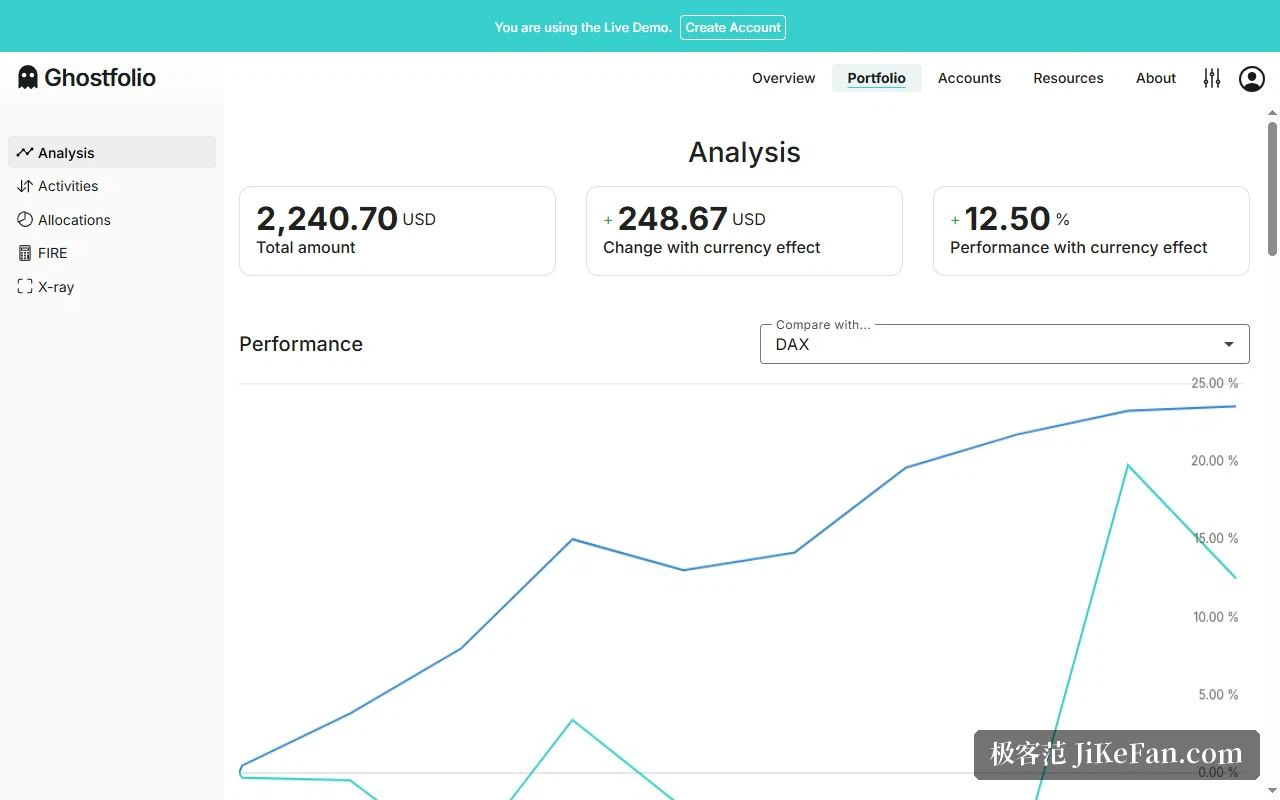
The analysis pages are where the tool earns its keep. Allocation is split by asset class, region, sector and currency, which makes an accidental concentration visible before it turns into a problem: a portfolio that feels diversified can turn out to be three technology names plus a broad fund tracking the same index. The performance section lists the return earned over the period separately from the effect of exchange rates, so a good year in a foreign currency is not mistaken for good stock picking. The net worth curve can be laid over a chosen market index on the same chart, which answers a question a homemade spreadsheet rarely answers well: did the portfolio beat the index, or did the index simply have a good year? Holdings, activities, a watchlist and market data each have a page of their own. In daily use the overview is enough, since one glance tells whether anything needs attention. A sidebar entry opens an X-ray view that pulls the portfolio apart along further dimensions, and the activity page lists every transaction in reverse chronological order, which is what makes reconciliation possible when a balance refuses to match the broker statement. Both the time range and the benchmark can be chosen, and the charts recompute as soon as either changes.
Accounts and records: the data stays in your hands
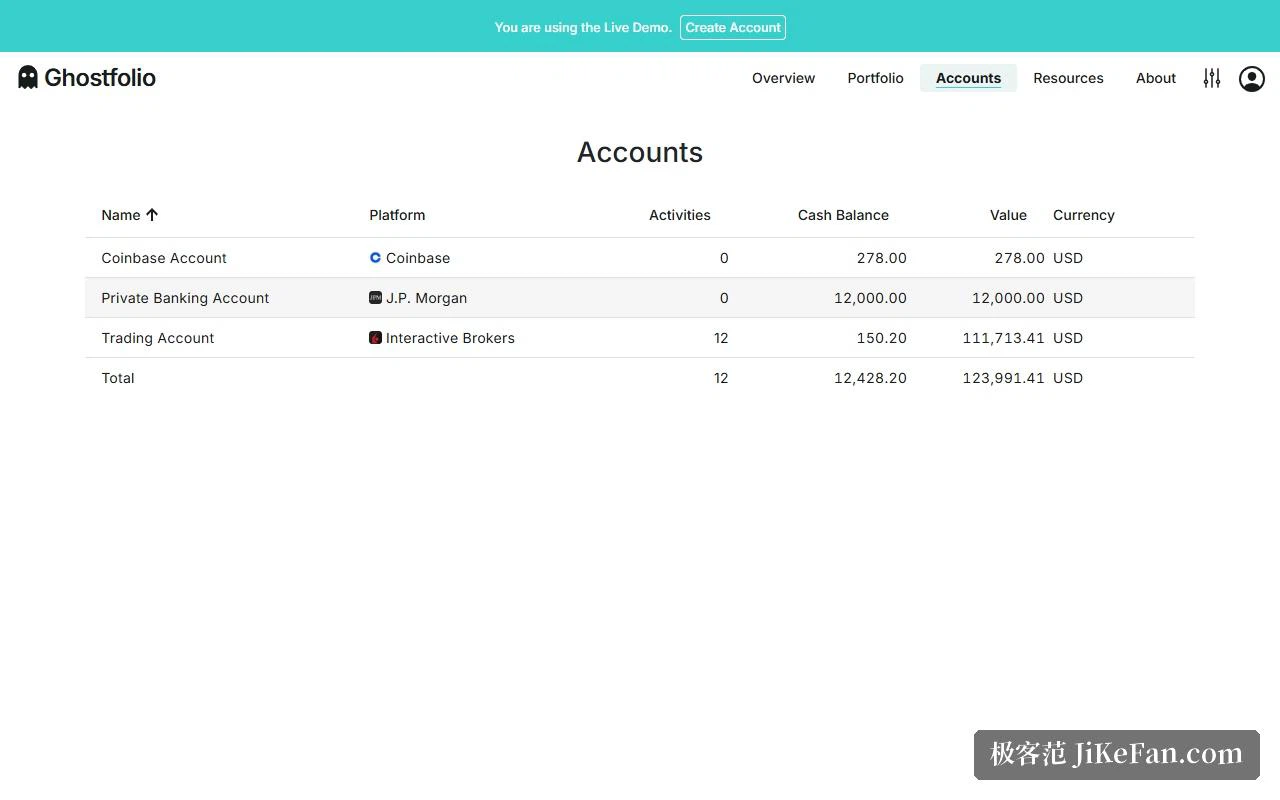
The accounts page lists each platform as a row with its name, the number of activities, the cash balance and the market value, then totals them. Older history can either be typed in or imported from a spreadsheet, which matters when years of trades have to arrive in one go instead of being reconstructed by hand. The open source edition can be self-hosted, so the records sit on a machine the owner controls; the hosted service also does without an email address and without a card at sign-up, so the account never has to be tied to a real identity. Every account carries its own currency and note, so statistics do not blend a euro account into a dollar one. All data can be exported in full, which removes the lock-in that comes with a single provider, and migration or backup stays a routine chore. The code is published under the AGPL. The project has collected close to ten thousand repository stars and more than three million container pulls, and the interface is translated into a range of languages including Simplified Chinese.
How to run it, and who it suits
Official container images are provided, so the whole stack can sit on a home server or a NAS, and there is a hosted tier for anyone who would rather not run the operations: the first keeps the data local, the second is a subscription and works out of the box. The documentation covers several deployment shapes, from a single container on one machine through a reverse proxy in front of it to a cloud instance, and the community has written walkthroughs aimed at home NAS boxes. The current release is 3.71 and moves with the repository; the 3.0 line landed in 2026-04. After more than three years of iteration it is among the more actively updated tools in the self-hosted category. It suits long-term investors who hold accounts at several platforms, want to stop maintaining their own spreadsheet and care where the data lives. Anyone who only glances at a few stock quotes now and then is better served by the broker's own app: a board like this only starts to pay off once assets are scattered across enough platforms that no single statement shows the whole picture, so a single-account user has no reason to rush.