
Fastmail: paying for a mailbox without ads, with domains and aliases as the main act
Summary
Fastmail charges its users instead of showing ads or scanning mail, and earns its keep with custom domains, one alias per site, and open protocols.
Recommend- Name
- Fastmail
- Version
- 2026
- Pricing
- Paid
- Open source
- Proprietary
- Operating system
- WindowsmacOSLinux
- Website
- https://www.fastmail.com/
- Updated
- 2026-10-06 16:32
A mailbox that does not pay for itself with advertising
Fastmail is a paid mail service run by a team in Australia, and the business model can be stated in one line: it charges the people who use it, so the interface carries no advertising and no mail is scanned in order to target anything. Measured against a free mailbox that has to be financed somehow, the selling points gather around stability, a serious attitude to privacy and openness to the protocols mail has always run on.
The framing matters more than it sounds. A free mailbox is not really free; it is paid for with attention, with data, or with limits that only appear later. A paid mailbox moves that cost onto a line of a bill, which is either the whole point or a reason to close the page. There is not much middle ground, so the honest question is whether the paid side delivers enough to justify the line.
Your own domain, and an alias for every site
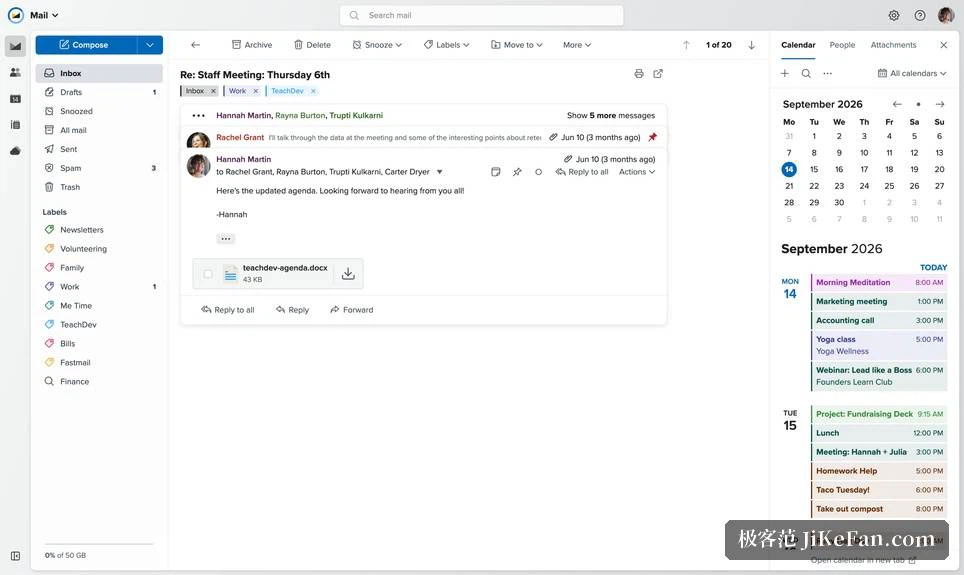
Custom domains are where the service is most complete. A domain bought elsewhere can be connected, separate addresses can be handed to family members or to people on a team, several identities can live inside one account, and when a message is written the signature and the reply address can be chosen for that message alone. For anyone who has run a household or a small group on a single shared address, this is the part that changes the daily experience rather than the specification sheet.
Aliases work along a different axis. A separate address can be generated for each site that asks for one, and when junk inevitably starts arriving at one of them, that alias is switched off and the main mailbox is untouched. Nothing has to be migrated, no contact list has to be told about a new address, and the decision costs a second instead of an afternoon.
Calendar and contacts in the same place
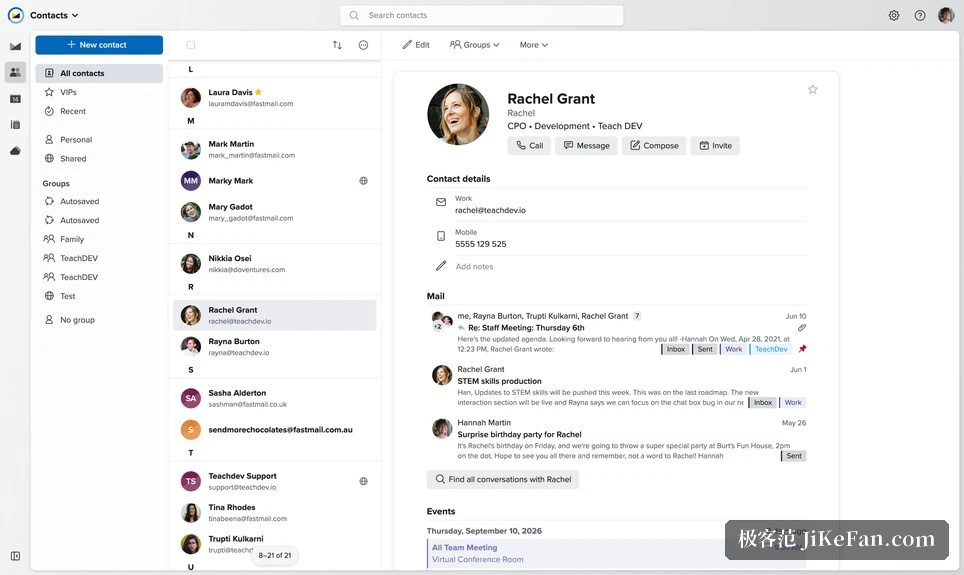
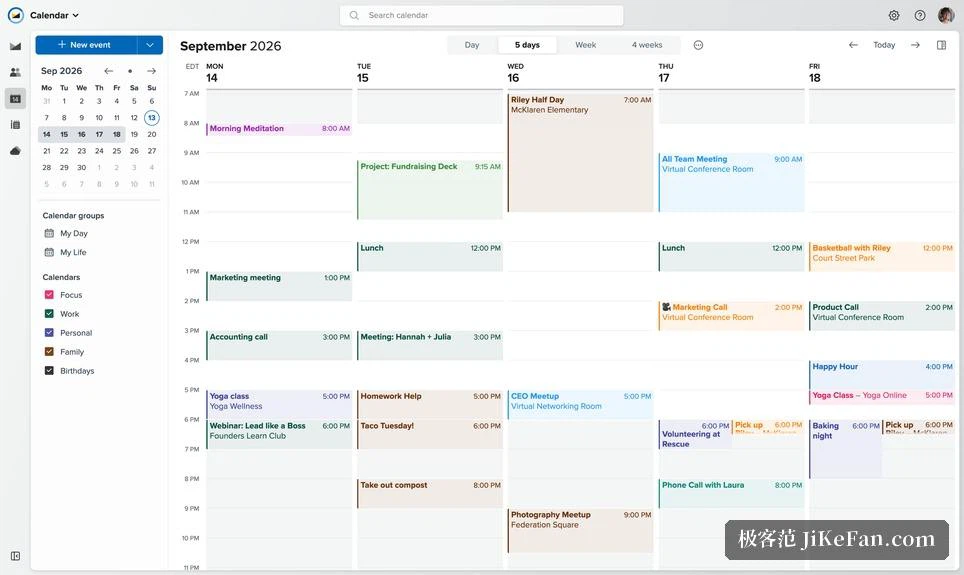
Mail is not the only thing in the account. A calendar and contacts are built in, available both on the web and in the mobile client, and several calendars can be managed inside one interface. For a personal account that is convenient; for a small group it removes a category of tool that would otherwise have to be bought separately and kept in step with everything else.
On protocols the service is deliberately friendly to other software. IMAP, POP, CalDAV and CardDAV are all supported, and the project also publishes a sync protocol of its own for clients that want to speak it, so a third-party desktop client or the mail application already sitting on a phone can be configured instead of being pushed towards a single official app. That freedom is the real difference between renting an address and owning the way you read it.
What it costs, and who it is not for
There is no permanent free tier. A trial period comes first, an annual subscription follows, and capacity is divided by plan: the personal and the family plans differ in storage and in how many aliases they allow, while business plans with administration and audit sit above them. Anyone looking for a free mailbox will find the positioning simply wrong; anyone who cares about privacy and control and is willing to pay for it will find this one of the steadier choices in that direction.
For someone who treats mail as long-term infrastructure and will not accept advertising in exchange for it, the reasoning here is clear: pay, and get a quiet interface together with open protocols, while a custom domain and aliases put the receiving side back under control. The price of that is the absence of a free tier, so the trial period is worth using to configure the domain and the clients before deciding.