
Jami: Peer-to-Peer Encrypted Messaging Without an Account
Summary
Jami is an open source, decentralised messenger: no account to create, no central server in the path, and messages plus voice and video calls travel device to device. Free on every major platform, it hands control of a conversation back to the two people having it.
Recommend- Name
- Jami
- Version
- 20260922
- Pricing
- Free
- Open source
- Open source
- Operating system
- WindowsmacOSLinuxAndroidiOS
- Website
- https://jami.net/
- Updated
- 2026-10-06 22:56
Another Shape for a Messenger
Almost every messenger you have installed begins from the same assumption. You hand over a phone number or an email address, the service creates an account for you, and from that moment the conversation lives somewhere you do not control: on servers belonging to whoever runs the service, under terms that can be rewritten whenever the operator decides to rewrite them. Nothing about that arrangement is hidden, yet most of us accept it, because for a long time there was no real alternative that behaved like an ordinary chat client. Jami is an attempt to build that alternative. It starts from decentralisation instead of treating it as a feature to be added later.
After installation Jami asks for no registration at all. The application generates a unique identity on the device itself, and that identity is what other people use to reach you. Adding a correspondent as a contact is the whole of the setup, and the conversation can begin. There is no central server in the path, which has consequences worth spelling out. Nobody can unilaterally switch your communication off, because there is no switch to flip in a room you are not allowed to enter. Nobody sits in the middle holding a copy of what was said, because there is no middle to sit in. The record of a conversation belongs to the devices that took part in it, rather than to a company that has to be trusted to look after it.
The project is not a recent experiment. It sits under the GNU umbrella, it is genuine free software, its source code is open to inspection, and a community has maintained it for years. Inside the narrow field of decentralised communication it counts as one of the veterans. That history matters when the thing you are installing is supposed to hold your conversations for the long run.
Peer to Peer, and Still Usable
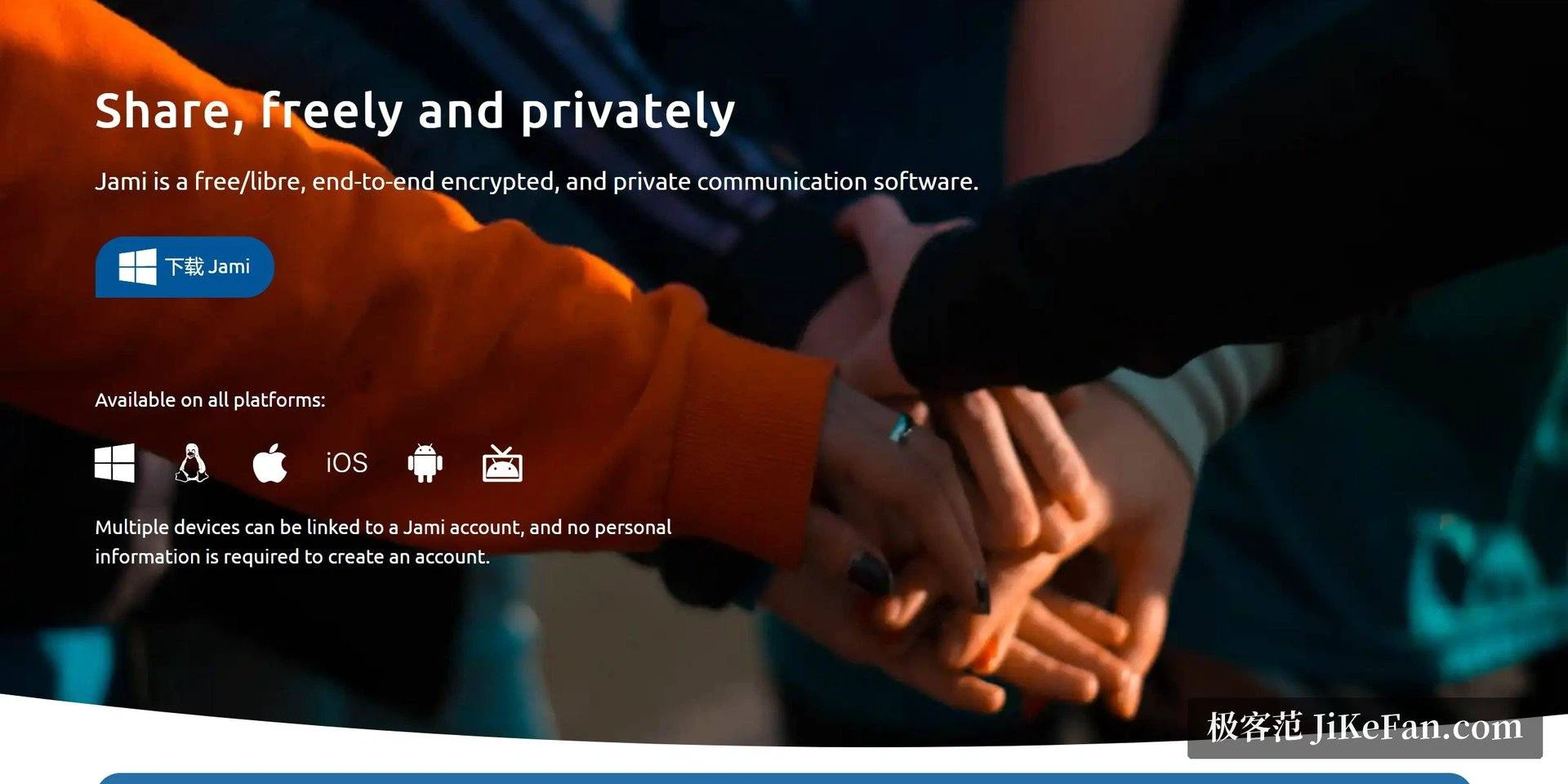
Decentralisation has a reputation for costing features, and here it does not. Text messages, voice calls, video conferences and file transfer are all present, and the traffic travels from device to device with everything on that path encrypted end to end, so the route itself never exposes the content. Platform coverage is equally complete: the three main desktop systems, Android and iOS all have clients, and several devices can sign in to the same identity at once, so a conversation started at a desk can be picked up again from a phone.
There is a wider point buried in that design. With an account based service the identity belongs to the platform: it exists because a row exists in a database, and it stops existing the moment that row is deleted. With Jami the identity is generated locally and kept on the device, so it does not depend on anyone remaining willing to host it. The trade is symmetrical. You gain independence from an operator, and you also take on the responsibility that the operator used to carry. That is the honest way to describe decentralisation: not as magic that removes every obstacle, but as a shift in who holds the keys and who answers when something goes wrong.
Jami proves one thing: communication itself does not have to depend on any platform. The device is the identity, the connection is the session, and the initiative of a conversation goes back to the two people who are actually having it.
The positioning deserves to be stated plainly as well. Under a peer to peer architecture both sides need to be reachable on their own networks, and in strictly isolated network environments connectivity is less immediate than what a centralised service provides. Contact discovery and the group experience also lean towards the geeky end of the spectrum rather than the polished consumer end. Those are real trade-offs, not footnotes to be skipped.
If what you care about is data autonomy and open transparency, and you are willing to accept a small learning curve in exchange for that control, Jami belongs in the category of tools worth keeping installed on a device permanently: completely free, covered on every major platform, and ready whenever you need it.
Worth noting as well is what the absence of the middle changes in daily use. There is no dashboard somewhere counting your conversations, no retention policy deciding how long a message survives, and no third party to be subpoenaed for a log. What was said stays between the machines that said it, which is either reassuring or inconvenient depending on what you expect from a messenger, but it is at least a position you can reason about rather than a clause you have to trust.