
Zulip: team chat that keeps the thread of a conversation
Summary
Chat organised the way mail is organised: every message belongs to a channel and a topic, so hundreds of messages stay readable, replies can arrive days later, and self hosting is free.
Recommend- Name
- Zulip
- Version
- 12.3
- Pricing
- Free
- Open source
- Open source
- Operating system
- WindowsmacOSLinuxWebAndroidiOS
- Website
- https://zulip.com/
- Updated
- 2026-10-08 21:24
The flood, and a structural answer to it
Team chat has one chronic problem: the timeline. Something decided in the morning meeting is buried under reaction images by the afternoon, and a colleague three time zones away signs in to four hundred unread messages with no way to tell which of them matter. Reading everything costs an hour; reading nothing costs a decision. Most tools answer with better search, which helps only if you already know what you are looking for.
Zulip answers with structure instead. Every message belongs to a channel and, inside it, to a topic. A request gets a topic, a defect gets a topic, a release gets a topic. A topic can sit quietly for three days and still be exactly where it was, with the conversation around it intact. Somebody who missed the live discussion reads the topic and catches up, because the discussion has a shape rather than a timestamp.
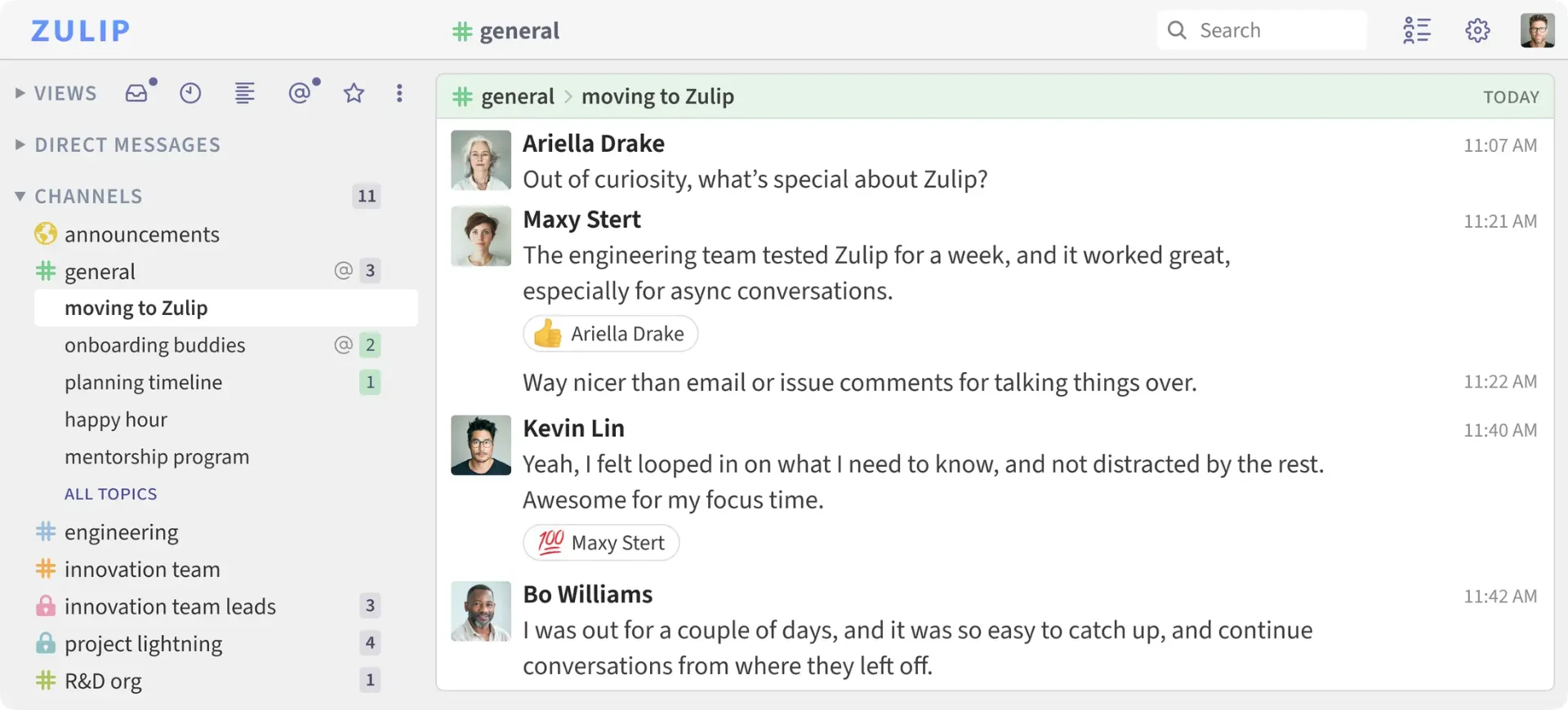
The most thorough open source option in this category
The self hosted edition is free and runs the same feature set as the hosted service, which is a stronger promise than it sounds. Data, backups, retention and access all stay under the control of the organisation running it. Teams that do not want to operate anything can use the hosted version, which starts free for small groups and prices upward from there.
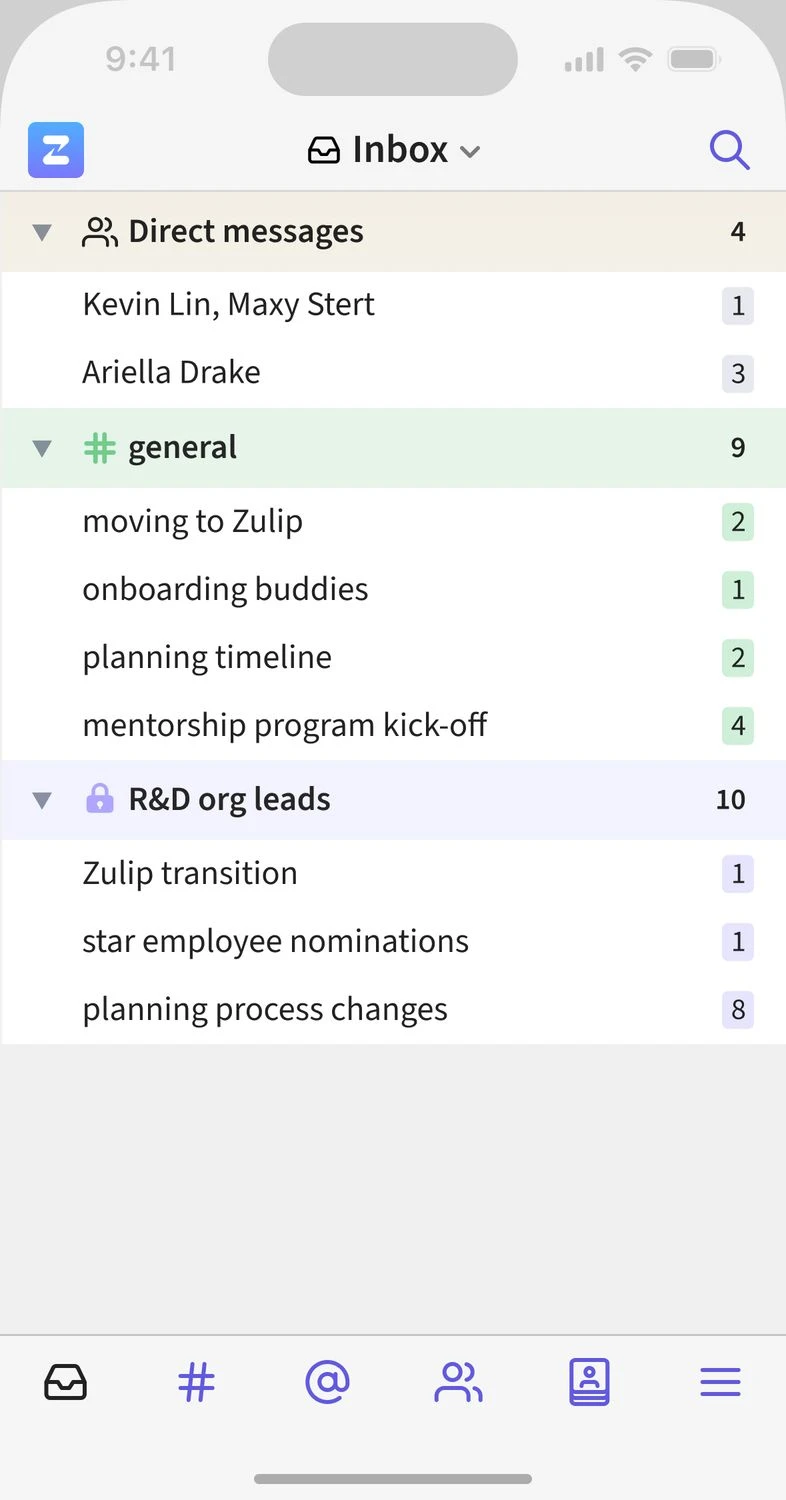
Clients cover desktop, web, Android and iOS, and the mobile experience is not an afterthought: reading by topic on a phone is one of the few ways to keep up with a busy project while away from a desk. Bots and integrations bring continuous integration results, issue tracker changes and monitoring alerts into the matching topic, so an alert lands next to the discussion that caused it rather than in a general channel nobody reads.
Proof by adoption
The strongest evidence is who uses it. A number of large open source projects run their official communication on Zulip, and those communities are the hardest possible audience: contributors spread across every time zone, working asynchronously, with a written record that has to remain searchable years later. Getting that audience to stay is not a marketing achievement.
Recent versions have added summaries generated from long topics, which addresses the one remaining weakness of the model: a topic with two hundred messages is well organised but still long. A digest that says what was decided, what is still open and who owns each item turns a well structured archive into something a returning reader can use in a minute.
The insight is sharp: the problem with team communication was never that messages arrived too slowly, it was that context did not survive. Give chat the lineage of mail, and asynchronous work starts to function.
Habits that make the structure work
Name topics as a single sentence that states the subject, because a topic called question is a topic nobody can find. Close important discussions inside the topic with a short summary of the decision, so the record is searchable later. And before choosing self hosting, count the operational cost honestly: a chat server needs updates, backups and somebody on call, and a small team may prefer to spend that effort elsewhere.
Tools of this kind succeed or fail on conventions rather than features. Zulip supplies a structure strong enough to make good conventions obvious, which is most of the battle.
One more convention is worth adopting early: treat a topic as a place where a decision is written down, not only discussed. A topic that ends with a paragraph stating what was agreed becomes a record, and a team that can answer why questions from last quarter saves itself a great deal of repeated argument.