
Bluecoins Review: A Ledger That Stays in Your Own Pocket
Summary
No account, no cloud, no subscription: records stay on the phone with an encrypted export as the backup. Multiple accounts, transfers, subcategories and cash flow reports make the depth worth the setup.
Recommend- Name
- Bluecoins
- Version
- 20260923
- Pricing
- Paid
- Open source
- Proprietary
- Operating system
- AndroidiOS
- Website
- https://www.bluecoinsapp.com/
- Updated
- 2026-10-08 12:15
Whose business is your spending history
A record of what you bought, when and where is one of the more revealing documents a person generates. It shows where you live, what you worry about, which pharmacy you visit and which habits you have not managed to break. Handing that to a service is a choice, and it is a legitimate one, but it should be a choice rather than a default nobody examined. Bluecoins takes the other position: records are stored on the device, no account is required, the cloud is not involved, and the backup is an encrypted export you keep yourself.
What makes that position workable is that the effort saved on synchronisation has been spent on the ledger instead. Multiple accounts for cash, current account, credit card and savings, with transfers that move money between them in one operation and adjust both sides. Subcategories deep enough that food can be split into groceries, delivery and restaurants. Notes and photographs attached to individual entries. The bookkeeping is granular enough to answer a question months later instead of merely totalling a month.
Reports that say something
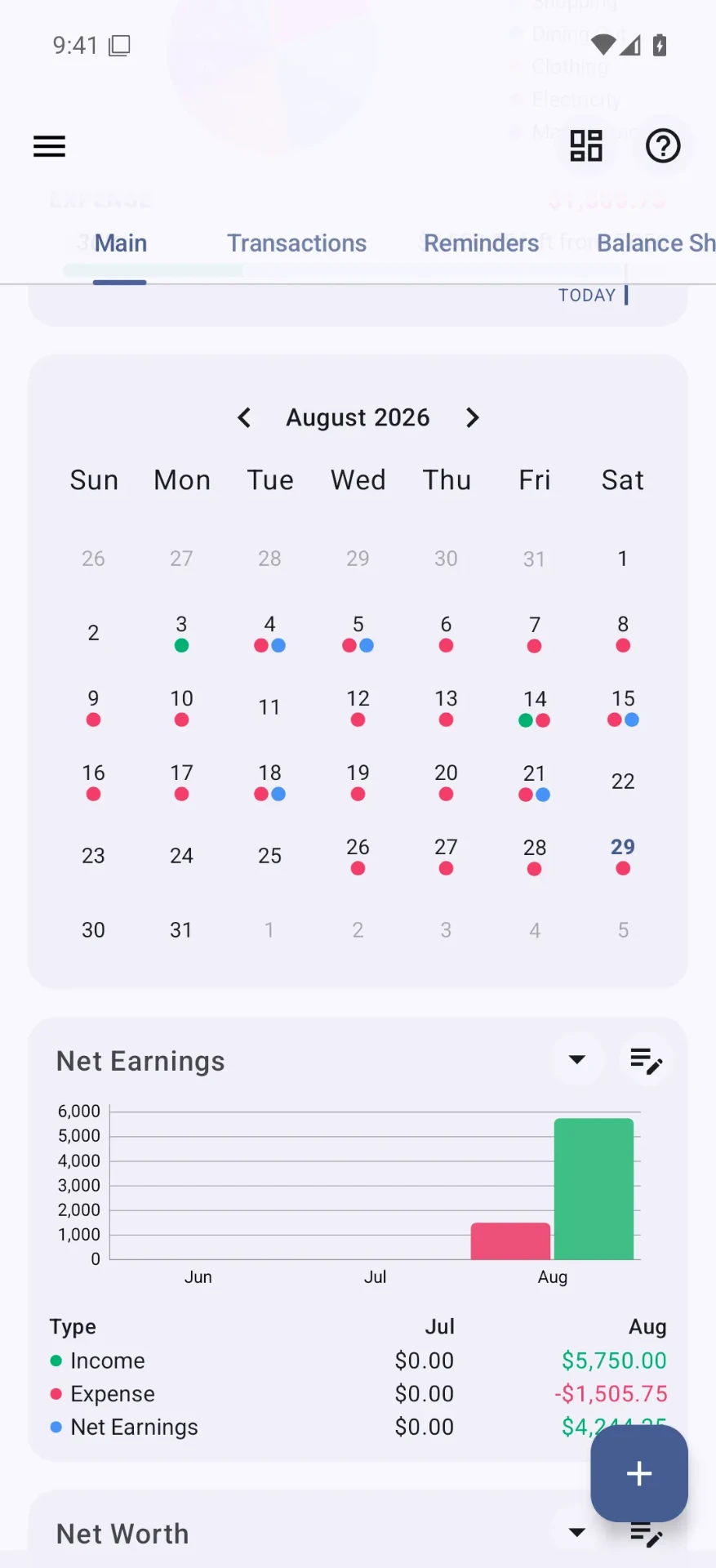
Recording is the easy half. Understanding is where most tools become decorative. The reports here are solid: trend lines that show the direction of income and spending over months, a cash flow view that lays out where money arrived and where it left, and budgets drawn as a line per category that lights up before the limit rather than after it. Category breakdowns make the shape of a household visible, which is often the first time anyone notices that the small frequent purchases are larger than the big occasional ones.
Then there is the commercial model, which is increasingly rare: one purchase, no subscription, no feature locked behind a monthly fee, and the app works offline because it has nothing to talk to. For a tool that holds years of personal records, the absence of an ongoing relationship with a vendor is not merely cheap, it is reassuring.
What it demonstrates is that the core value of a tracking tool is not a decorative interface but keeping your data firmly in your hands while explaining clearly where each amount went.
Set it up once, properly
Spend ten minutes on the structure before entering a single transaction. Decide how many accounts you actually need, then build subcategories that match your own habits rather than a generic taxonomy; a category you invented is a category you will use. Turn on the passcode and decide where the encrypted export will live, because a backup file sitting in the same place as the phone is not a backup.
Then fix a weekly review, ten minutes, looking at the trend line rather than the rows. Two questions are enough: which category moved, and did the movement surprise you. Adjust one budget line at a time. Monthly exports, kept in a folder you actually open, protect against the one scenario that would otherwise be catastrophic, which is the phone being lost with the only copy of five years of records.
The trade offs you accept
No synchronisation means a second device does not see the same book, so a shared household needs one person to be the recorder, or a discipline about exporting and merging. No bank connection means every transaction is typed, which is the price of the privacy and, for many people, the reason the habit sticks: entering a purchase makes it memorable in a way an automatic import never does.
And there is no web interface, so the phone is the tool. If the analysis you want involves a spreadsheet, the export exists, but the workflow is not built around it. These are real limits, and they are the correct limits for the design. A person who wants automatic aggregation across a household should choose a different tool; a person who wants an honest private record of their own money is exactly the intended user.