
One sentence, a 3D world you can walk through and edit object by object
Summary
The 3D team at Tencent Hunyuan published WorldClaw: an open ended description goes in, and a large 3D world comes out, walkable and editable piece by piece. The paper is out, the code is not.
Recommend- Name
- WorldClaw
- Version
- 20260807
- Pricing
- Free
- Open source
- Proprietary
- Operating system
- WindowsmacOSLinuxWeb
- Updated
- 2026-10-10 10:26
The 3D team at Tencent Hunyuan published WorldClaw: an open ended description goes in, and a 3D world comes out that you can walk into and change object by object.
Getting a model to paint mountains from a sentence has stopped being novel over the past two years. The hard part is different: the picture looks like a world, and it is not one. You cannot walk in, and you cannot change it. Trees and houses are fused into one image, and moving a single tree often means regenerating the whole frame.
WorldClaw goes after that gap. It splits building a world into a coarse to fine multi agent pipeline: raise the skeleton, then fill in detail, and finally deliver a set of textured 3D meshes that are independent of each other. The paper went up on arXiv in August 2026, the project page appeared at the same time, and eleven generated worlds were published as examples.
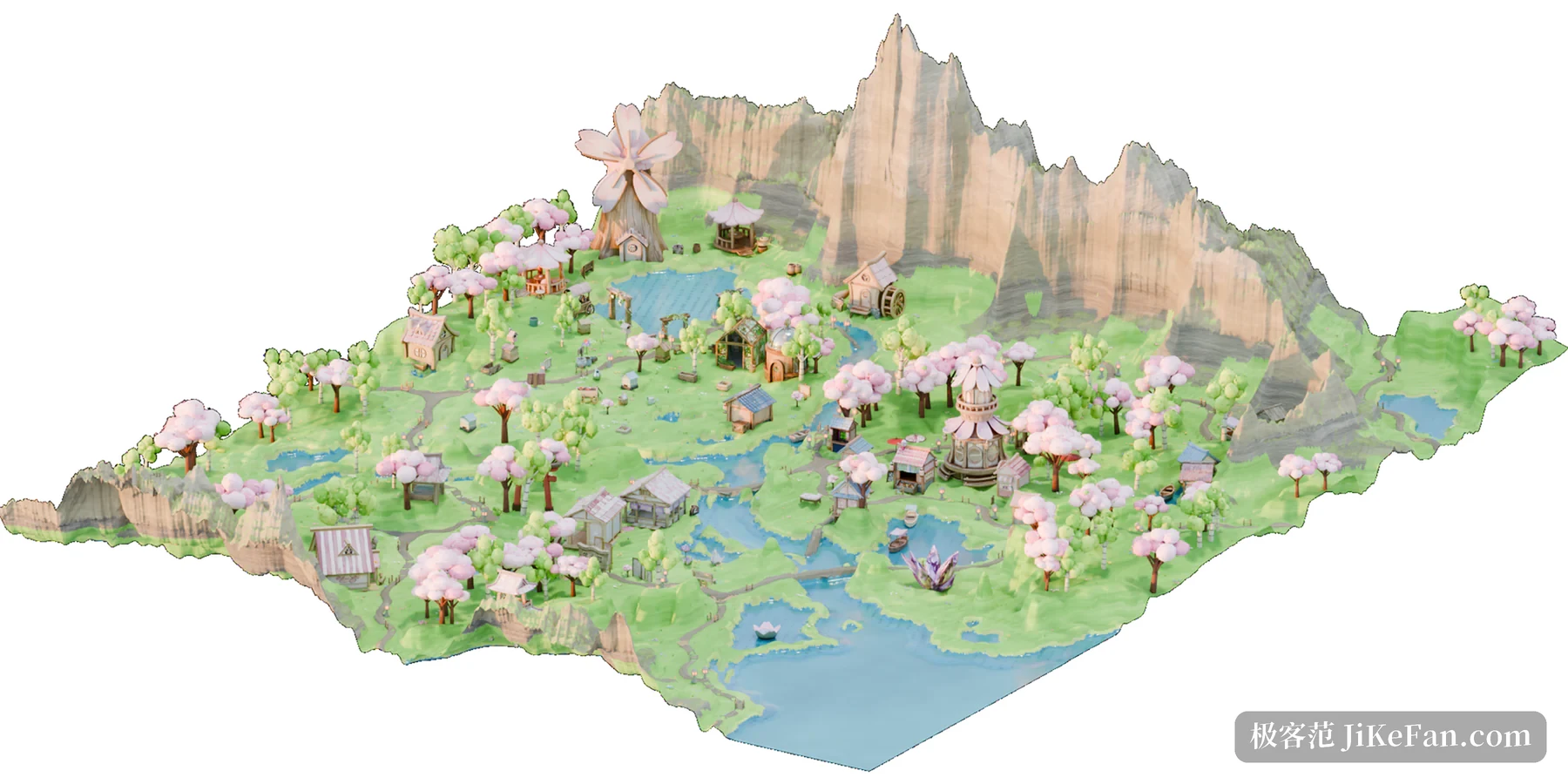
Skeleton first, detail after
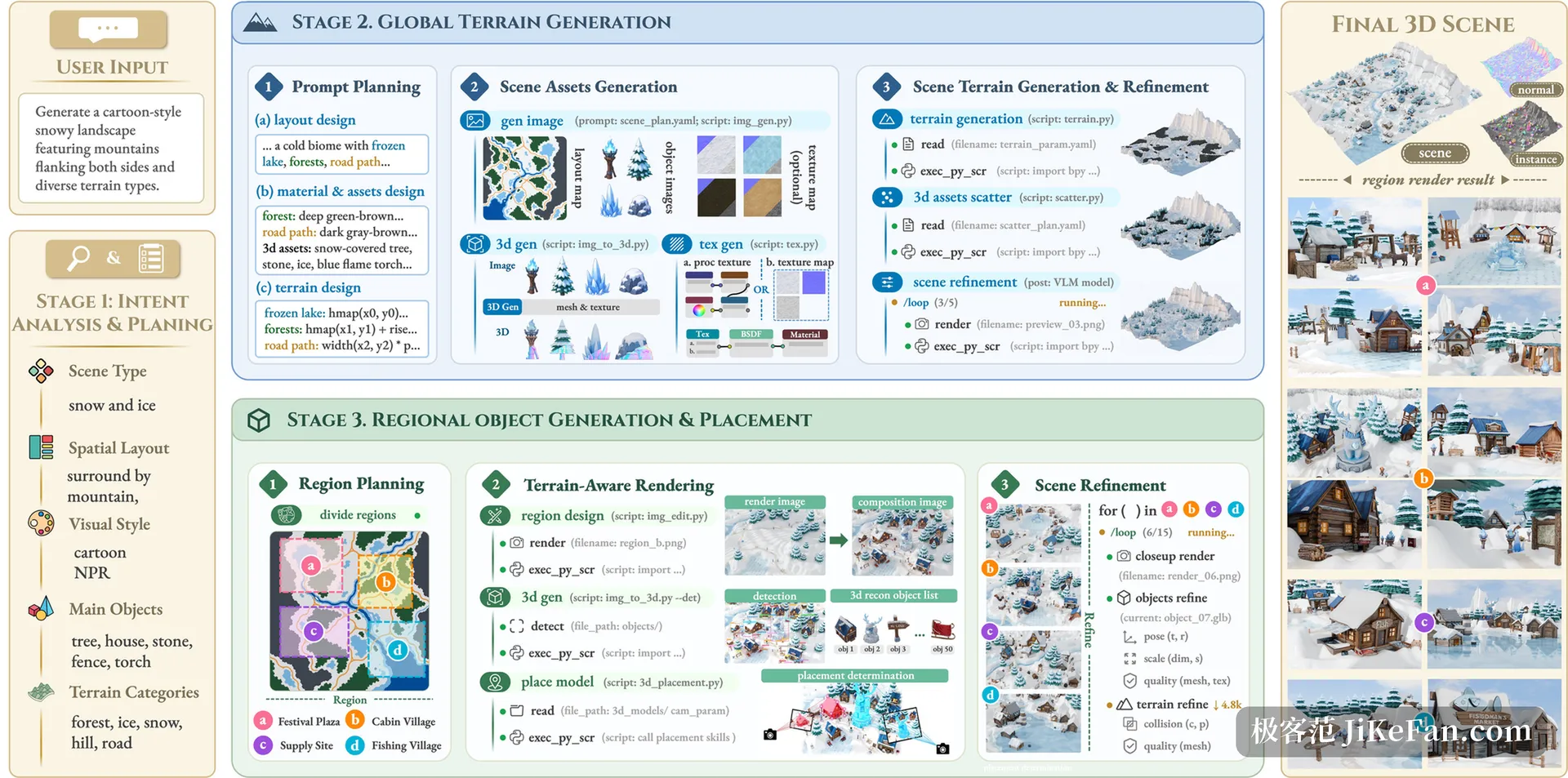
The pipeline runs in three stages, each owned by its own agent, with information passed through one shared structured representation. The first stage is intent analysis and planning: the intent agent extracts only the constraints you actually stated and does not invent more, then the scene planning agent fills the gaps and outputs a scene specification covering region division, terrain parameters, object categories, material style and spatial relations.
The second stage generates global terrain. The system paints a colour coded semantic layout map, then stacks a region weighted height field that combines base elevation, multi frequency noise and landform operators such as peaks, dunes, plateaus and erosion, so mountains, rivers and plains blend at their borders instead of being pasted together. Surface material is assigned by region as well, either as generated texture or as procedural nodes.
Only the third stage is about detail, and it does not fill the whole world at once. It first picks the regions that both need content and offer suitable terrain, and concentrates compute only there.
Every object stays a separate mesh
The regional content stage works differently from generating meshes straight in three dimensional space. The system renders the existing terrain into a two dimensional image and gives it to an image editing model to paint in buildings, vehicles and plants, producing a composite conditioned on the terrain. A segmentation model then cuts out each object, rebuilds them one by one as textured 3D meshes, and finally places them back on the terrain at matching positions through ray intersection.
Scale is calibrated too: after re-rendering, the area a rebuilt mesh occupies on screen should roughly match the patch it was cut from. Because every object keeps its own shape, position, scale and texture, replacing a tree or shifting a house a few metres means editing that one object, and the ground around it does not have to be rebuilt.
The render and check loop
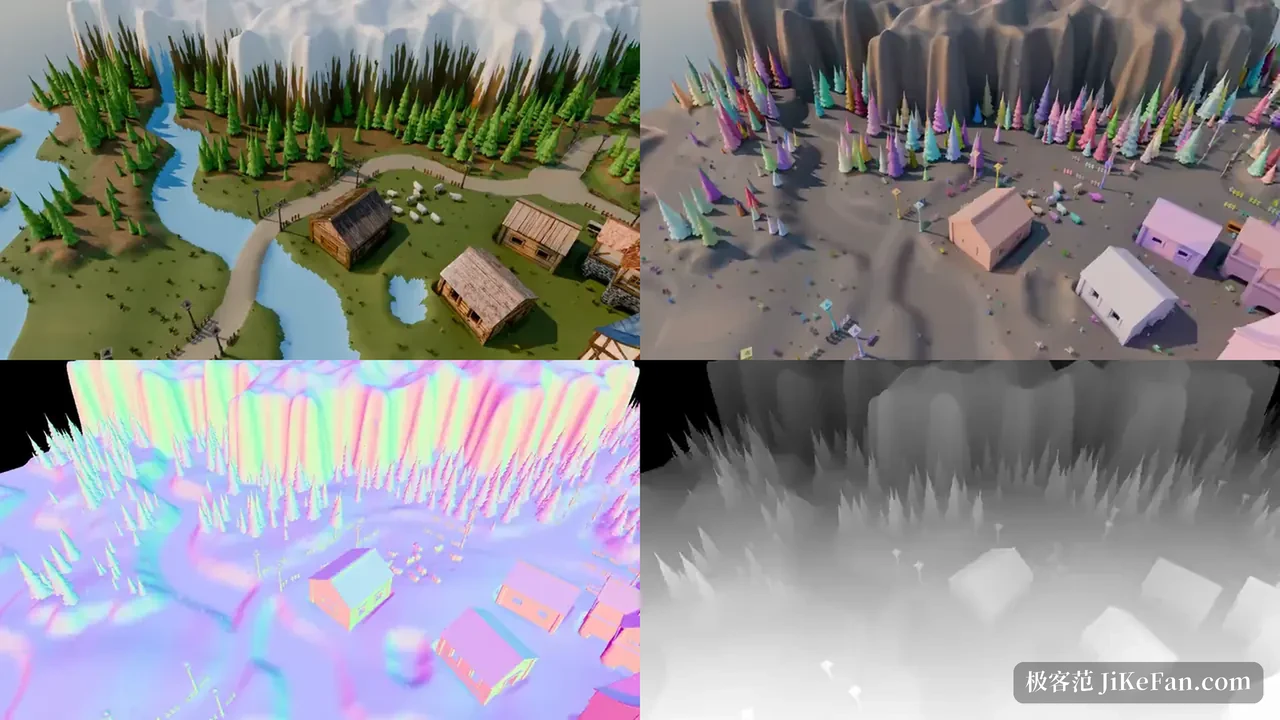
Placing the objects does not finish the job. A refinement agent connects to Blender through MCP, renders from several viewpoints, and checks proportions, pose, and how each object meets the ground. Anything floating, sunk, intersecting or obviously mis-scaled is picked out, then the object is moved, or the small patch of terrain under it is raised or smoothed, and another render confirms the change.
That loop of render, inspect, correct is also why the terrain and the objects can be generated separately: after a local change, the whole still holds together.
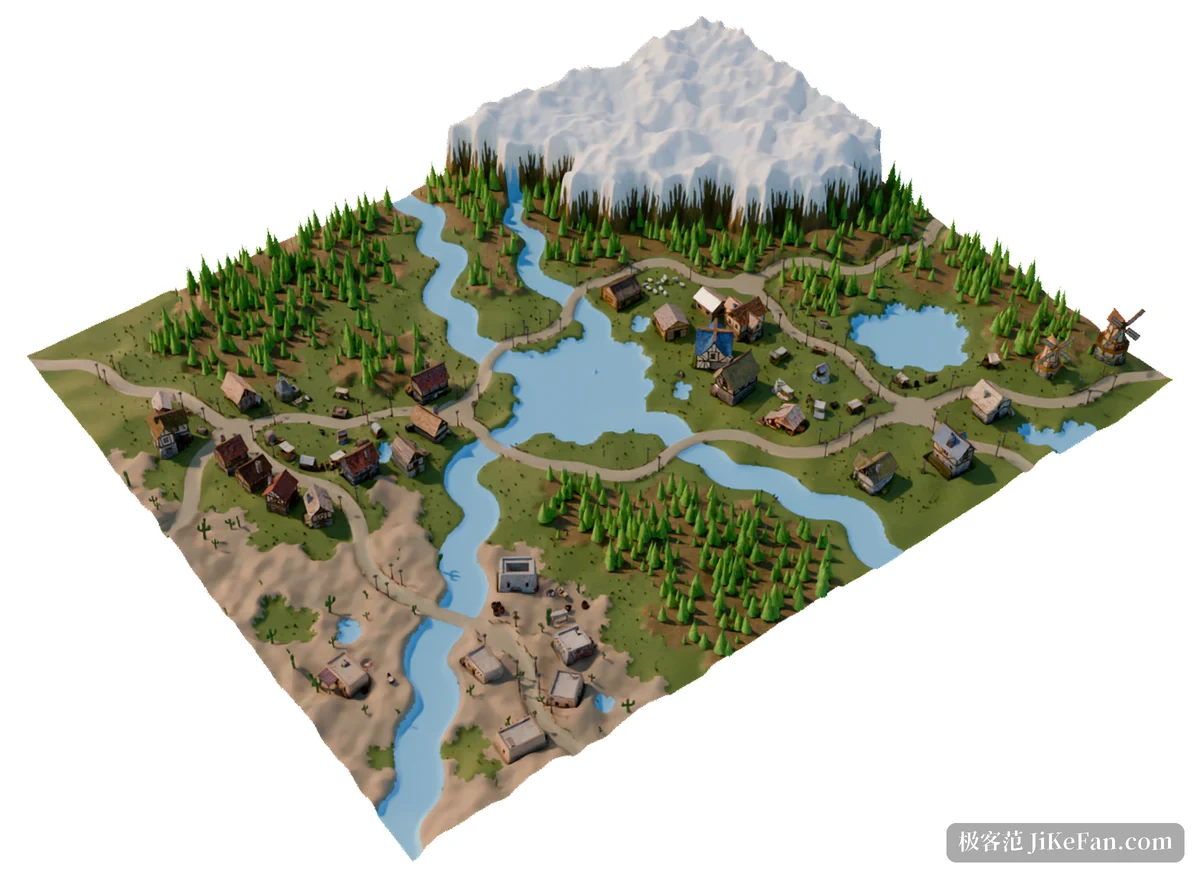
What it can do right now
To be clear, WorldClaw is still a research project. What has been published is the paper and the project page; the code, the model weights and the interface are not out, and there is no pricing. The experiments in the paper ran in Blender 5.1.1 on a server with four NVIDIA H20 cards, and the authors note that each additional object and each extra round of repair pushes time and cost up.
The paper is fairly direct about its own limits. One is dependence on model capability: final quality is bounded by the ceiling of the 3D generation module, and a weaker model visibly degrades the result. The other is unstable code generation: terrain construction, material generation, object placement and local refinement all have steps where a large model writes code on the fly, so a mistake in scale estimation, a numeric parameter or a node connection shows up directly as inconsistent landform or wrong material.
What it delivers is editable scene assets, not a game you can play. Navigation, physics and interaction logic have to be added afterwards, and engine integration is listed as future work. For people building level prototypes, virtual production previsualisation or digital twins, the approach is worth watching. As for when it can actually be used, that depends on the next step from the team.
The value of WorldClaw is not the phrase about a world from one sentence. It is that the world has been split into parts that can be inspected and changed. Today it is a paper and a project page, but the coarse to fine route, corrected while rendering, has pushed 3D scene generation one step toward being editable.