
Tingwu turns an hour of audio into minutes of notes, with live transcription and AI minutes
Summary
A work and study assistant from Alibaba Cloud: start a live recording and speech becomes text as it is spoken, translated on the fly and summarised into key points, with speakers told apart. The official claim is an hour of audio turned into a transcript in five minutes.
Recommend- Name
- Tingwu
- Version
- 20260917
- Open source
- Proprietary
- Operating system
- Web
- Website
- https://tingwu.aliyun.com/
- Updated
- 2026-10-06 18:52
The gap between the recording and the notes
The meeting ends, the recording sits on the phone, and the minutes have not been started. That is the ordinary working day for most people in an office, and it is the stretch Tingwu is built to take over. It is a work and study assistant from Alibaba Cloud, and the official product description is more technical than the marketing line: an agent that uses speech recognition and a large language model to summarise and analyse live or offline recordings from meetings, interviews and classes.
Three entrances on the home page
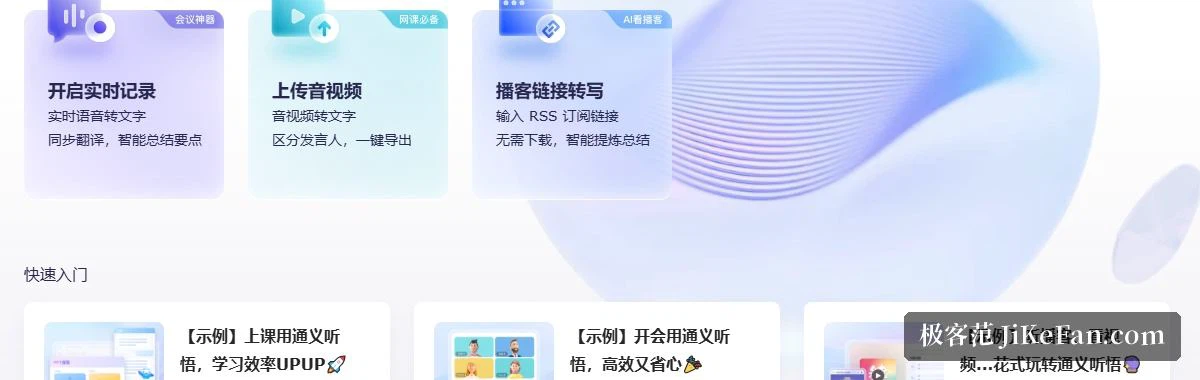
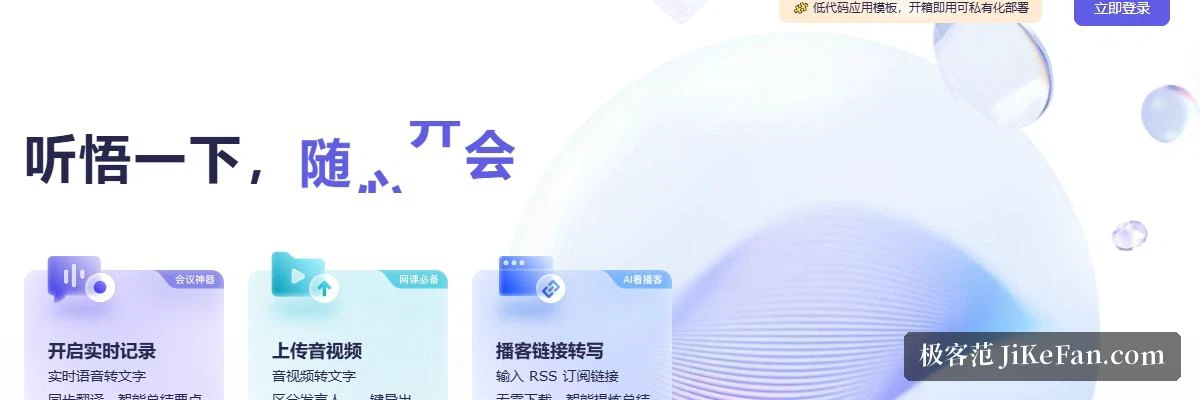
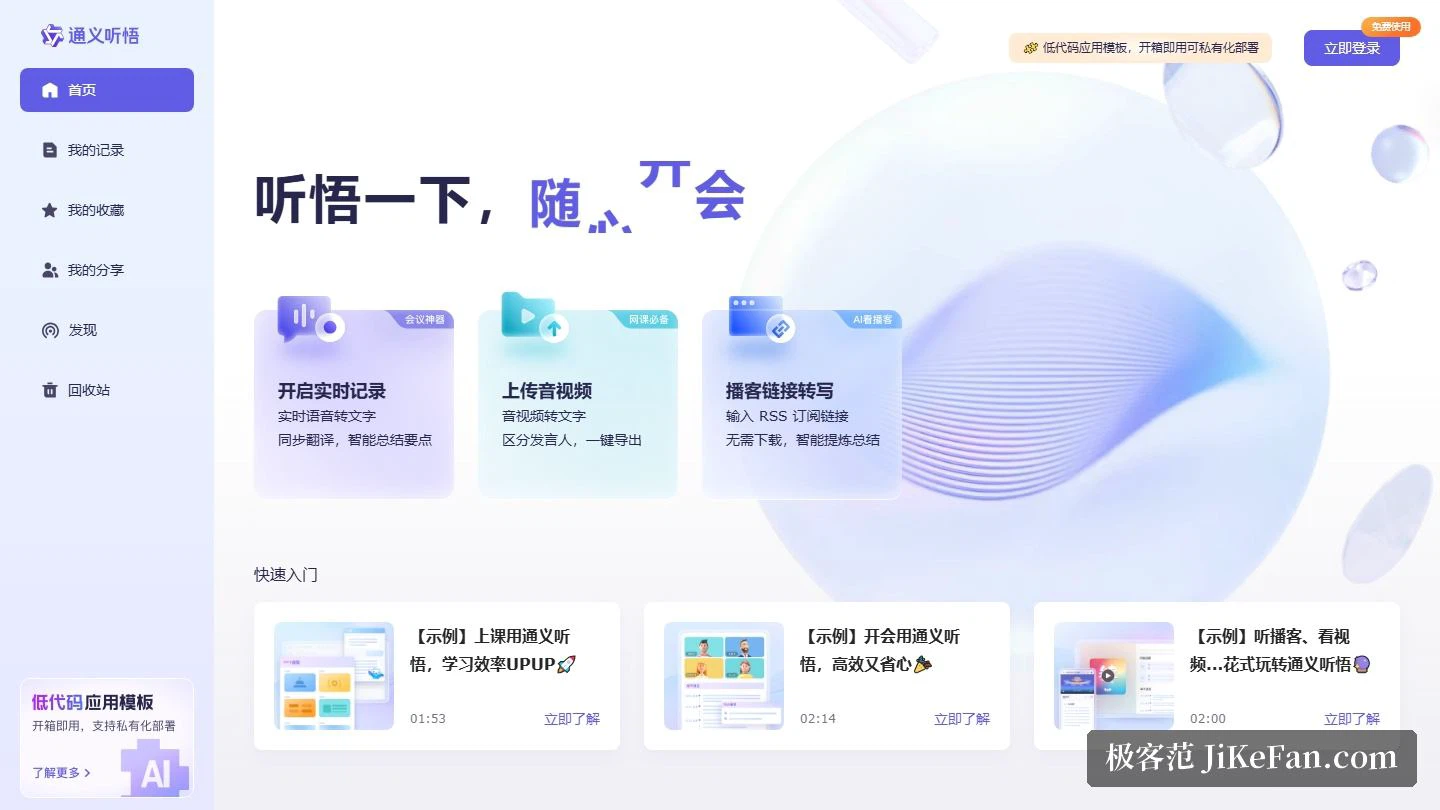
Open the site and three routes stand at the front. Start a live recording, which turns speech into text as it happens, translates alongside and summarises key points. Upload audio or video, which transcribes, separates speakers and exports in one step. Paste a podcast feed link, which needs no download at all and produces a condensed summary. The efficiency claim is equally concrete: an hour of audio transcribed in five minutes, with speakers told apart automatically.
Live recording: a draft while the meeting is still running
Live recording is the core of the product. On a computer the pitch is hands free and ears on the room: speech is transcribed as the meeting proceeds, translated across languages at the same time, and the key points are summarised alongside. One project manager quoted in the official user stories puts it plainly: the tool records every detail of the discussion, summarises the chapters and the action items, and a two-hour meeting becomes minutes in five minutes.
On languages the documentation is specific: transcription and live two-way translation cover Chinese, English, Cantonese, Japanese, Korean, German, French and Russian. A meeting that mixes Chinese and English, an interview in Cantonese, a lecture recorded in Japanese, Korean or German, all pass through the same pipeline.
AI minutes: from a transcript to a structure
Transcription is only the first step; the language model is where the minutes come from. The official list includes a chapter overview, a full-text summary, a per-speaker summary, a review of key points, a mind map, keywords, action items, scene detection, extraction and summarising of slides, conversion from spoken to written Chinese, and custom prompts. Record a two-hour meeting and the chapters, the summary, who said what and who does what next arrive already broken into structured blocks.
Subtitles get dedicated support: results can be returned with paragraphs, sentence boundaries and word-level start and end times, ready for caption display. For anyone producing video, that means the subtitle timeline no longer has to be aligned by hand. The stated scenarios are office work, education and training, finance and media.
Podcasts: one feed link does it
Of the three entrances, podcast transcription is the least effort. Paste an RSS feed link, download nothing, and the system transcribes and condenses the episode. For people who skim podcasts, reading the summary of an hour-long show before deciding whether to listen closely is simple arithmetic.
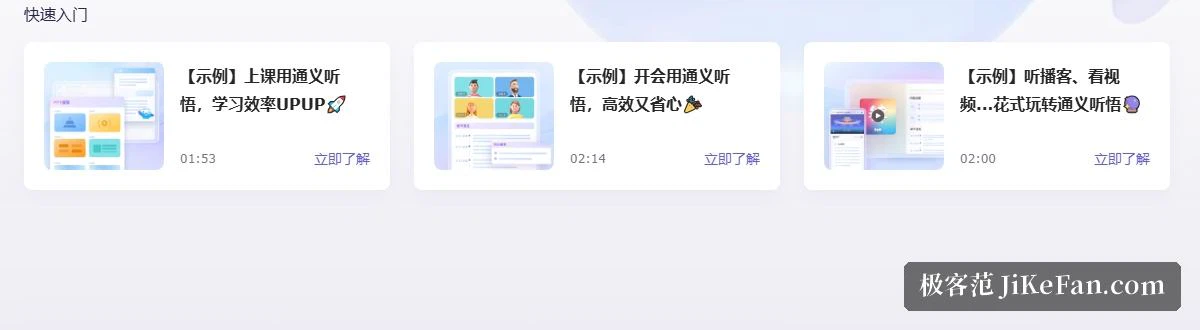
The getting-started section also carries three short videos: using the tool in class at one minute and 53 seconds, in a meeting at 2 minutes and 14 seconds, and with podcasts and video at 2 minutes, which covers exactly the three scenarios the product pushes.
Free quota and prices
Pricing follows the billing documentation in the Alibaba Cloud help centre. A newly activated account gets a 90-day free trial, and nothing is charged during it. Inside the trial the daily allowance is 48 hours of live recording with 2 concurrent streams, and 2 hours of audio for uploaded files; a day's quota returns 24 hours after it runs out.
Beyond the trial, or for business integration, billing is per interface. Transcription costs 0.6 yuan per hour, speaker separation and automatic language detection included. Each language model capability costs 0.064 yuan per hour, and they add up when several are used. Slide extraction with a summary costs 0.64 yuan per hour. Live translation costs 4 yuan per hour and offline translation 0.5 yuan per hour. Live meeting recording accepts up to 3 audio inputs, and when several are connected only the hours that produced a transcript are billed. The site also announces a general price cut, support for custom prompts, low-code templates that work out of the box and can be deployed privately, and an enterprise API entrance in the sidebar.
Who it suits
Three groups fit most directly. People whose calendars are full of meetings, researchers who have to work through interview recordings, and listeners who follow podcasts closely. The first two care about live transcription plus structured minutes; the third saves time with a feed link. Multilingual translation covers foreign-language classes and cross-border meetings as well.
Two honest notes. First, transcription accuracy depends on recording quality, accent and technical vocabulary, so an important set of minutes deserves a human pass before it goes out. Second, language model features are billed per hour and separately, so using several of them adds up; before subscribing or calling the API, run the numbers against the official billing page. The tool takes over the listening and the note-taking. Deciding which parts are worth keeping is still a human job.
A transcription tool takes over the keyboard, not the judgement. It compresses two hours of recording into five minutes of minutes, but which of those minutes to act on is still decided by the person who listened.