
iFlyRec turns an hour of audio into a draft in five minutes, minutes included
Summary
A transcription service from iFlytek: an hour of audio becomes a draft in as little as five minutes, text appears while the recording runs, and key points, follow-ups and structured minutes are produced along the way. The vendor puts multilingual accuracy at up to 98 percent.
Recommend- Name
- iFlyRec
- Version
- 20260917
- Open source
- Proprietary
- Operating system
- WebWindowsmacOSiOSAndroid
- Website
- https://www.iflyrec.com/
- Updated
- 2026-10-06 12:58
The pile of recordings nobody wants to open
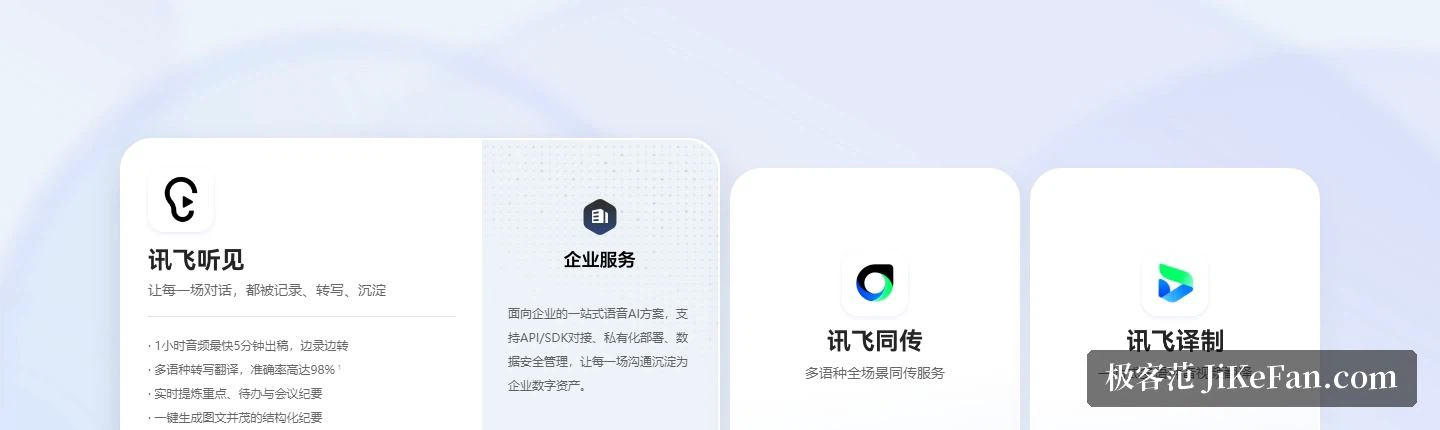
Recordings of meetings, interviews and lectures accumulate on phones, and the real labour starts when someone has to turn them into text. iFlyRec is aimed at exactly that segment. It sits inside the iFlytek family as the product dedicated to transcription and speech translation, and the platform it belongs to presents itself as an office SaaS suite rather than a single utility.
The efficiency claim is specific: an hour of audio becomes a draft in as little as five minutes, and text appears while the recording is still running. The app listing on the App Store, published by the Anhui-based developer behind the service, gives a slightly wider band — an hour of recording turned into a draft in five to ten minutes — which supports the shorter figure rather than contradicting it. On accuracy the site claims up to 98 percent for multilingual transcription and translation, with a footnote naming a provincial electronics inspection institute in Anhui as the testing body. That detail matters: the number carries a third-party source, and the app listing repeats the same figure.
Minutes that are assembled during the call
The second line on the home page is summarisation. Key points, follow-ups and notes are extracted in real time, and the recording ends with a structured draft that carries both text and images rather than a wall of paragraphs. The app listing fills in the AI details: a chapter overview that condenses the transcript, a question-and-answer view for digging into the content, and keyword matching that pushes the salient passages forward.
The document layer gets attention too. Speaker attribution and paragraph breaks are applied automatically, the text is aligned with the audio, and a tidying pass turns spoken phrasing into written prose. For anyone whose job is to send the minutes out, that compresses the distance between recording and sendable document into a single proofread.

Interpretation and media translation
Cross-language work is a separate product line on the same platform. The interpretation tool is listed with real-time translation across 9 languages and export of the audio document in a single click, plus a browser subtitle overlay that needs no installation, several display modes, and a one-to-one team that corrects output and walks users through it. Audio and video translation covers subtitle recognition and translation in 14 languages, with voice cloning for the dubbed track and a human team for delivery.
Language coverage is set out in the vendor's knowledge base. Ordinary users get 9 national languages — Chinese, English, Japanese, Korean, Russian, French, Spanish, German and Italian — plus 2 regional varieties (Cantonese and the Henan dialect) and 2 minority languages (Uyghur and Tibetan). Owners of the vendor's recording pen hardware are extended to 10 national languages, with Vietnamese added, and 12 regional varieties; the documentation notes that Cantonese produces a Cantonese text result.
Where the free tier stops, and what the tariffs are
The free boundary is stated plainly. Recording in the app costs nothing, and the live transcription and translation can be viewed for the first five minutes; the complete result — including the AI features and export or sharing — requires an entitlement.
Billing runs on three tracks. Machine transcription is 0.33 yuan per minute, payable with prepaid cards, rounded up to the next minute, and available 24 hours a day. Human transcription starts at 2.17 yuan per minute for Chinese and 30 yuan per minute for English, with minimum order values of 18 yuan and 30 yuan respectively, staffed from 9:00 to 22:00 including holidays. On the subscription side, a monthly package grants 30 hours of machine transcription: the first continuous month costs 6 yuan, renewal is 18 yuan, and bought separately it is 25 yuan per month, 68 yuan per quarter or 198 yuan per year, limited to audio recorded in the app. A larger package raises the allowance to 50 hours a month and also accepts imported audio. For companies there are API and SDK integrations, private deployment and data governance options.
The platform underneath
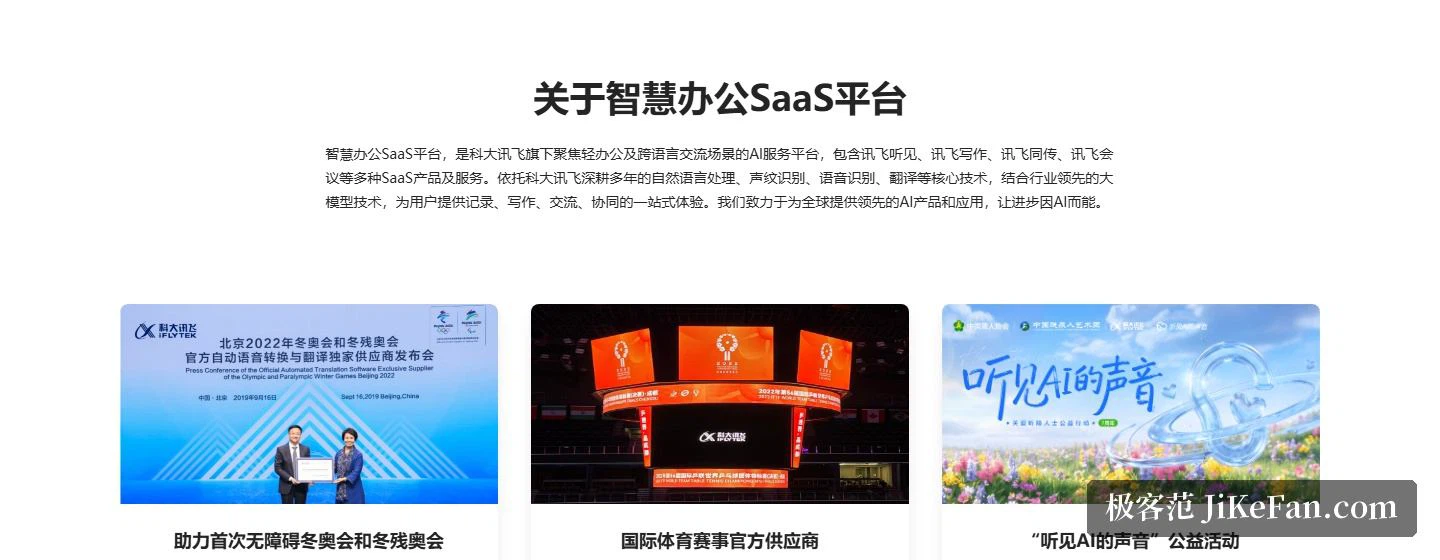
The about section describes an AI service platform for light office work and cross-language exchange, holding several SaaS products for transcription, writing, interpretation and meetings, built on natural language processing, voiceprint recognition, speech recognition and translation, combined with a large model. One credential is worth repeating: on 16 September 2019 the parent company became the exclusive supplier of automatic speech conversion and translation for the Beijing 2022 Winter Olympics and Paralympics. The same section describes a public-welfare project run with a national association for deaf people, and the help centre includes a verification channel that gives hearing-impaired users access to entitlements.
Who it suits
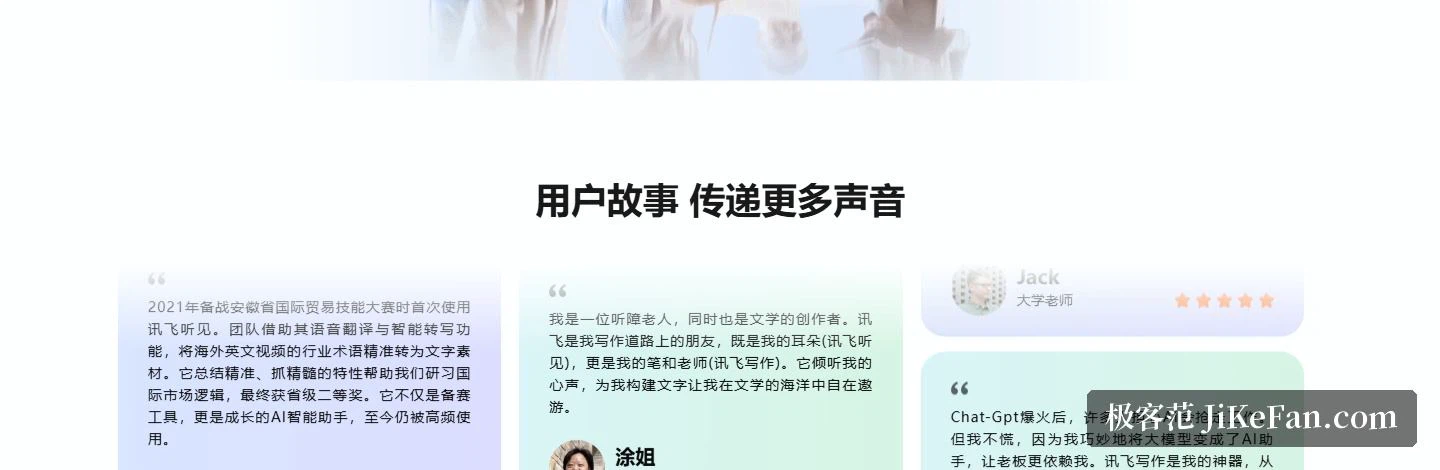
The user stories on the site cluster tightly: meeting minutes for office workers, interview cleanup for reporters, lecture notes for teachers and students, roadshow archives for researchers. Mandarin meetings with Chinese minutes are the comfortable zone; when a second language is involved, the floating interpretation subtitles and the document translation cover most of the ground.
Two honest notes. The live view is free for five minutes only, and the complete result plus the AI features need an entitlement, so light users should compare their own volume against a package first. And machine versus human transcription are two quality tiers with very different per-minute prices; for anything that has to be delivered, do the arithmetic on minutes before choosing. The tool finishes the recording and the transcription. Deciding which line of the minutes deserves a follow-up is still a human call.
A transcription tool changes a recording from something stored into something searchable. An hour of audio collapses into a five-minute script, but which follow-up gets scheduled and which promise gets honoured is still judged by whoever was in the room.