
SWE-agent: hand it a bug report and it reads the code, edits the files and returns a patch
Summary
A research agent that takes a single bug report and carries the repair to the end: it clones the project, reads the description, hunts for the relevant files, edits them, runs the tests and hands back a patch that can be merged. Its real contribution is not the model but the interface built for reading and editing code.
Recommend- Name
- SWE-agent
- Version
- 1.1
- Pricing
- Paid
- Open source
- Open source
- Operating system
- LinuxmacOS
- Website
- https://swe-agent.com/
- Updated
- 2026-10-06 07:31
Open projects and small teams share the same awkward position: the pile of unfixed reports keeps growing, and the number of people who can pick one up stays exactly where it was. Most coding assistants stop at helping you complete the lines in front of you — faster typing, but nobody carries a bug from beginning to end. This project takes the other route and hands over the whole job.
SWE-agent was built by researchers at two universities and released as open source. Give it the address of a bug report and it clones the corresponding project, reads the description, searches the code for the relevant places, works out what is wrong, changes the files, runs the tests to confirm nothing else broke, and produces a patch that can be submitted as a merge request. All of it happens in an isolated environment, with nobody standing by to approve each step.
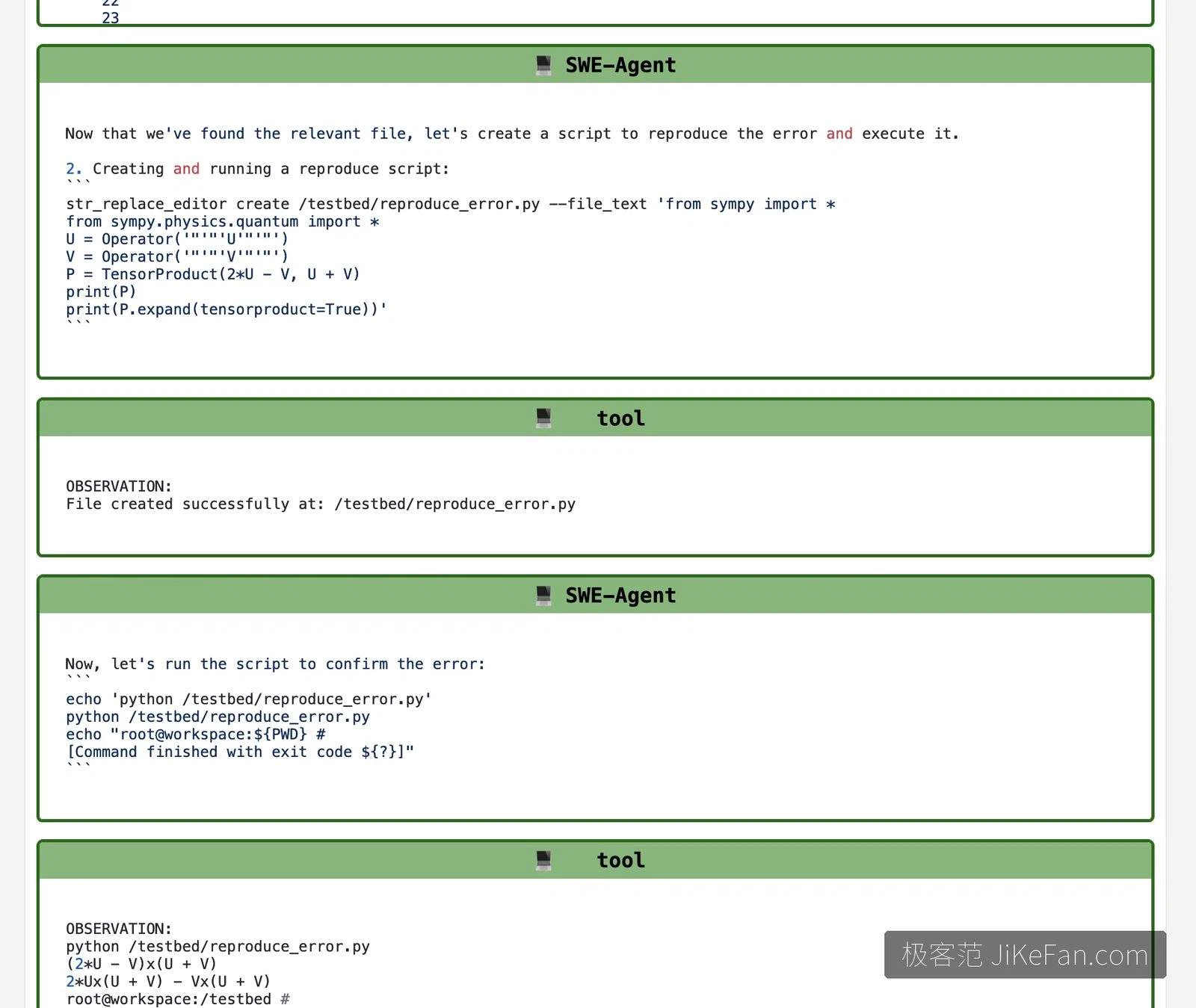
Not completion, but one repair carried to the end
The approach first appeared in 2024. On a public benchmark assembled from real reports, it solved a little over twelve percent of the problems, at an average of ninety-three seconds each. That was the first time an open approach reached a two-digit figure, and it turned whether a model can actually fix a bug from a matter of opinion into a measurable question. As the models improved, a later major release repeatedly reset the best open result on that kind of evaluation.
The model is not the point; the tools it holds are
Set an ordinary chat model loose in a real repository and it mostly gets lost: too many files, more context than fits, and one malformed answer wasting everything done before it. The central contribution of the accompanying paper is an interface between agent and computer — not a raw terminal handed to the model, but a set of commands redesigned for the specific work of reading and changing code.
The details are concrete. The file viewer shows roughly a hundred lines per turn, which happens to sit inside the range where a model reads accurately. The editing command runs a syntax check first and refuses to apply a change that is not valid. A whole-directory search returns only the names of matching files instead of stuffing context. A command that produces no output gets an explicit reply saying it succeeded and printed nothing. These look like trivia, and they are exactly what keeps a model from falling apart on a long task; the paper confirms that the same model performs far worse without a tuned interface.
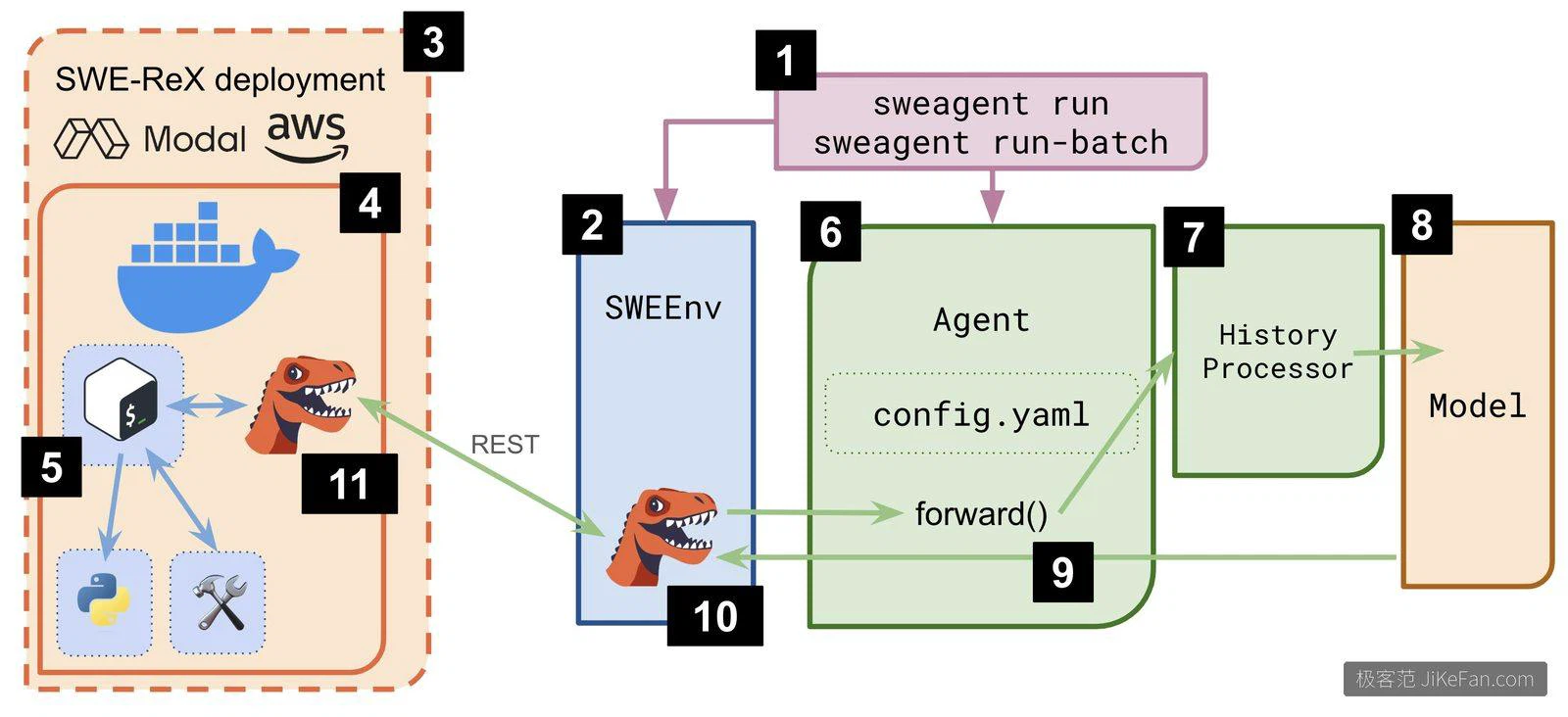
Any model, and one file of configuration
No vendor is bound here. Commercial models and open models running locally both attach, and the model and its parameters live in a single configuration file, so switching means changing one line rather than touching code. That makes it unusually good for the side-by-side comparison of which model is stronger on the same task.
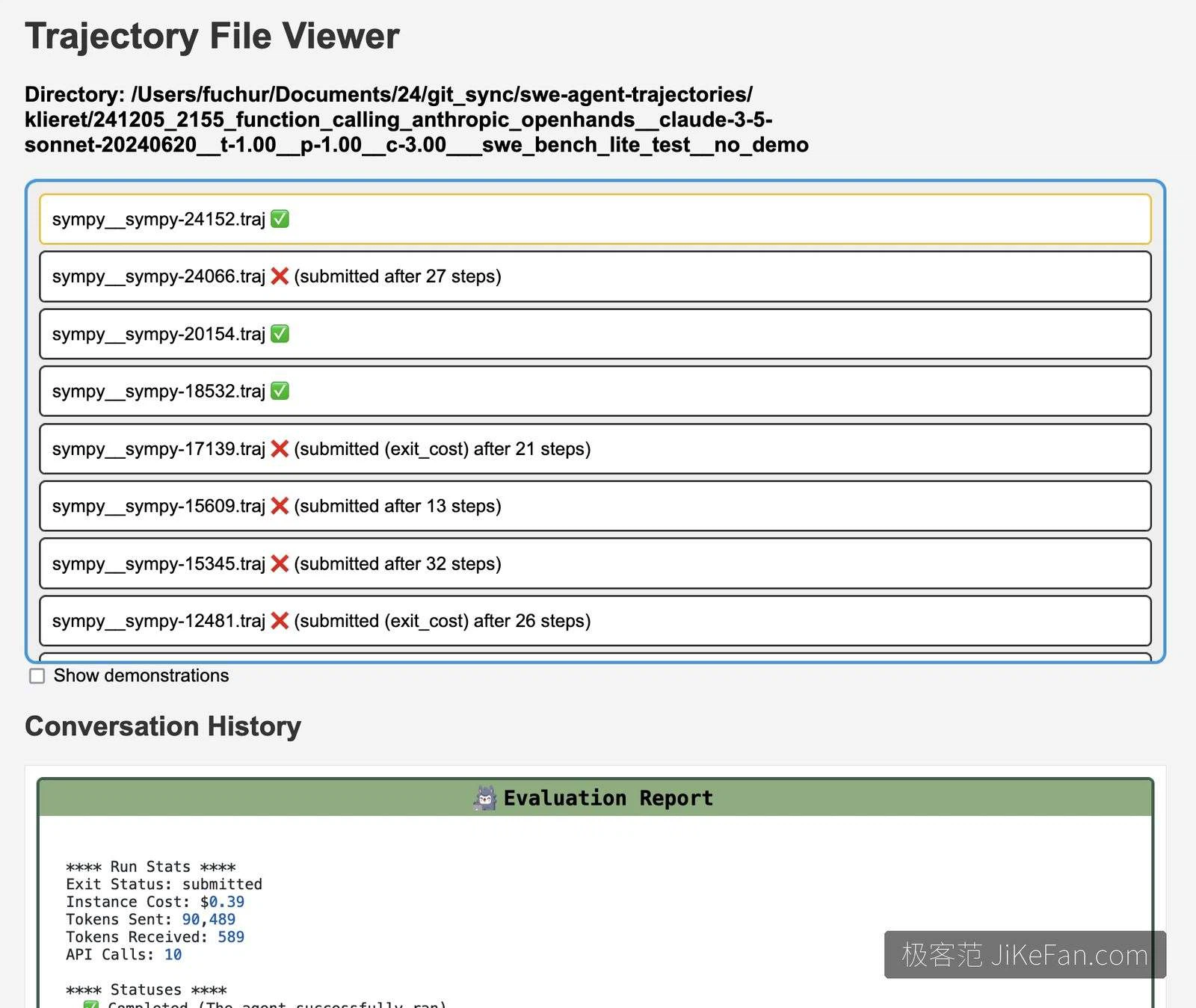
Isolation is handled by containers: every run happens in a sandbox and cannot damage your machine. Dozens or hundreds of reports can be processed in parallel batches. A complete trajectory is kept afterwards — which file was read, what was searched, what was changed, all traceable — and an online viewer shows, step by step, what each one cost and how many tokens it consumed.
Fixing bugs is only the start
The same framework does other work. Teams have used it for security competitions, where it reached leading positions on the relevant scoreboards, and for competitive programming problems; anything that can be described as operating inside an environment until a goal is reached can be plugged in. The project is open throughout — auditable, changeable, reproducible — which is why academic work keeps citing it.
Where it stands now, plainly
In July 2025 the same team released a lighter version: about a hundred lines of Python, with all custom tools removed and only a basic shell left, still solving roughly sixty-five percent of the validation problems. Their current advice is that most new users should start there; SWE-agent itself has moved into maintenance, with new features no longer the focus.
That clarifies when it is still the right choice: a toolchain that needs deep configurability, experiments with different ways of handling history, or research into how a good agent interface should be designed. This is research infrastructure, not a packaged product. By late 2026 the repository had passed twenty thousand stars and two thousand forks, and the accompanying benchmark has become a public yardstick the field cannot avoid.