
Pieces keeps nine months of your workflow on your own disk
Summary
Not a faster typist but a memory: it records what you did in editors, browsers and terminals, keeps it on the machine for nine months, and lets other AI tools borrow it through MCP.
Recommend- Name
- Pieces for Developers
- Version
- 5
- Open source
- Proprietary
- Operating system
- WindowsmacOSLinux
- Website
- https://pieces.app
- Updated
- 2026-10-05 00:07
The trouble Pieces goes after is not speed of typing but whether last week's work still exists. Every developer has rebuilt a solution from three weeks ago, because the browser history, the chat log and the unnamed scratch file were all gone.
Pieces for Developers is a memory rather than a writer. It stores snippets, links, notes and screenshots together with the context they came out of, and hands them back when you describe what you need in ordinary language.
It is infrastructure for a workflow: plugins spread across editors, browsers and collaboration tools, and the 2026 update pushed that memory outward through MCP so other AI tools can draw on it. The numbers are 150,000+ installs, a million saved items and 17 million context links, with everything kept on the local machine.
Three pillars hold the product up. The Long-Term Memory Engine runs in the background, observing which editor is open, which documents were read and which terminal commands ran, and infers what you are working on. Pieces Drive manages the assets. Pieces Copilot is the assistant that answers from that recorded context rather than from the open web.
In practice: come back on a Monday, ask where you left off, and it names the list animation in a Svelte project with links straight to the files involved. Ask what that SQL was on Tuesday evening and the statement comes back. The rolling window is nine months, which is roughly the life of one project.
Every saved snippet gets metadata filled in automatically: language, tags, source URL, a short description of what it does. Code grabbed from an editor, a browser, a terminal or a document turns into an asset that can be searched, cited and shared. Search takes natural language, so a forgotten file name is no obstacle: the React hook that handled the modal state is enough to find it.
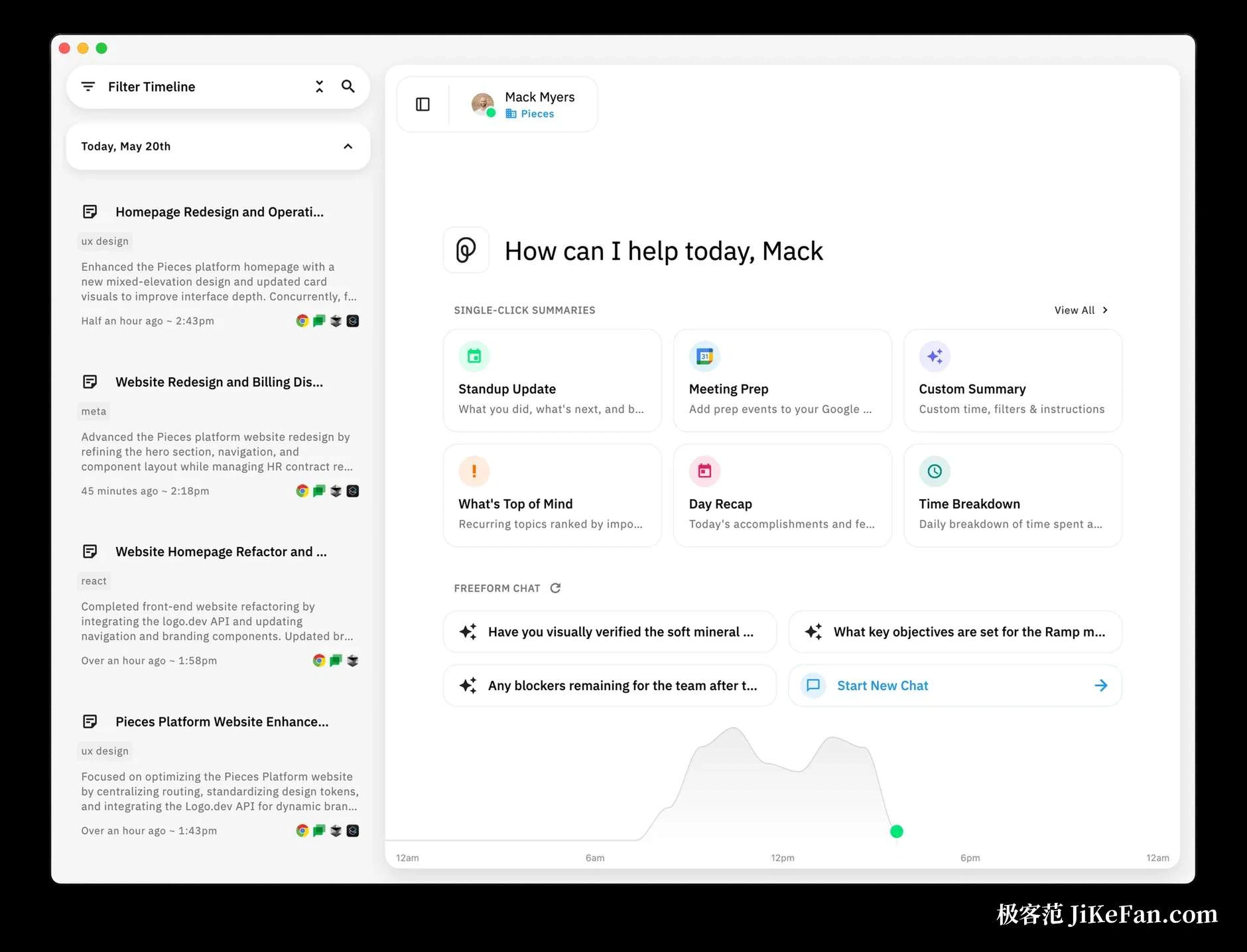
The timeline replays a day by date, semantic search queries the whole memory at once, and anything found can become a shareable link that carries its context along to a colleague.
Local first is where it parts ways with most cloud AI tools. All memory processing happens on the machine; the official claim is air-gapped operation, 100% offline storage and code that never leaves the device. The free tier runs device-side models, keeps working without a network and answers without API latency.
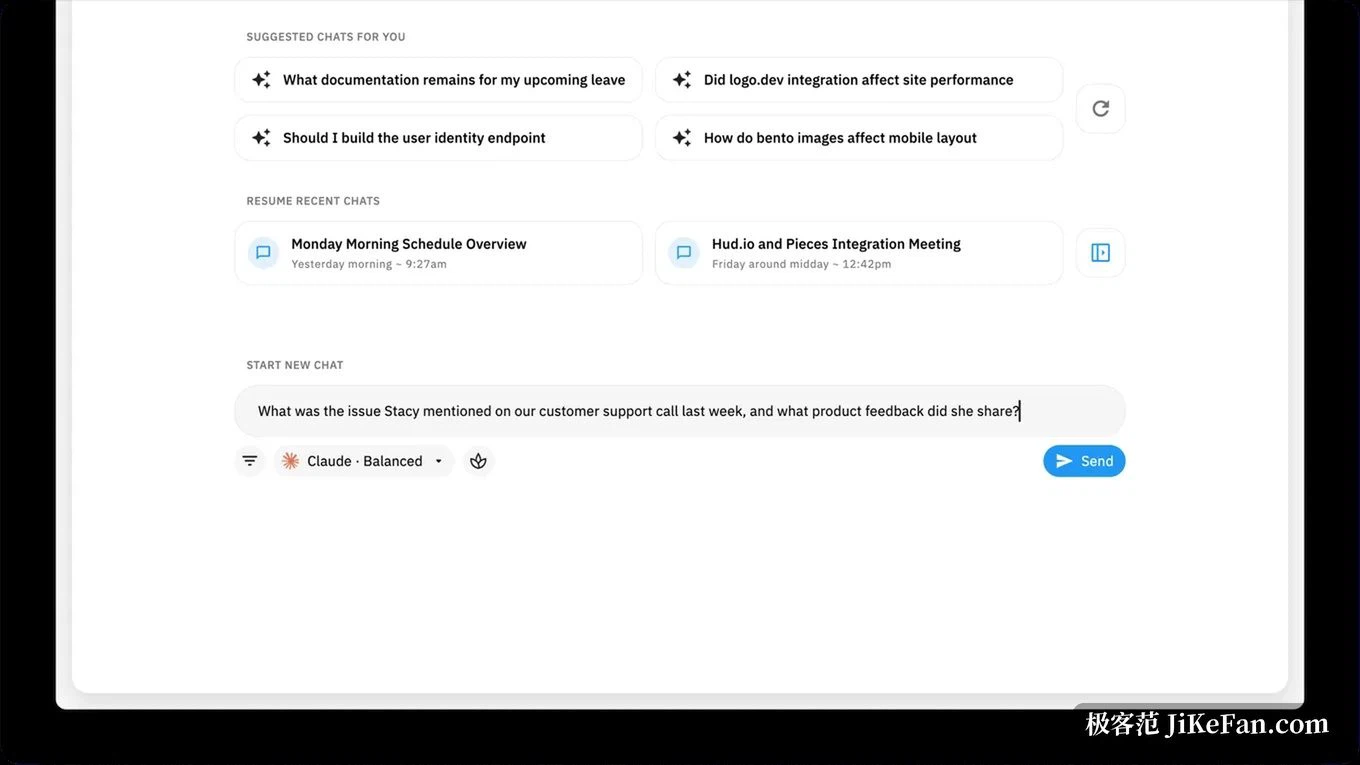
The substrate underneath is PiecesOS, a runtime for the whole suite roughly in the way Docker is a runtime for containers: the desktop app, the browser extension and the editor plugins all sit on it, and the machine learning plus cross-application messaging stay local. It goes in first, then the app or the plugin, and macOS, Windows and Linux are all covered.
The most interesting step in 2026 is MCP. Pieces ships an MCP server that exposes 39 tools - full-text search, vector search, batch retrieval, time filtering - to 19 compatible clients including Cursor, Claude Desktop, VS Code, Windsurf and JetBrains. A snippet saved in VS Code can be cited while writing in Cursor, and a problem solved in the terminal is on call inside Claude Desktop. The memory ends up shared across every AI tool instead of trapped in one.
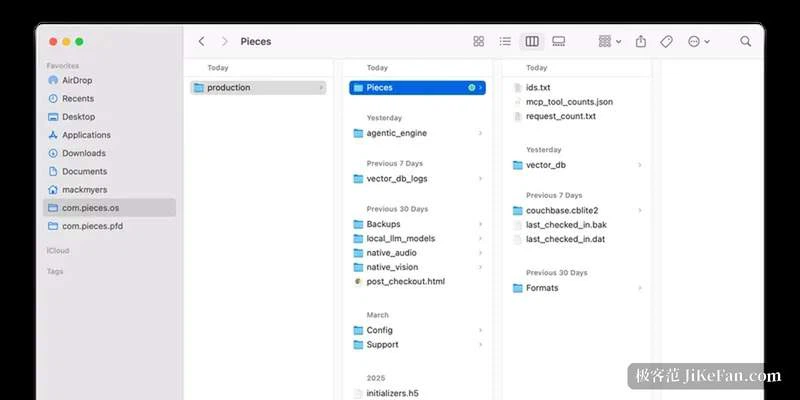
Pieces Copilot switches between cloud and local LLMs and accepts your own API key. Its context window stretches from the current conversation to the whole repository, and the answers rest on the long-term memory, so the subject is the project it watched you build rather than generic training data.
Free is a working product rather than a teaser: unlimited snippets, local long-term memory, device-side models and every plugin, at no cost. Pro adds advanced cloud models from the Claude and GPT families, encrypted cloud sync and priority support for 18 dollars 99 cents a month. Enterprise adds a shared team memory, SOC 2 compliance, on-premise deployment and administrative controls, quoted by sales. For teams whose code cannot leave the building, this is close to the only comfortable option on the market.
The idea is unusual among coding tools: while everyone else races to write code for you, this one concentrates on remembering what you already wrote. An individual can stay on the free tier and treat it as a second brain for the whole machine - save snippets for a week, run one semantic search, and going back becomes hard.