
Ornith spans 9B to 397B and writes its own training tasks
Summary
From DeepReinforce, Ornith hands task writing, scaffolding and solution writing to the model itself, comes in three sizes from 9B to 397B, and ships under MIT with a 256K context and local deployment.
- Name
- Ornith
- Version
- 1.5
- Pricing
- Free
- Open source
- Open source
- Operating system
- WindowsmacOSLinux
- Website
- https://ornith.ai
- Updated
- 2026-10-10 14:39
Ornith is an open source family of coding models that hands both what to train on and how to train to the model itself, and takes its name from the Greek word for bird.
Ornith comes from the AI research lab DeepReinforce and targets agentic coding. It does not stop at tuning a model more precisely inside a fixed training routine; it gives the organisation of training itself back to the model. The training task is proposed by the model, the solving scaffold is built by the model, and the final solution trajectories are generated by the model too. The vendor calls this route self improvement and makes it the main line of the whole family.
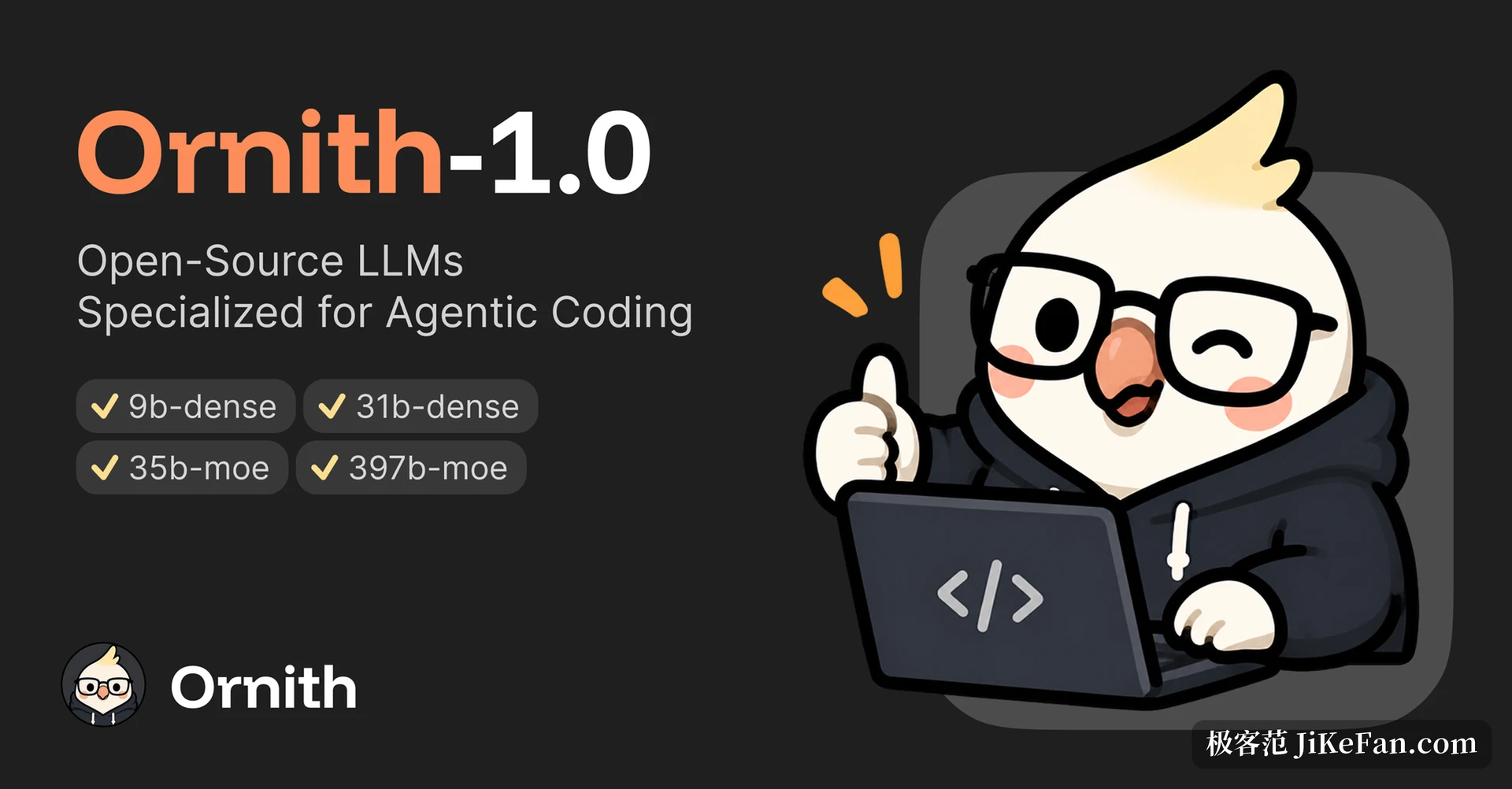
Two generations exist so far. Ornith-1.0, released in June 2026, put forward the self scaffolding framework; Ornith-1.5, released in August 2026, widened it from jointly optimising scaffold and solution into a complete self improvement loop.
From self scaffolding to a self improvement loop
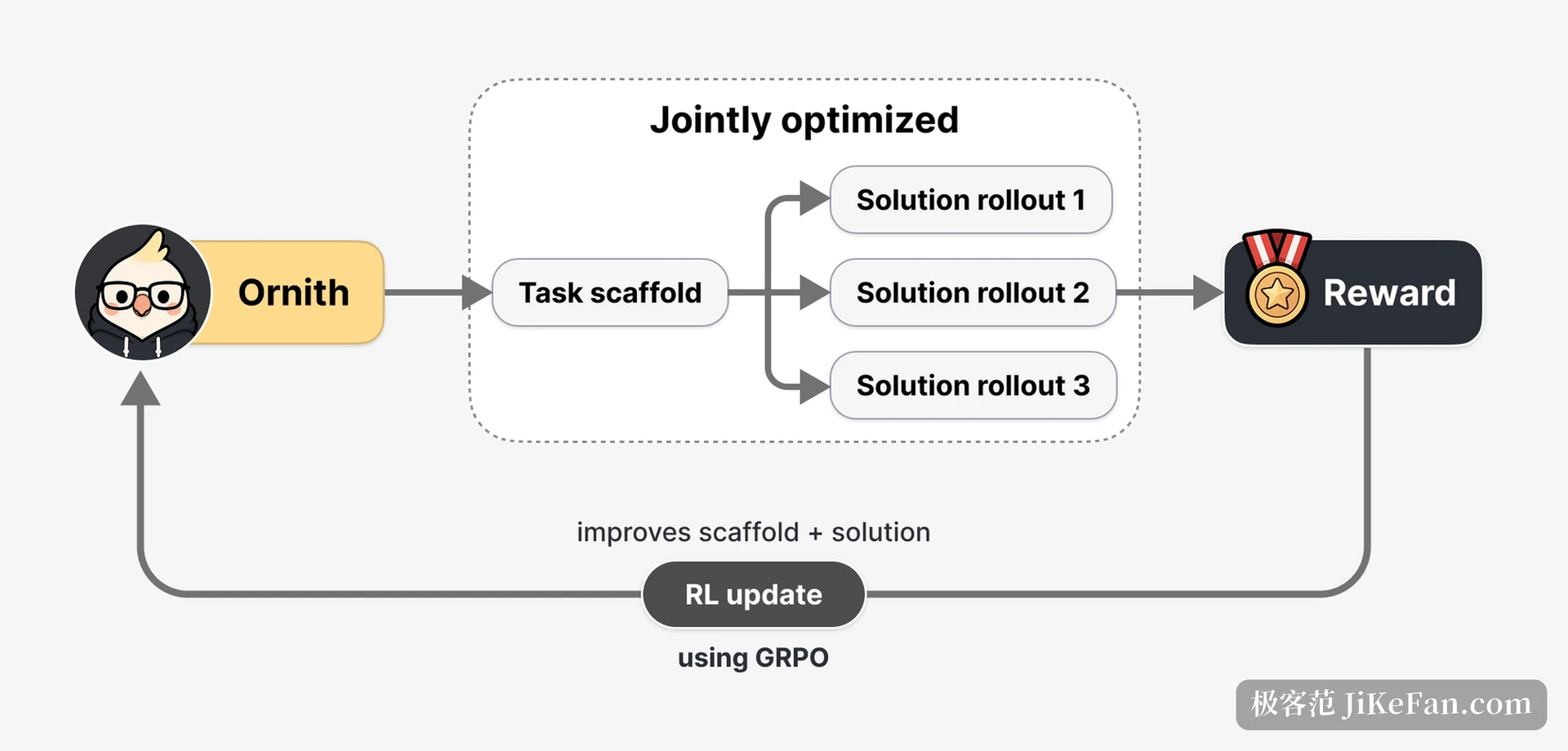
The core move of Ornith-1.0 is to treat the scaffold as something learnable. In ordinary reinforcement learning the order of tool calls, the retry logic after an error and the way memory is organised are all fixed by a hand written skeleton, and the model only produces a solution inside it. Ornith-1.0 has the model first propose a finer version of the scaffold from the task description in every training round, then generate solution trajectories under that scaffold; once a solution earns reward, the reward flows back to both the scaffold writing and the solution writing stage. After enough iterations the orchestration strategy for each task category emerges on its own, with no need for a human to specify it class by class.
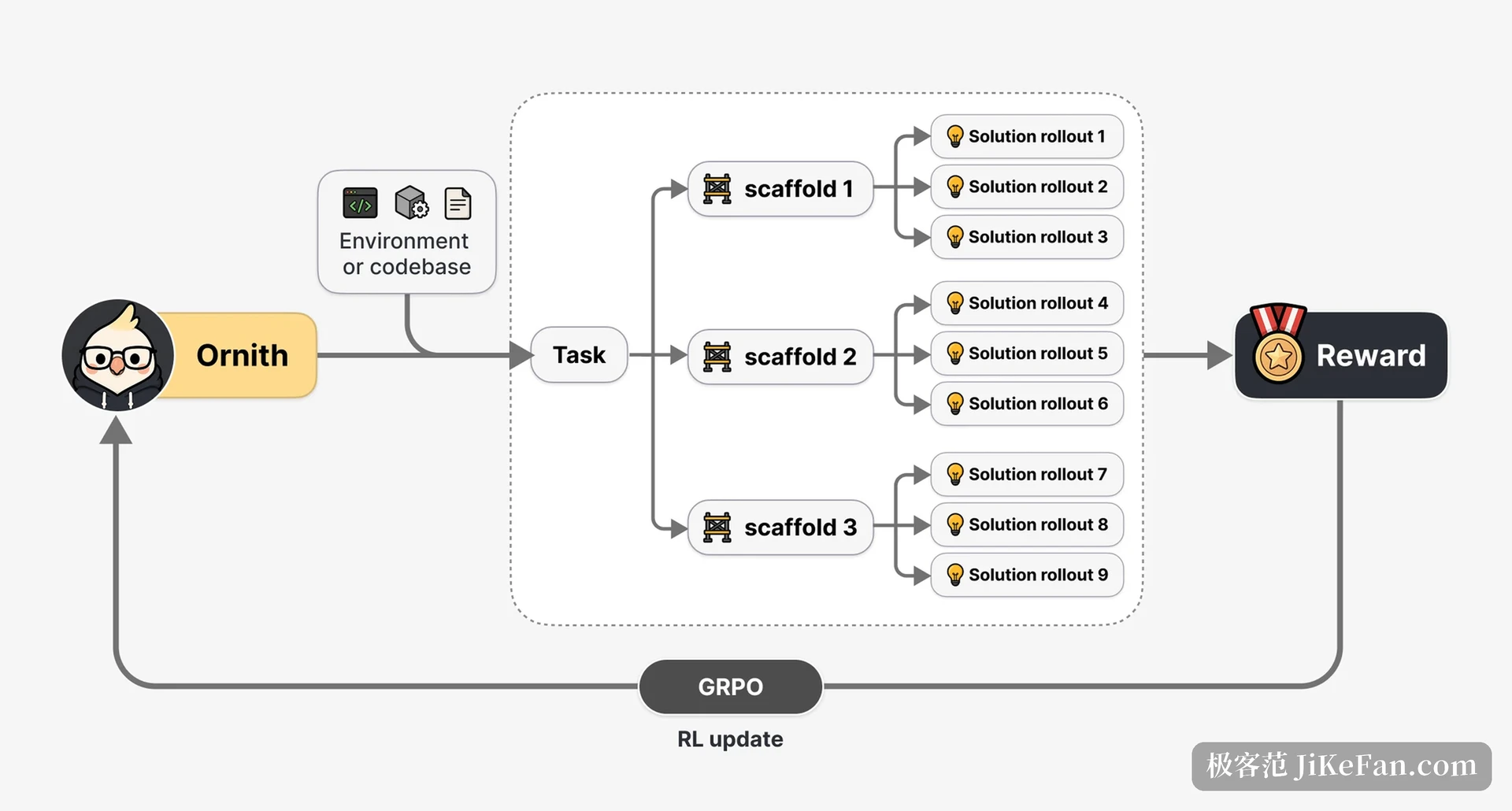
Ornith-1.5 pushes the idea a step further. The training loop goes from two stages to three: the model proposes a new task harder than the ones before, generates a scaffold built for that task, and finally produces solution trajectories under that scaffold. Reward runs through all three stages, so what the model learns is not only how to solve more accurately but also how to set more valuable tasks and how to build a more effective scaffold.
How the tasks get set: three rewards multiplied
Letting a model set its own tasks carries an obvious risk: it picks the soft targets, or keeps generating variations of the same thing. Ornith-1.5 constrains the direction by multiplying three signals: validity, frontier difficulty and novelty. Validity measures whether the task and the scaffold make a well defined, checkable learning environment; if the scaffold will not run, or the evaluation criteria do not match the task specification, this term falls to zero and the whole task earns nothing.
Frontier difficulty is estimated from the model actual success rate on a task. The closer that rate is to 0.2, the higher the difficulty reward; as the model gets steadier on a category, the reward for that task slides down of its own accord and the direction of task setting is pushed towards harder ground. Novelty suppresses repetition, scored inversely from the maximum similarity between the current task and a buffer of past ones. Multiplied together, the three mean only a task that is at once checkable, challenging and not repeated earns anything.
Three sizes and the official numbers
Ornith-1.5 comes in three sizes covering the whole span from a data centre to a handset: the 397B mixture of experts version for flagship settings, the 35B-A3B version activating about 3B parameters per token, and the 9B dense version for a single card or an edge device. Beyond those three, the previous Ornith-1.0 also offered a 31B dense model. Every checkpoint in the family shares one OpenAI compatible interface.
Size
Terminal-Bench 2.1
SWE-bench Verified
Hardware target
397B MoE
86.1
86.0
Multi card node
35B-A3B MoE
68.5
79.0
Mid sized team
9B Dense
47.0
70.6
Single card and edge
The 9B version also spawns a quantised Mobile edition, which the vendor says runs directly on iPhone and Android devices. All three support a 256K context window, 262,144 tokens, and with a YaRN scaling factor of 4.0 that stretches to roughly one million tokens.
How to run it: local inference and an open licence
The Ornith family are reasoning models, so by default the assistant reply opens with a think block before the final answer; the official recipe returns that chain of thought in a separate field and opens up tool call parsing, which makes it easy to plug into agent orchestration frameworks.
On how to run it: Ornith has no hosted API and no price list, all capability ships as model weights and has to be deployed by you. The vendor provides recipes for inference stacks such as vLLM and SGLang, along with a configuration aimed at long context; quantised formats cover GGUF and MLX, so it runs locally through llama.cpp and Ollama.
The weights are released under the MIT licence, and the vendor describes them as globally accessible and free of regional restriction, with neither research use nor commercial deployment needing an extra approval step.
Ornith hands both what to train on and how to train to the model itself: setting the task, building the scaffold and writing the solution form a closed loop, with validity, difficulty and novelty multiplied to steer what gets asked. Three sizes cover hardware from a data centre to a phone, and the MIT licence with purely local deployment buys complete freedom to use it.