
Qodo leaves the writing to others and audits what comes out
Summary
A test writer and a pull request reviewer in one platform: Qodo reads a function, builds a suite that covers the awkward paths, then vets the change before it merges. Free for individuals.
Recommend- Name
- Qodo
- Version
- 2
- Open source
- Proprietary
- Operating system
- WindowsmacOSLinux
- Website
- https://www.qodo.ai
- Updated
- 2026-10-29 22:00
Almost all the attention in this corner of the market goes to tools that produce code faster. Qodo took the other half of the job: whether the code that came out is correct, whether the tests actually cover it, and whether a pull request deserves to be merged at all.
The company began life as CodiumAI and renamed itself Qodo in 2024. What started as a test generator has grown into a multi-agent review platform that spans the editor, the pull request, the command line and Git workflows. Its editor plugins have passed one and a half million installs across the VS Code and JetBrains marketplaces, with an average rating just short of the top score.
The relationship to a coding assistant is complementary rather than competitive. One side produces the code, the other signs it off. The faster production gets, the more weight the checking side carries, which is exactly the half this product occupies.
Test generation is the flagship. Select a function or a class in the editor and Qodo reads the logic, then writes a suite that covers the normal path, the edge cases, error handling and boundary conditions. These are not assertions tossed in to lift a number: the output shows it understood what the function was supposed to do. You can also declare a coverage target and let it fill the gap.
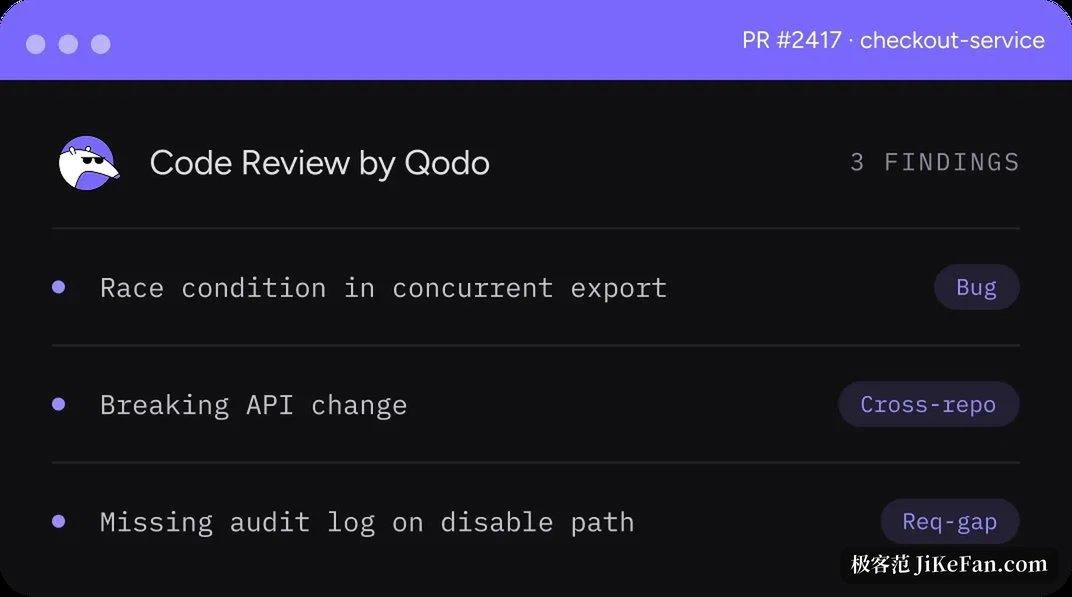
Spotting edge cases is where it earns its keep. Null input, empty collections, concurrent access, boundary values - the situations a developer skips when a deadline is close - get enumerated systematically, following the conventions of whichever framework the project uses. Jest, Mocha, PyTest, JUnit, Go testing and Vitest are all on the list, and the language support is close to open-ended.
The chat panel also handles clean-up, bug and vulnerability detection and documentation, but the direction never changes: make the code sturdier rather than produce more of it.
For teams the centre of gravity is Qodo Merge, a review bot wired into GitHub and GitLab. Every pull request gets a written description, a walkthrough that lets a reviewer get oriented quickly, the risky lines highlighted so attention lands where it matters, and suggestions ordered by severity - merge as soon as nothing objects.
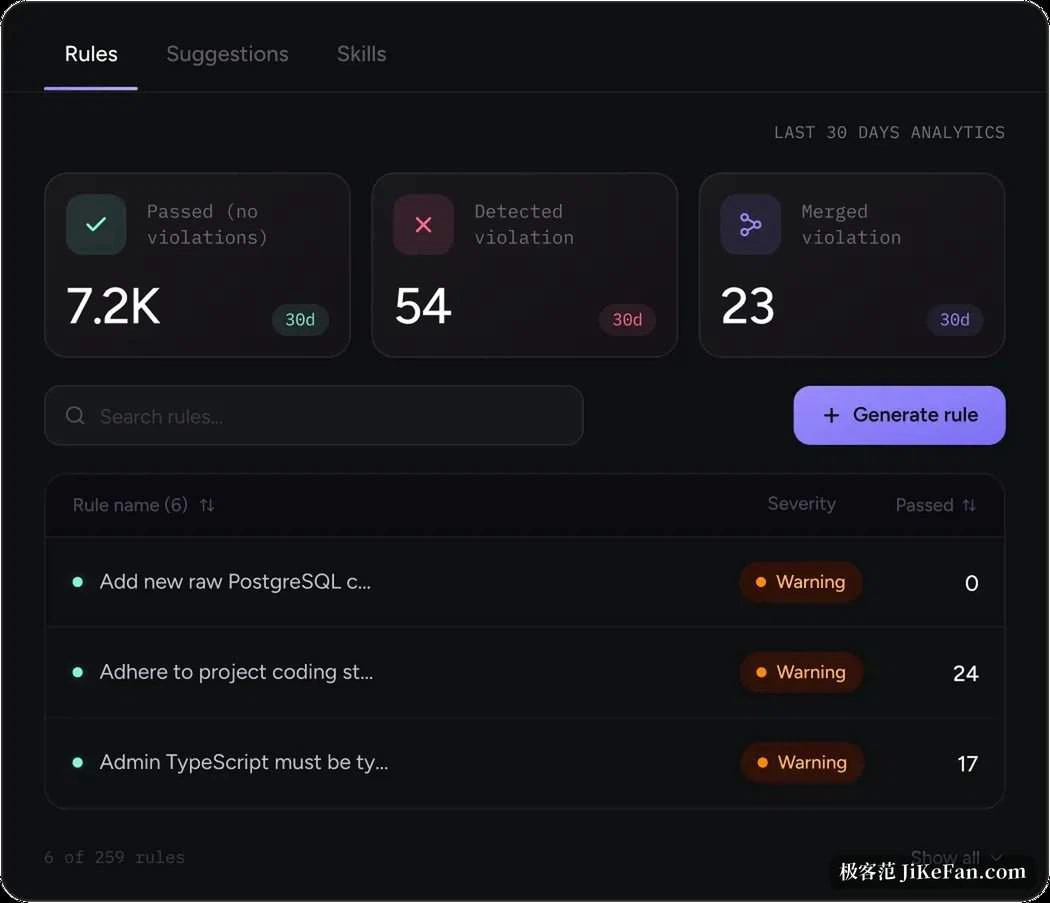
That review is systematic in a way a first human pass rarely is, catching what a busy reviewer scrolls past. Teams can also point it at security, performance or house style specifically.
The recent focus has moved up a level, to governance. Team standards can be condensed into a rule system, and self-learning rules mine patterns and conventions out of the codebase and the pull request history, turning them into machine-readable standards that every developer, reviewer and agent has to respect. Compliance is monitored, so violation trends and fix rates become visible instead of anecdotal.
Underneath sits a context engine. Repository structure, past pull request discussion and ticket requirements are pulled together so a change can be judged by its blast radius across repositories rather than by the diff alone. Engineering teams at NVIDIA and Microsoft use it for quality management.
Only the context needed to generate tests is analysed, traffic is encrypted with SSL, and the product holds SOC 2 Type II. Enterprise customers can run it on their own infrastructure, use private models or bring an LLM key.
Pricing takes three shapes. Developer is free: 75 credits a month, local review in the editor, review of Git pull requests and a command line plugin. Teams costs 30 dollars per person on annual billing, with 2,500 credits each, private support and no data retention. Enterprise is quoted by sales and adds a multi-repository context engine, SSO, isolated deployment and dedicated models. Most model requests cost 1 credit; a premium model such as Claude Opus costs 5 and Grok 4 costs 4. Credits reset every 30 days from the day of first use, and annual billing saves around a fifth against monthly.
The positioning is clear-headed: no completion, only quality. If an assistant is already writing code for you, this is the inspection partner standing next to it. An individual can start by pointing the free tier at an old codebase that never had tests, and a team has a reason to try Qodo Merge and stop giving every pull request a manual first read.