
rotki: the asset ledger that stays on your own machine
Summary
An open source ledger for holdings that keeps everything on your own computer: positions across exchanges and chains are gathered into one view, chain activity is turned into readable events, and four costing methods produce a profit and loss report. Data lives in an encrypted database on the machine, nothing is uploaded.
Recommend- Name
- rotki
- Version
- 1.44
- Open source
- Open source
- Operating system
- WindowsmacOSLinux
- Website
- https://rotki.com
- Updated
- 2026-10-05 15:29
The ledger lives on your own computer
Most portfolio tools are cloud services: the trade history and the wallet addresses are handed to somebody else's server, and the operator can see exactly what is held and what was bought or sold. rotki takes the opposite line. It is an open source tool for tracking holdings and doing the accounting that goes with them, and the entire data set lives in an encrypted database on your own computer. Nothing is uploaded and no email registration is needed. The project has been in development since 2017, the source code is fully public in the official repository, and the calculation logic that more than twenty thousand commits have accumulated can be audited at any time. It installs on Windows, macOS and Linux, and a container deployment is offered as well for anyone who prefers to run it that way.
Several places, one dashboard
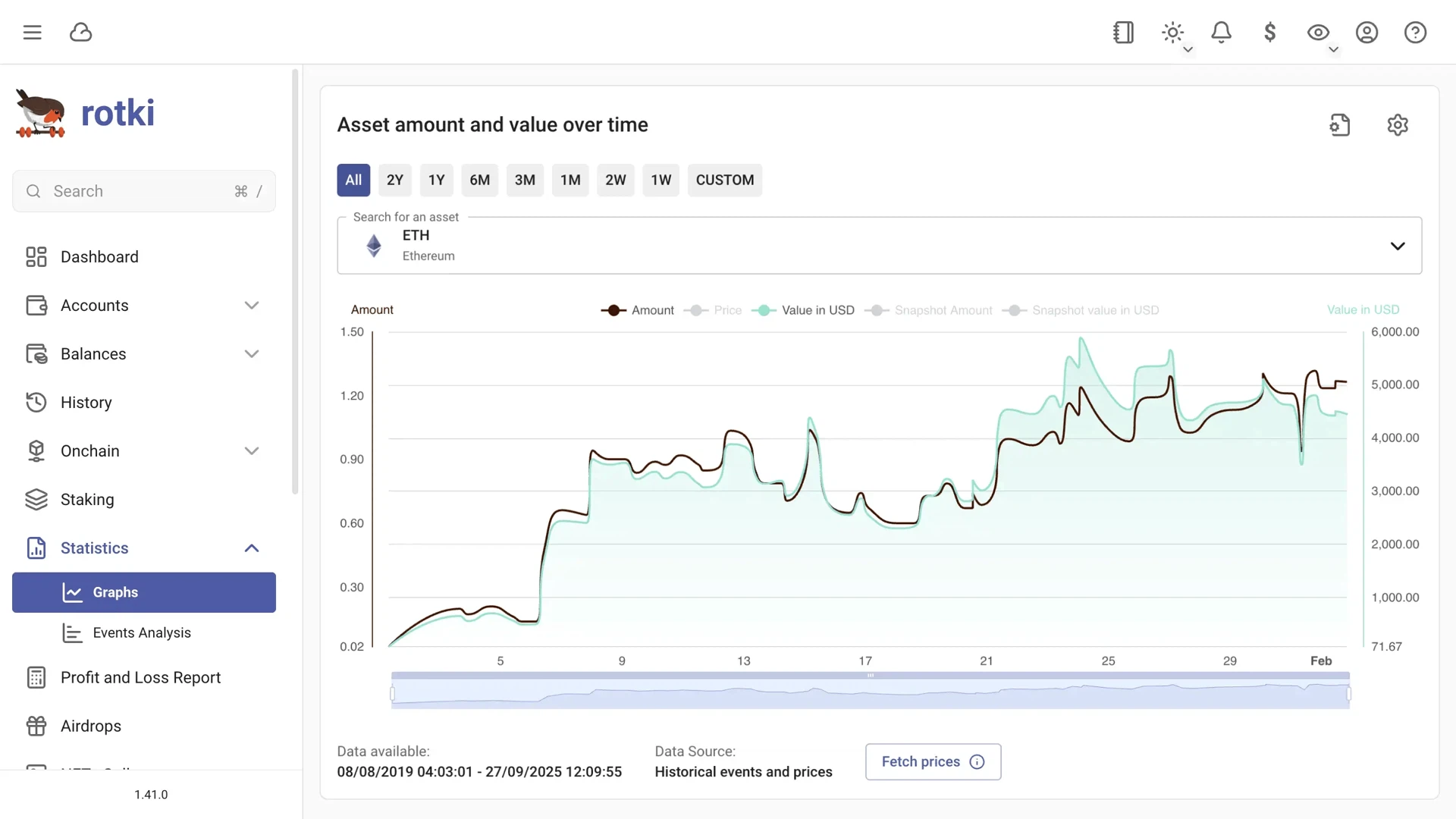
Connecting an exchange means configuring an interface key with read-only permission, and that key never leaves the machine. A chain wallet is added by typing an address, and a name registered as an alias is recognised as well. Assets held on close to thirty centralised exchanges and on more than a dozen mainstream chains can be gathered into one place, and the dashboard shows total net worth, the share each asset takes, the liabilities side, and a curve of net worth over time. Complicated activity in decentralised finance is decoded automatically into readable event records, so a swap, a transfer and a liquidity operation can be told apart at a glance, and positions forgotten long ago can be dug back out. The interface switches between a light and a dark theme, and the presentation is clean.
A profit and loss report built for bookkeeping
The accounting side is the core of it. Choose an accounting period and a costing method, of which four are offered: first in first out, last in first out, highest in first out, or average cost. The result is a complete profit and loss report in which every taxable event has its detail line, and it can be exported as a file to hand to an accountant. The report is produced on the machine, and no data leaves it during the process. One thing should be clear: what it provides is the ability to calculate and to report. It does not stand in for professional tax advice, and the forms each country requires still have to be filled in by the person filing them.
Staking and airdrops are watched as well
Beyond purchases and sales, there are dedicated views for the passive side: staking income, airdrops, liquidity rewards. A staking overview lists the yield period by period, and a scan of historical airdrops can point out rewards that were probably missed or never claimed. A platform without a ready interface can be covered by importing a table file instead, and details such as the time zone are configurable. On the security side, the local encrypted database is something the owner has to back up; a lost key cannot be recovered by anyone, and that is the other face of a design that keeps everything local.
Why the source being open is not decoration
For a ledger, that is not a pose. When a profit and loss figure is questioned, it has to be possible to follow the line back: which costing method was applied, how one particular event was treated. An open repository with more than twenty thousand commits behind it means a third party can follow that line too. The container option belongs to the same argument: keeping the data on your own machine is one thing, and deciding where the process itself runs is another.
A free core, a subscription for the deeper parts
The basics are free for an individual: gathering assets, the history of events and the profit and loss calculation all work, with some range limits on the deeper data. A paid subscription unlocks a longer history of net worth, more protocol decoding and encrypted synchronisation through the cloud. As of September 2026 the current release, 1.44, had appeared shortly before, bringing a local interface to artificial intelligence models, pairing of cross-chain bridge transactions, and an editor for balance snapshots. The pace is brisk: the public repository alone has passed a hundred and thirty releases. For anyone whose holdings are spread across several places and several chains, and who would rather not hand financial privacy to a third party, this local-first shape deserves serious consideration.