REAPER: keep the budget for the music instead
Summary
Music software tends to start at four figures. REAPER went the other way: a sixty-day trial with nothing removed, a personal licence at sixty dollars, and free upgrades through the whole major version.
Recommend- Name
- REAPER
- Version
- 7.78
- Pricing
- Paid
- Open source
- Proprietary
- Operating system
- WindowsmacOSLinux
- Website
- https://www.reaper.fm/
- Updated
- 2026-10-07 20:03
The price of the software is a decision about the music
Music production software tends to start in the four figures, and the subscription model has made that a permanent monthly cost rather than a purchase. For a studio with clients that is a line item. For the person writing songs in a spare room, it is the difference between a microphone they can afford and one they cannot, and the arithmetic is not close.
REAPER took the opposite position and has held it for years. The trial is sixty days with nothing removed: not a save limitation, not a nag screen, not a disabled export. When you decide to buy, a personal licence is sixty dollars and a commercial one is two hundred and twenty-five, with free updates across the whole major version series rather than an annual renewal. The feature set is not the reduced one that such pricing usually implies. Multitrack recording, mixing, mastering and scoring to picture are all present, third-party plug-in compatibility is broad, and a small team or an individual studio can use it as the main tool rather than a compromise.
Light, rearrangeable, and updated constantly
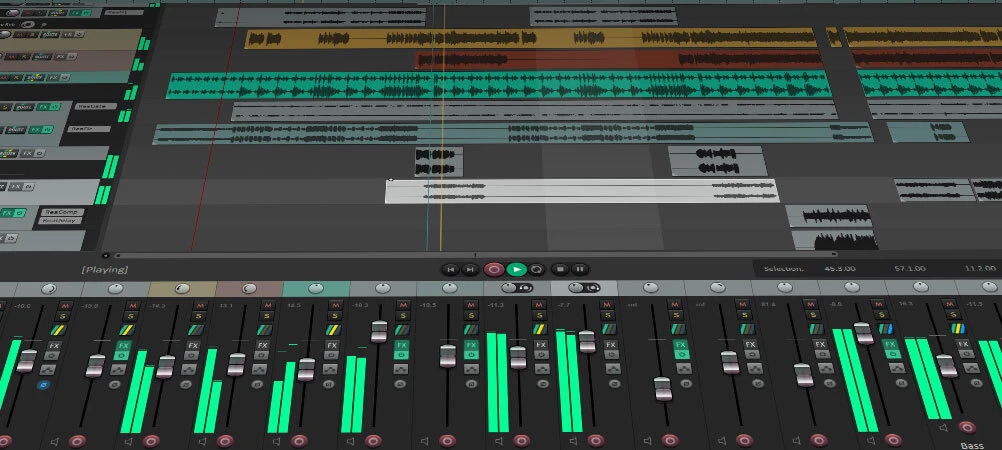
The engineering character shows in three places. The installer is small and the resource use is light, so an older laptop can still carry a large project without the interface stuttering under its own weight. The interface is fully rearrangeable: panels can be assembled around the way you actually work rather than around the way a designer imagined you working. And the scripting layer, together with the packages the community shares, automates the repetitive parts until the ceiling of what can be customised stops being visible.
The update rhythm is famous in its own right. Dozens of minor versions have rolled forward to version 7.78 in 2026, and each one carries real improvements rather than a marketing badge, which means a single payment keeps improving for years. That combination, cheap and actively developed, is rare enough that people who do not make music tend to assume it is not true.
It demonstrates that a professional tool does not have to be expensive: no reduction in features, no pause in updates, no traps in the pricing. It returns the choice to the person making things: try it first, pay when you think it is worth it.
What the first hour actually looks like
The default interface is plain, and it is worth spending an hour rearranging it along the lines of a tutorial before judging the program. This is not a defect, it is the consequence of a layout system that lets you build your own; the price of that freedom is one session of setup. Following a tutorial for that first hour is the difference between a tool that feels awkward and one that feels built for you.
The Chinese-language community material is extensive, with ready-made templates for arranging, podcast production and voice work, so the first useful result does not require inventing a workflow from nothing. It runs on the three desktop platforms, Windows, macOS and Linux, which matters if your studio machine is not the same as your writing machine.
For anyone serious about audio who does not want to pay for a subscription indefinitely, this is the rational first recommendation. Not because it is free, since it is not, but because the amount you pay is proportionate to what you get, and the trial lets you establish that for yourself before any money changes hands.