
PixVerse splits its models in three, and V6 turns one prompt into a finished 15 second cut
Summary
One generation now yields a quarter-minute clip at full HD with several shots and its own dialogue, effects and ambience, and the frame shape is fixed before the render instead of cropped after. A separate line pushes the same engine toward worlds that keep answering input.
Recommend- Name
- PixVerse
- Version
- 20260916
- Pricing
- Free
- Open source
- Proprietary
- Operating system
- WindowsmacOSiOSAndroid
- Website
- https://pixverse.ai/
- Updated
- 2026-10-04 23:22
PixVerse builds its own video foundation models and organises them into three lines. V6 handles clip generation, C1 aims at film production, R1 points at realtime interactive worlds. The vendor states the split plainly: V6 for precise control and native artistic expression, C1 for cinematic control and physical simulation, R1 for high-fidelity human likeness, motion aesthetics and commercial synchronisation.
V6: 15 seconds at 1080p, with the sound made in the same pass
The model page lists four capabilities. First, 15 second 1080p generation — longer and steadier continuous footage, which means fewer scraps and less manual joining. Second, native multi-shot: wide, medium, close and the transitions between them come out of one generation, so the narrative structure arrives already assembled. Third, native audio, with dialogue, effects and ambience produced together. Fourth, aspect ratio control, so 16:9, 9:16 or another delivery shape is fixed before generation rather than cropped afterwards.
Read as a set, those four answer one question: can a single generation go straight out? Long enough, structurally shot, carrying its own sound, already in the right frame. The page also advises aligning output settings with the channel up front instead of fixing the frame at the end.
Text or image as the starting point
The FAQ is explicit that V6 works from a text prompt and can also animate a still. Text-to-video suits a new concept; image-to-video suits a product shot, a character design, a photograph or a visual reference already in hand. Results lean on input quality, so the vendor asks for images with a clear subject, readable edges and strong composition, and for the prompt to state whether the camera pushes in, pans, tilts, tracks or orbits. Holding a character together comes down to repeating the same identity anchors — hair colour, garment, accessory — in every shot.
The leaderboard figure and the per-minute price
The comparison area on the site cites a third-party image-to-video leaderboard dated 2 April 2026. V6 sits at an ELO of 1,343 with an API price of 4.80 dollars per minute. The same chart carries four comparison rows: 1,333 points at 4.20 dollars, 1,298 at 13.44, 1,291 at 9.00, and 1,195.5 at 18.00.
Two caveats matter. Metric definitions, sampling dates and other vendors' list prices all move, and this is the vendor's own presentation of third-party data, so a budget should be checked against the page at the moment of purchase rather than copied from a chart.
C1 and the surrounding tools
C1 is positioned as a full-stack creation engine for film work. Around the models sit five entry points: the web app for ordinary video work; an agent that turns an intent expressed in conversation into a workflow and can produce several shots at once; a marketing centre aimed at advertising and commerce with a guided path to a publishable spot; Canvas, an editable graph linking references, prompts, motion and final cuts; and a CLI that takes prompts, reference assets, output ratios and batch jobs from the terminal.
A second layer holds lighter tools — templates, lip sync, a sound effect generator, local image editing, outpainting and clip extension among them. The shape of the product is therefore not a chat box that returns video but a platform that owns everything from preparing assets to shipping the cut.
R1 and R2: generation as a world you can enter
The R line reaches further. The announcement dates R1 to January 2026 and calls it a realtime world model, turning generation from a one-off output into a stream that keeps answering input; three months later R1 gained shared worlds and personalised avatars, so several people can step into the same generated world and shape it together.
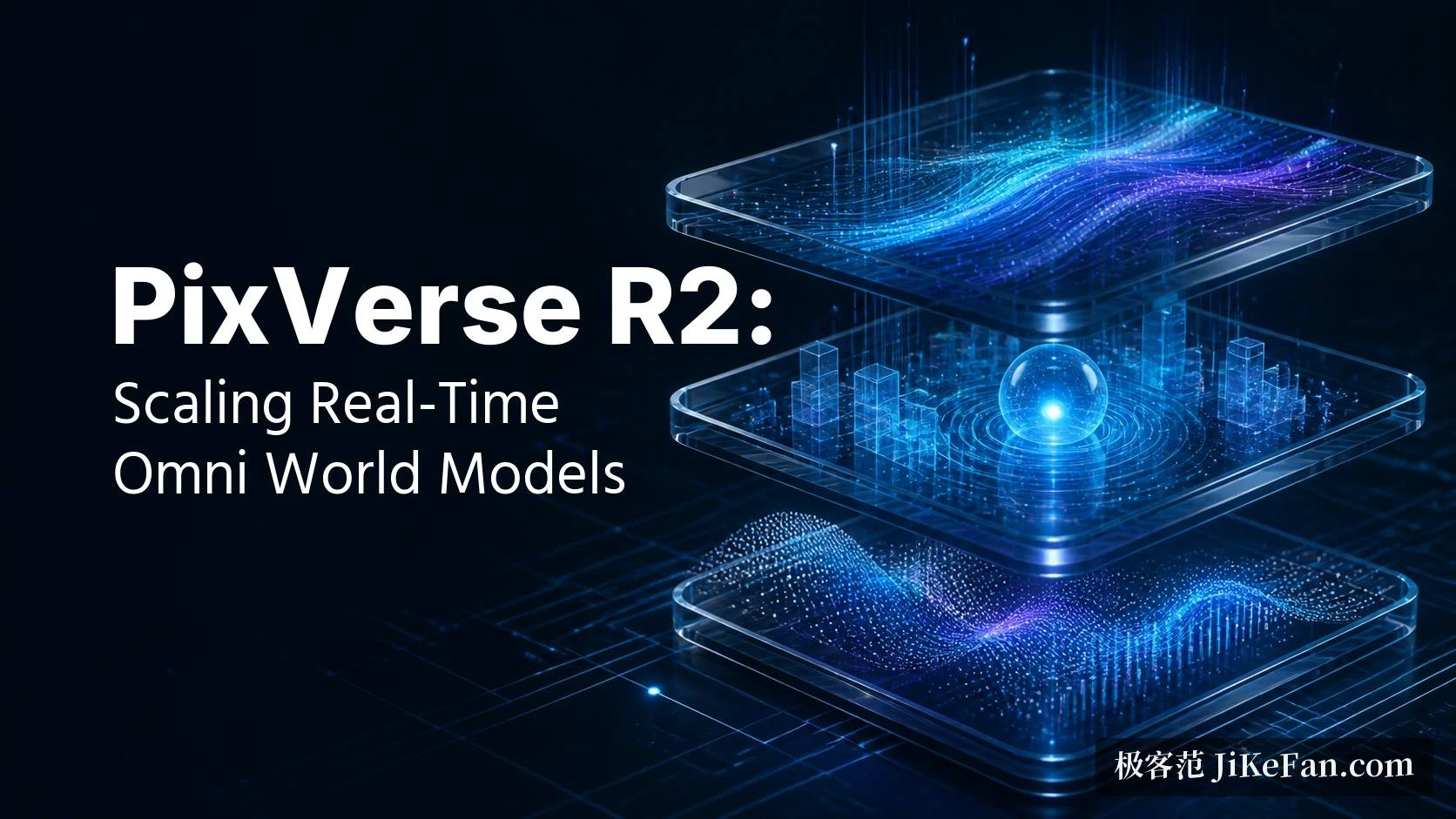
An August 2026 research post explains how R2 got there. Conventional long-video and realtime stacks run through roughly five training stages, and every hand-off costs quality and long-horizon stability. R2 collapses that into two: an Omni Causal AR model is pretrained continuously as a unified world model, then that same causal base is distilled straight into a realtime model, on the principle of speeding up without relearning. To keep identity and scene intact across long runs, R2 splits memory into three channels — Sink Memory holds persistent anchors such as character identity, environment, style and world rules; Rolling History records recent motion, pose, camera behaviour and environmental change; Object KV Cache reuses object-level history.
One more design deserves its own line. An Error Bank stores representative failure states and replays them during training alongside normal history, so a model that has drifted away from the entered world state can still recover. The internal figures quoted are a long-horizon brightness drift measure falling from 0.201 to 0.129, a 35.8 percent improvement, with 20 of 29 long sequences improved, and attention sparsity above 90 percent in internal tests. All of it is the vendor's own staged evaluation, not an independently reproduced result.
Enterprise access and the API
Developers reach PixVerse through an open platform. The documentation promises video output up to 1080P and, on the fast path, an average render of about 10 seconds with a best case of 5. It describes the base as a fully in-house video foundation model and the audience as more than 100 million creators and businesses across 175 countries. Endpoints cover text-to-video, image-to-video, effects, lip sync, transitions, extension, camera moves, sound, blending, wardrobe and motion control.
Third-party models also live in the same workspace, and five of them appear in the model list, image and video alike. One video model there takes 4 to 30 second clips and, in reference mode, up to 50 reference assets split into 30 images, 10 videos and 10 audio tracks. Placing rivals side by side turns the choice of model into an in-platform comparison.
Games and interactive entertainment
The same announcement extends R1 into games. The game engine separates mechanics from visual expression: players interact in natural language and the world answers in both look and behaviour without being limited to pre-authored options. A realtime interactive stream is part of the same release, with AI-generated characters responding to viewers as they type.
Boundaries
15 seconds and 1080p describe a single V6 generation; longer cuts still need several segments or the extension tool. The leaderboard and the per-minute prices come from third-party data the vendor reproduces, sampled on 2 April 2026, and quotes move, so check the live page before buying. The drift reduction and the attention sparsity figure are internal staged results, not third-party benchmark scores. And commercial rights depend on the subscription tier — the model page tells teams to confirm their plan before publishing paid or client-facing work, while generated material must also respect community rules and local law.
Summed up: three lines that do not overlap. V6 makes a single generation usable as a finished unit — 15 seconds, 1080p, several shots, its own audio, the frame chosen in advance. C1 aims at film-level control. R1 and R2 push generation toward a realtime audiovisual world you can keep interacting with. Underneath sit an API spanning more than ten capabilities and a workspace where competing models can be compared side by side.