
Wan walks from an 8.19 GB video model to a 27B dual-expert MoE, all in the open
Summary
Two experts of about 14B each add up to 27B, yet only one fires per step, so the cost stays near a single-expert model. A separate 5B branch keeps 720P at 24fps inside a single consumer card, and compression in the VAE is what buys the room.
Recommend- Name
- Wan
- Version
- 20260916
- Pricing
- Free
- Open source
- Open source
- Operating system
- WindowsmacOSLinux
- Website
- https://wan.video/
- Updated
- 2026-10-06 17:14
Wan is the open video model line from Alibaba Cloud, with weights and inference code published under Apache-2.0. It starts at Wan2.1 in February 2025, reaches Wan2.2 with a mixture-of-experts architecture that lifts total parameters to 27B, then branches into audio-driven generation, character animation and music-to-dance specialists — while keeping a light path that still runs on a consumer graphics card.
Wan2.2: bringing mixture-of-experts into video diffusion
The technical report puts the core idea in its first paragraph: MoE is brought into the video diffusion model. The A14B series uses two experts — a high-noise expert for the early denoising steps where overall layout is settled, and a low-noise expert for the later steps that refine detail. Each holds about 14B parameters for roughly 27B in total, but only about 14B is active at any step, so compute and memory stay close to a single-expert model. The handover point is decided by signal-to-noise ratio: denoising begins at a low SNR with high noise, so the high-noise expert runs, and the threshold step sits at half of that low SNR value.
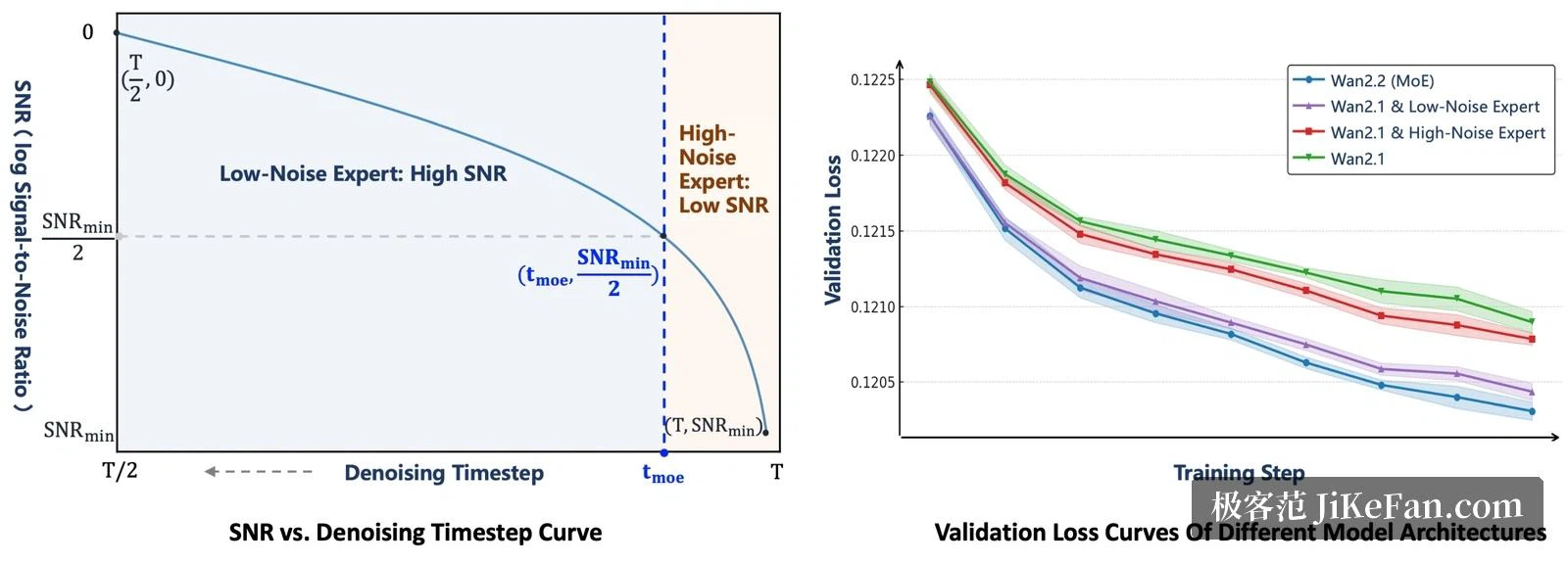
Architecture is not the only variable this generation changed. The report states that against Wan2.1, Wan2.2 adds 65.6% more images and 83.2% more video, aimed at generalisation in motion, semantics and aesthetics. Aesthetic data is also tagged along separate axes — lighting, composition, contrast, colour tone — which makes a cinematic look something you can ask for rather than hope for.
The 5B branch: 720P at 24fps in a consumer card
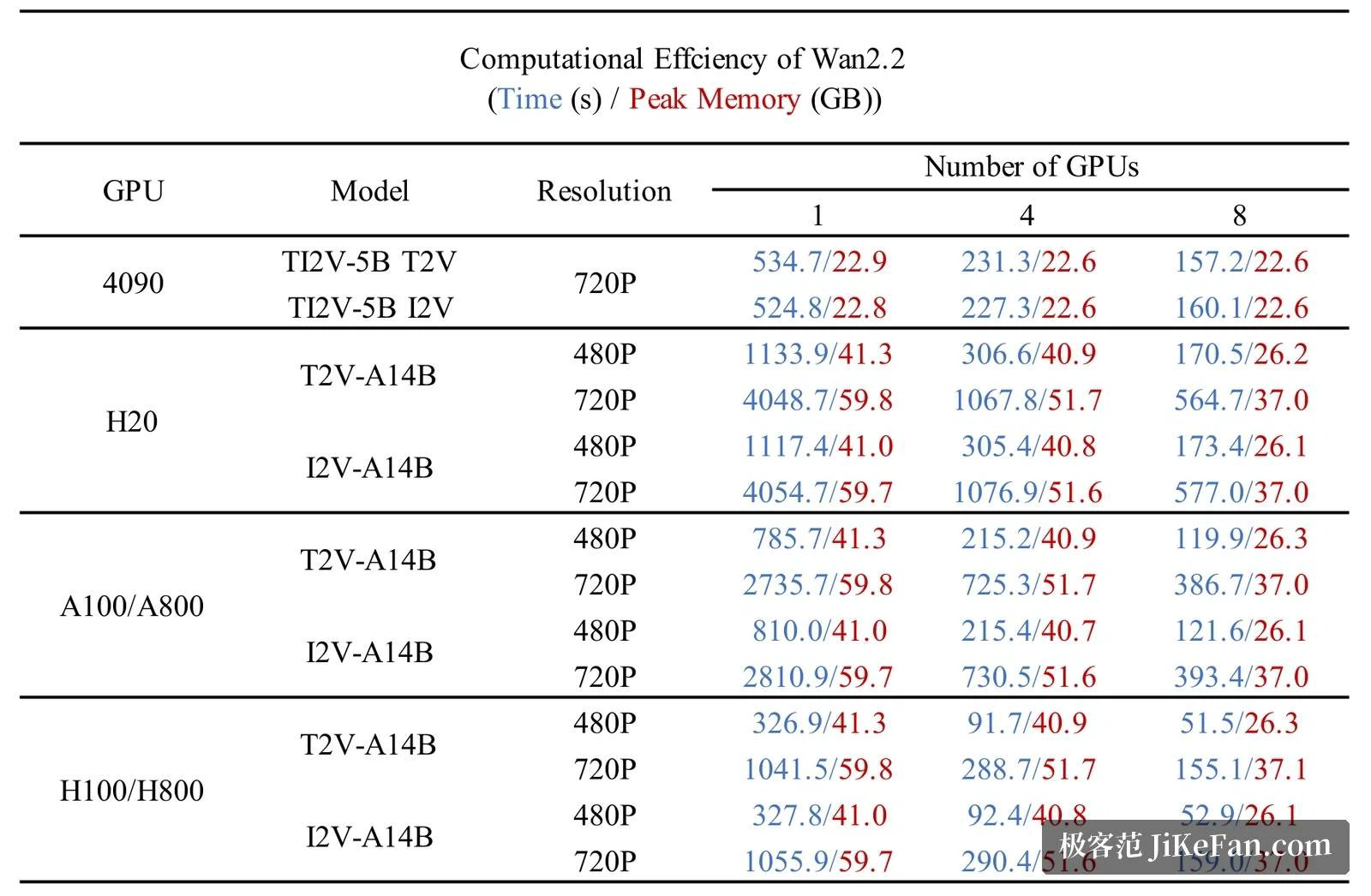
TI2V-5B is the friendlier path for individual developers. It folds text-to-video and image-to-video into one model, supports 720P output at 24fps, and runs on a consumer card such as a 4090. The published efficiency numbers translate straight into cost: on one 4090 a 720P text-to-video job takes about 534.7 seconds with peak memory around 22.9 GB, while image-to-video takes about 524.8 seconds at roughly 22.8 GB. Spread the inference over 8 cards and those times fall to about 157.2 and 160.1 seconds.
The compressed VAE that buys the memory
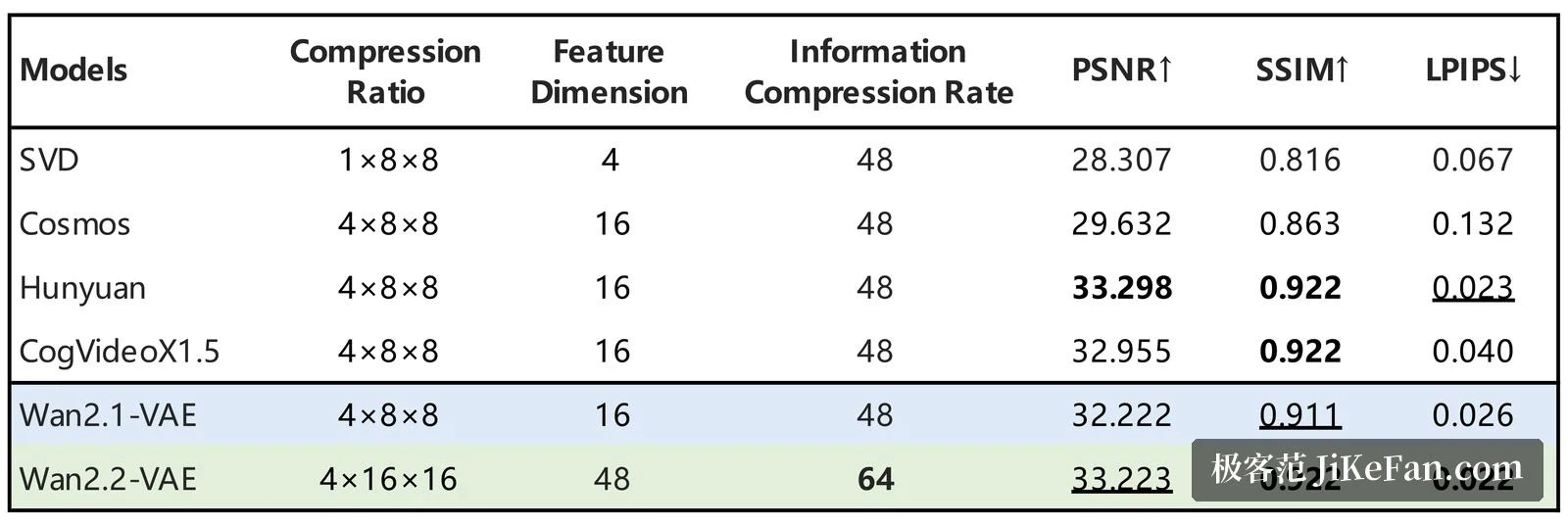
What lets a 5B model fit on a consumer card is largely the compression ratio of the video VAE. Wan2.2-VAE works at 16×16×4, a higher multiple in both time and space; the comparison table puts Wan2.1-VAE and several peers at 4×8×8. At a compression factor of 64, Wan2.2-VAE also lifts reconstruction PSNR from 32.222 to 33.221, with SSIM and LPIPS improving slightly as well. Higher compression without worse reconstruction is the direct reason one card can handle a higher resolution.
The efficiency table across cards
The repository ships a table of seconds and peak GB per configuration. Beyond the 4090 rows, the A14B tier runs 720P text-to-video on an H20 in about 4048.7 seconds at 59.8 GB on one card, dropping to about 1067.8 seconds at 51.7 GB across 4 cards. The repository also warns that the default single-card command for A14B needs a GPU with at least 80GB, and that model offload plus dtype conversion can trade speed for capacity when memory is short.
Three specialist lines: audio, character, dance
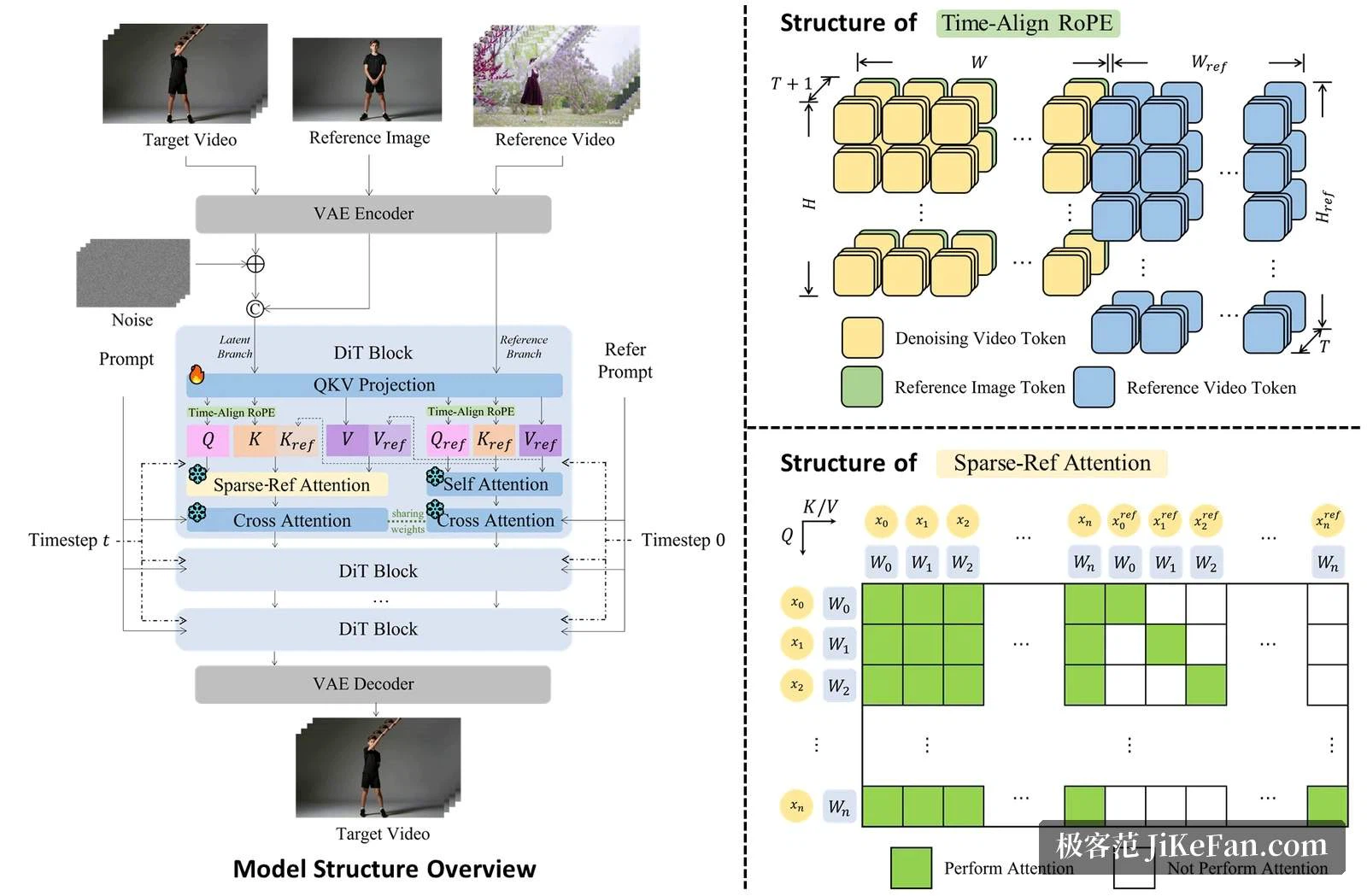
After Wan2.2 the open line splits into sharply targeted work. Wan2.2-S2V-14B, released on 26 August 2025, is the audio-driven video model, shipped with inference code, weights and a technical report across 480P and 720P. Wan2.2-Animate-14B followed on 19 September 2025 for character animation and character replacement, again with weights and code, and it was integrated into Diffusers on 13 November 2025 after arriving in ComfyUI earlier.
Wan-Animate-2, released on 7 August 2026, pushes that direction further: an end-to-end character animation framework that feeds the driving video straight into a redesigned Diffusion Transformer and removes the intermediate motion extractor, which buys fidelity in motion and identity. A second addition is text-driven viewpoint control that decouples the output camera from the driving clip. A Lite variant trims inference latency to the realtime threshold for streaming animation.
Music-to-dance is open-sourced separately as Wan-Dancer. The framework produces dance footage longer than a minute at 720p and 30fps across five styles including classical, street and Latin. It splits generation into global keyframe planning and local temporal refinement, then uses time-mapped positional encoding and a flow loss to hold long-range stability. The tested environment is 8 A800 80GB cards, the steepest requirement among these specialists.
Looking back at Wan2.1: 8.19 GB and bilingual text
Wan2.1 is where the line began, and it explains why the light branch matters. The T2V-1.3B build needs only 8.19 GB of memory, which puts it on nearly every consumer card; on an RTX 4090 it renders a 5 second 480P clip in about 4 minutes without quantization or other tricks. The tiers cover T2V-14B at 480P and 720P, I2V-14B in both 480P and 720P, T2V-1.3B at 480P, FLF2V-14B at 720P, and VACE in 1.3B and 14B versions.
Capability runs wider than text and image input: video editing, text-to-image and video-to-audio are all included. The vendor lists Chinese and English text rendering inside generated video as a selling point, and notes that Wan-VAE can encode and decode 1080P footage of arbitrary length while keeping temporal information. Those two traits are why so much downstream work uses it as a base.
Licence, weights and integration
The organisation page states that all 6 public repositories under the name use Apache-2.0, covering Wan2.2, Wan2.1, Wan-Dancer, Wan-Animate-2, Wan-skills and a Diffusers branch. Wan2.2 carries about 17.5k stars and Wan2.1 about 17k. Weights are published on both Hugging Face and ModelScope and can be pulled locally with the matching command-line tool. For a team, licence and distribution channel decide whether the model can enter an internal pipeline, and both are visible on the repository front page.
The community layer
Third-party work around the line has reached real scale. What the README collects includes light inference frameworks, one that runs on a current flagship card and another on an 8GB 4060; an optimiser offering layer-by-layer offload, FP8 quantization, sequence parallelism and LoRA training; sparse-attention and caching accelerators; a ComfyUI wrapper; and a group of prompt-relay and long-video projects. A separate Wan-skills repository packages model abilities as skills an agent can call — generating and editing with an image model, or turning a document into slides, for example.
Boundaries
All timings and memory figures come from the official efficiency table, measured under specific parallelism and attention implementations, so your own machine will differ. A14B needs more than 80GB on a single card to run the default command; the 5B branch is the realistic choice for a consumer card. Hardware demands vary widely between specialists — Wan-Dancer was measured on 8 A800 cards. And licence and commercial terms should be read from the licence file in the repository, with rights on depicted people and source footage checked separately.
Summed up: the value of this open line is not a single score. It is a gradient — 1.3B gets an 8GB machine to produce footage, 5B uses a high-compression VAE to reach 720P at 24fps on one 4090, A14B lifts total parameters to 27B through a dual-expert MoE without raising per-step cost, and above that the audio, animation and dance specialists answer three concrete problems.