
HeyGen separates who you are from how you look, so one avatar holds across 175 languages
Summary
Fifteen seconds of webcam footage is enough to build a presenter that survives a change of set, a change of clothes and a change of language. What makes that work is not a better face but an identity signal lifted across frames and kept apart from appearance.
Recommend- Name
- HeyGen
- Version
- 20260916
- Open source
- Proprietary
- Operating system
- Web
- Website
- https://www.heygen.com/
- Updated
- 2026-10-06 06:56
What really eats the time in a talking-head video is rarely the script. It is the lamps, the touch-ups, the three shirt changes, and saying the same paragraph to the lens one more time. A digital presenter is meant to remove that loop, and for several years it kept failing in the same place — a single frame looked fine, a sequence gave it away: the face drifted when the background changed, the lips slipped out of step on a longer take, and a second language broke it outright.
HeyGen is one of the faster-moving platforms in that field. Its current model, Avatar V, makes a plain offer on the product page: record 15 seconds of webcam footage, get a presenter that holds together across scenes and can speak more than 175 languages and dialects. The distance between an avatar that looks right and one that is right comes down to two words in that sentence — consistent, and multilingual.
The test was never a single frame
Character consistency is the first capability listed on the Avatar V page, and the wording is blunt: consistency is the line between a usable avatar and a gimmick. The page defines it as the same face, the same micro-expressions and the same presence holding up in a 30 second clip and in a 10 minute course module — no drift, no artefacts, no slide into the uncanny valley.

Behind that sentence sits a change of method. Earlier versions largely drove one face from one photograph, and a single reference frame can only carry so much identity. Avatar V works over the context window of an entire reference video, letting the model choose the moments in the recording that carry more information.
Lifting identity out of appearance
The page explains the new model as a separation of two things: who you are, and what you look like. What the model learns is the specific way you move, gesture and show emotion, and that learned motion can then be applied to any version of you. In practice that means one recording, no matter what you wore or where you stood, and afterwards the avatar can appear against any background, in any garment, in any styling.
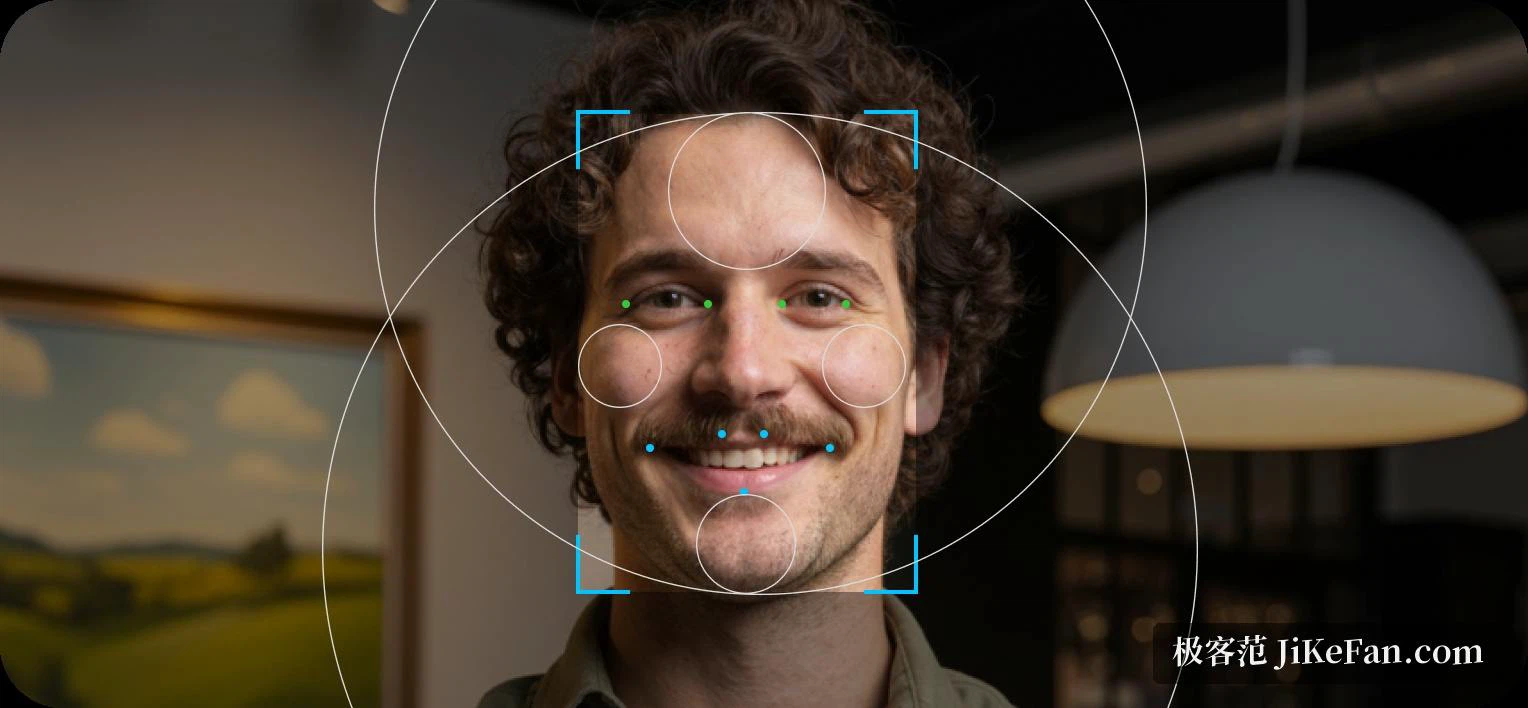
The mechanism is selective attention: the model pulls identity signals such as mouth geometry, facial structure and expression transitions out of many frames, while actively suppressing frames with poor pose, lighting or occlusion. The resulting identity representation spans frames and carries time. The problem it targets is named identity drift — the slow divergence between reference identity and output in single-frame conditioned models — and the claim is that stability across scenes, camera positions and long durations comes without extra fine-tuning or added reference input.
The published figures put long-video consistency beyond 30 minutes, with no cap on duration or quality at generation time. Training is described in three stages: learn to copy facial appearance faithfully inside one scene, fine-tune across scenes to absorb differences in background, lighting and pose distribution, then use reinforcement learning with a human preference reward to push identity similarity higher.

Video Agent: one prompt, a finished cut, still editable
A presenter solves the problem of you being on camera. A second product line solves where the video comes from. Video Agent takes a prompt and returns a finished piece, and the emphasis is that it does not just output a talking head: motion graphics, visual overlays, explanatory animation and B-roll are organised into the narrative, so script, voice, visuals and transitions all happen in the same generation.

The more interesting part is editability. Every dynamic element stays editable after rendering — text, position, colour, timeline, layout can be changed inside AI Studio, so fixing one line does not mean re-rendering the whole video. There is also a preview before publishing, with the concept broken down by scene and further changes made in natural language. Those two together mark the difference from a one-shot generator where an unhappy result means starting over.
Translation changes more than the voice
Multilingual output is the natural extension for a digital presenter, and it is the area HeyGen was first known for. The translation page describes the flow: upload a local file or paste a link to an online video, pick an engine and a target language, and the platform handles translation, dubbing and lip alignment without a reshoot or manual mouth matching. Timbre, mouth movement and expression of the original speaker are kept.

One operational detail is worth remembering: up to 10 languages can be selected per run, so a single master can be pushed out in parallel instead of queued one at a time. Brand control has its own design — the upgraded glossary supports forced translations, protected terms and pronunciation fixes, so a term set can be built, translations adjusted, and several language versions produced from one video. A video collection can also carry a multilingual player for embedding into a page or an LMS.
Verification is a precondition, not a patch
Trust is unavoidable in this category. HeyGen puts identity verification at the very start of creation: every custom avatar requires the person being filmed to complete on-camera verification, and no verification means no avatar. Deletion requests from that person are always carried out. On the content side there are two layers, machine scanning and human review, with violence, political campaigns and harm to minors named as hard lines.
What the plans actually allow
The free plan produces 3 videos a month with a 1 minute cap each, enough to test the result. Creator starts at 29 dollars a month, raises the per-video limit to 30 minutes, adds 1080p export and voice cloning, and lifts language coverage past 175. Pro starts at 49 dollars a month, with 4K export and faster processing as the main differences. Business starts at 149 dollars a month and adds more custom avatars, seat management and collaboration. The larger the team, the more the seat-plus-credit design needs an estimate of usage before committing.
Structurally, HeyGen pulls three jobs that used to live in separate tools — building the avatar, producing the cut, localising it — into one pipeline, and that is the more complete part of the product. The caveat is that quotas and concurrency are tiered, so a team with heavy output should work out its credit burn from real production frequency before choosing.
The real threshold for a digital presenter was never whether one frame looks convincing. It is whether the face still holds after a change of scene, of length and of language. Avatar V addresses consistency by treating identity separately from appearance, while Video Agent and translation close the rest of the road from script to a finished piece in several languages.