
Huozige V12.0 Update 1 puts AI to work on screens and devices into work orders
Summary
Huozige V12.0 Update 1 lets AI generate data tables, screens and server side commands, adds OPC UA device connections and multi Gantt scheduling, and supports HighGo, DM and the MCP plugin ecosystem.
Recommend- Name
- Huozige
- Version
- 12.0-update-1
- Open source
- Proprietary
- Operating system
- WindowsLinux
- Updated
- 2026-11-01 15:51
The hard part of low-code sits in the execution layer
Low-code platforms tend to look excellent in a demo. Drag a few forms together, point them at a table, and the application runs. The trouble starts once a real enterprise project is underway, and it usually appears in the execution layer: the business side describes an action, the developer has to break that action down into table structure, screen interaction and server side logic, and that middle step still depends on a person writing it. Huozige, an enterprise low-code platform from GrapeCity, spends V12.0 Update 1 shortening exactly that link, bringing AI into the path from requirement to running application while also wiring device data into business applications.
What the AI produces is more than an interface
In V12.0 Update 1, once a business requirement has been described clearly, the AI can generate data tables, front end screens, server side commands and server side notifications; JavaScript, SQL execution, and the creation or editing of views are all open to generation as well. One design decision is worth noting. On the front end the AI writes code, which leaves room for a personalised interface; on the server side it produces the standard commands the platform already has, so business processing stays inside the engineering system the team knows, and later inspection, configuration and changes do not have to go around the platform. For new demands on a legacy system, the AI can add screens and logic to the existing project rather than pushing for a rewrite. Project analysis, problem tracing and the built in knowledge base are supporting pieces, aimed at everyday questions of the where is this logic implemented kind.
Agents working with outside tools
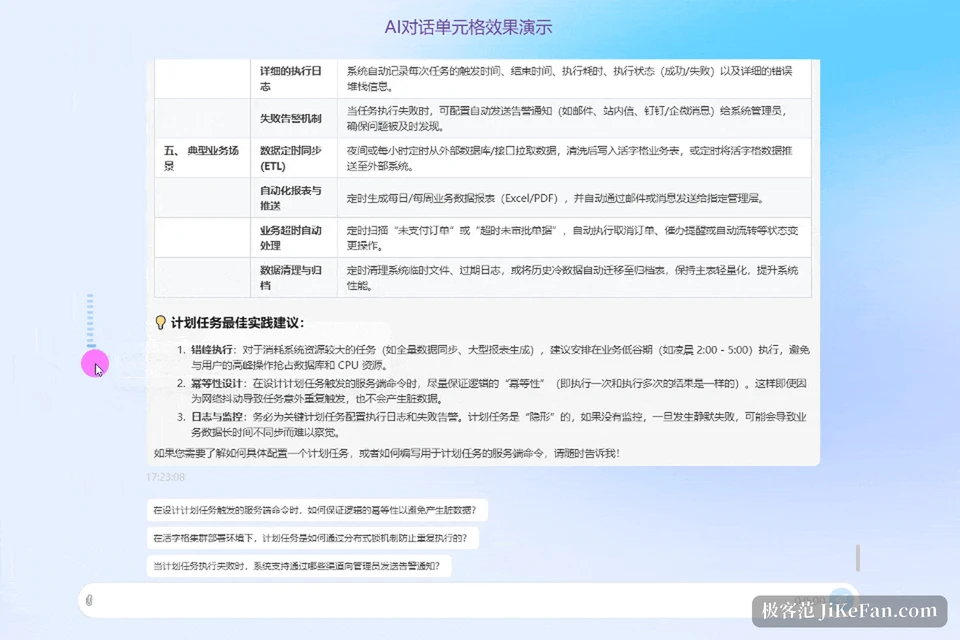
Through MCP the AI can consult the screen structure while helping to build, and it can run front end tests that check whether interaction and styling have drifted. Front end AI coding accepts third party libraries, so specialised tables, three dimensional views, maps and calendars can be pulled into a business screen and combined with project data into an interaction that fits the job at hand. External AI development tools can take part in creating a project as well: describe the requirement in a conversation and a Huozige project comes out, which shortens the distance between having thought it through and having something clickable. The agent side of the update is mostly about experience: the reasoning trace can be expanded or folded away, long conversations offer message previews and quick jumps, files can be dragged in and previewed online through the file management plugin, and when the AI assistant is used to orchestrate a workflow the result streams into the conversation.
Device data enters the business application
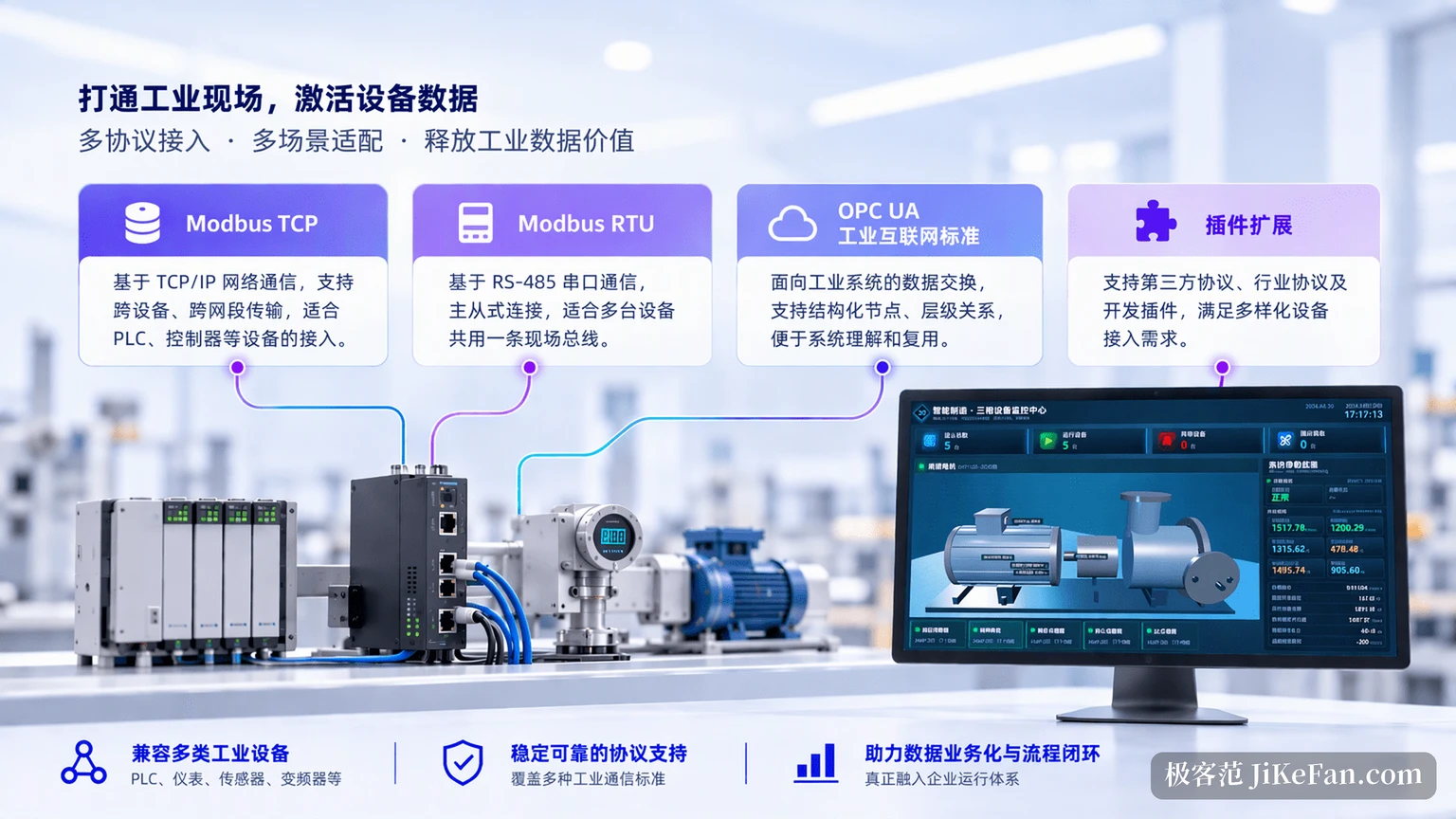
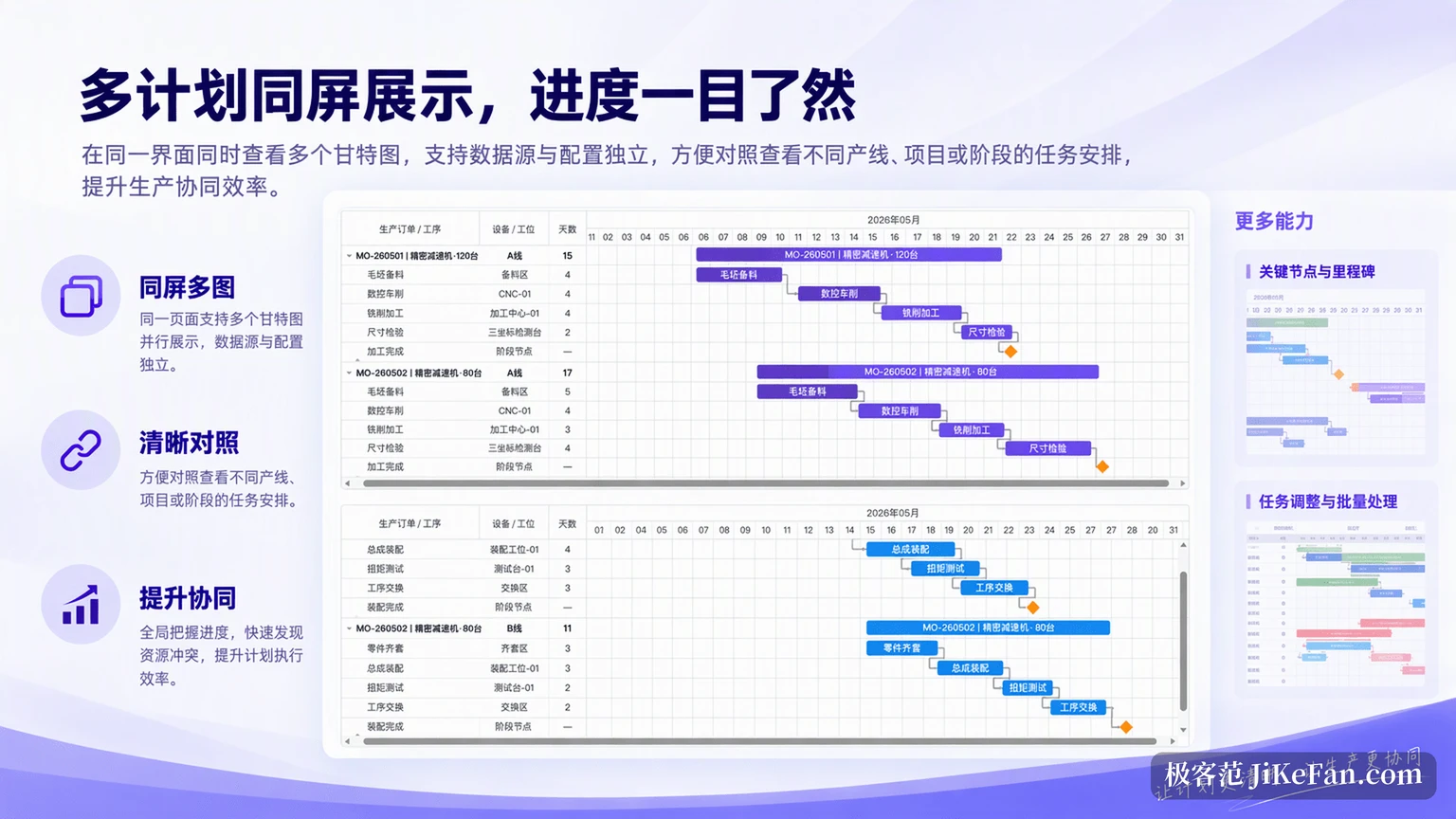
Industrial work is the second thread of this update. On connectivity, the platform adds an OPC UA client command alongside Modbus TCP and Modbus RTU, giving one more option for linking equipment and industrial systems. More useful is the business tie in: using the data nodes the site provides, a developer can attach device information to work orders and to the asset ledger, which serves on site lookup and follow up handling. On scheduling, the DHTMLX Gantt component has been strengthened, with several Gantt charts on one screen, each bound to its own data source and configuration, which makes it practical to compare plans across production lines, projects or phases. Milestone creation and updating, custom task types, batch updates of task properties and adjustment of the sorting hierarchy have all been filled in, and selecting a task or the current row can drive details and business actions, so looking at a plan and acting on a task happen in the same place.
Domestic platform support and engineering governance
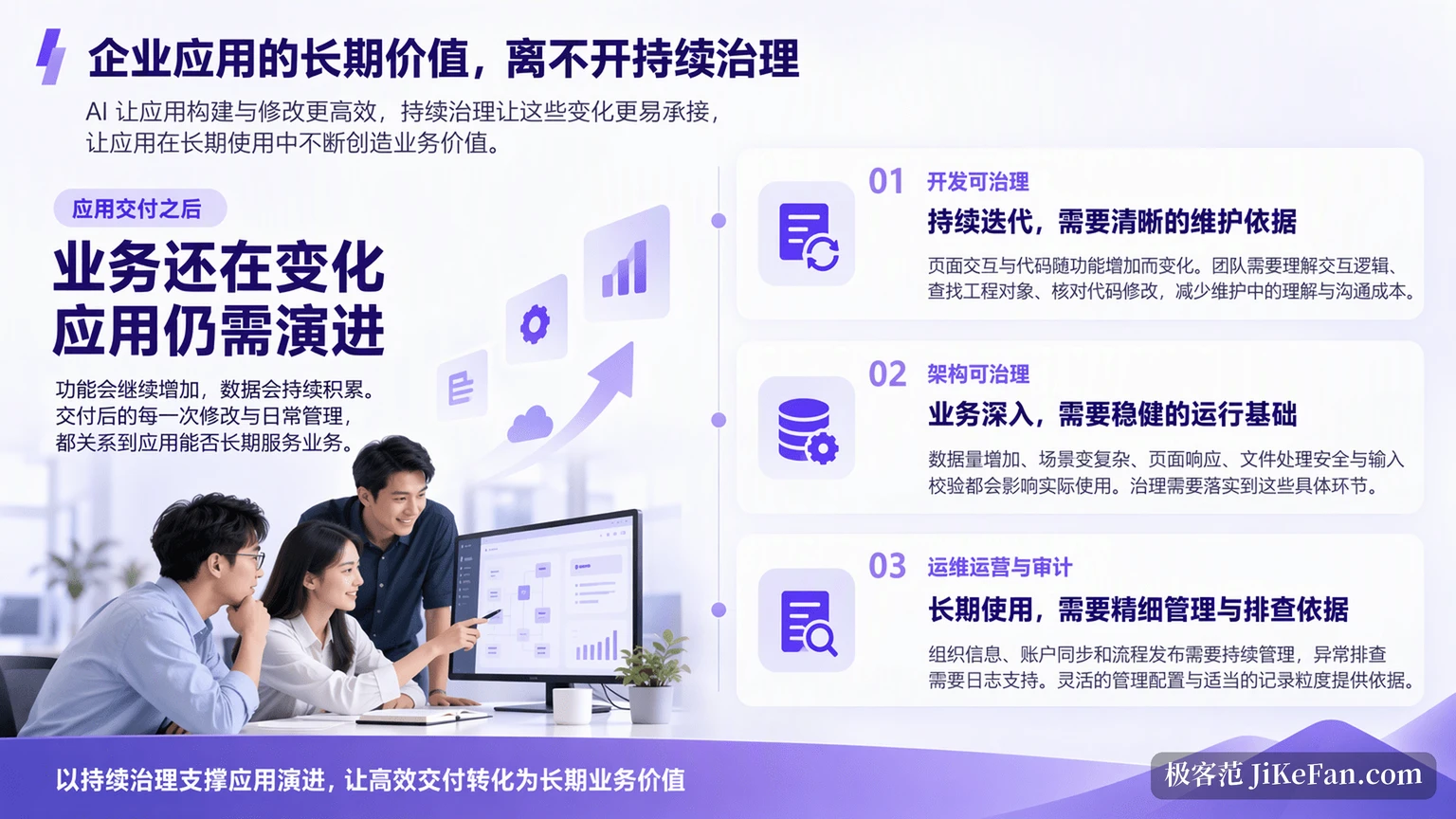
On adaptation, a connection for the HighGo database is new, the platform user information store supports PostgreSQL and DM, and together with the existing support for Kylin and UOS operating systems this hands the choice of underlying storage back to the enterprise. Governance has been filled in at a fine grain this time: limits on the number of uploaded files, security policies and user selector validation tighten the edges of frequent operations; organisation management allows custom attributes on organisation nodes; domain accounts can be given a sync start time; the online process designer accepts notes at publication; the expiry date of a licence is displayed and the management console has been reworked; logs offer finer levels of verbosity to help track anomalies down. None of these look impressive on its own, yet it is precisely this kind of detail that carries an enterprise application into its second and third year.
What the foundation already provides, and how licensing works
Back to the groundwork laid by V12.0: a unified process center lets several applications share one process system, and data permissions inside a process node can be narrowed to a visible range, to read only, or to editable. Screens are configured at property, command and event level, and server side commands can generate the standard create, update and delete operations from a table structure, with parameters for master and detail tables adapted automatically. The usual tools for working with objects and collections have entered the official plugin system, giving arrays, objects and dictionaries a proper entry point for creation, query, sorting and processing. Export has been extended as well: before exporting to Excel, PDF or HTML the page properties and cell values can be initialised dynamically, and MQTT subscriptions can retrieve full topic information under wildcards. On licensing, the designer itself is free, the server manager is billed by deployment licence and user licence, and the end users of an application need either user or concurrent licences.
The Double 11 licensing promotion
From 1 November to 11 November the vendor runs a buy one get one offer on user and concurrent licences, open to new purchases and to additions alike, and the user counts for the private deployment edition and for Huozige Cloud fall inside the same scope. User licences start at 40 users and additions are made in units of 10; concurrent licences start at 8 and additions come in units of 2; whatever is bought is matched. A few boundaries are worth checking in advance: the contract follows the payment date, and payment closes at 24:00 on 11 November; each customer, partners included, may buy one set; the offer does not stack with other discounts; database, traffic and storage resources of Huozige Cloud are excluded. The detail of the rules is set out on the official promotion page.
If a team is looking for a platform it can maintain itself, for device ledgers, production planning or internal approvals, the point of interest in this release is whether the engineering left behind after AI generation can still be held on to. Generating standard commands rather than one off code is one answer to that question. The designer is free, and running a small application on real business will say more about fit than any specification table.