
1Panel review: an open source server panel with 234 apps in its store
Summary
1Panel is an open source operations panel for Linux servers written in Go under GPL v3, bringing host monitoring, files, databases, containers and websites into one web interface, with 234 applications in its store.
Recommend- Name
- 1Panel
- Version
- 2.0.4
- Open source
- Open source
- Operating system
- Linux
- Website
- https://1panel.cn
- Updated
- 2026-11-01 11:25
Buy a Linux server and the first afternoon disappears into installing things: a web server, a database, a certificate, a set of firewall rules. The command line can do all of it, but every change sends you back to the documentation for a path, a flag, a parameter, and a failure means jumping between log files.
What 1Panel is
1Panel is one of the newer entrants on that path. It is written in Go and released under GPL v3, the first version arrived in March 2023, the project has passed thirty-seven thousand stars on GitHub, and the vendor counts 3 million installs to date.
An open source operations panel for Linux servers: host, files, databases, containers and websites behind one web interface.
Visual operations: the command line, moved into a browser
Once installed, the server is visible from a browser. Host monitoring draws live curves for processor, memory, disk and network; the file manager handles uploads, downloads, editing and permission changes; database management covers backup, restore and remote access rules; container management lists images, containers, orchestration, networks and storage in layers.
None of that is remarkable on its own. What matters is having it in one place: chasing a website that will not load usually means moving between system load, container state, database connections and reverse proxy logs, and the panel shortens that path to a few clicks.
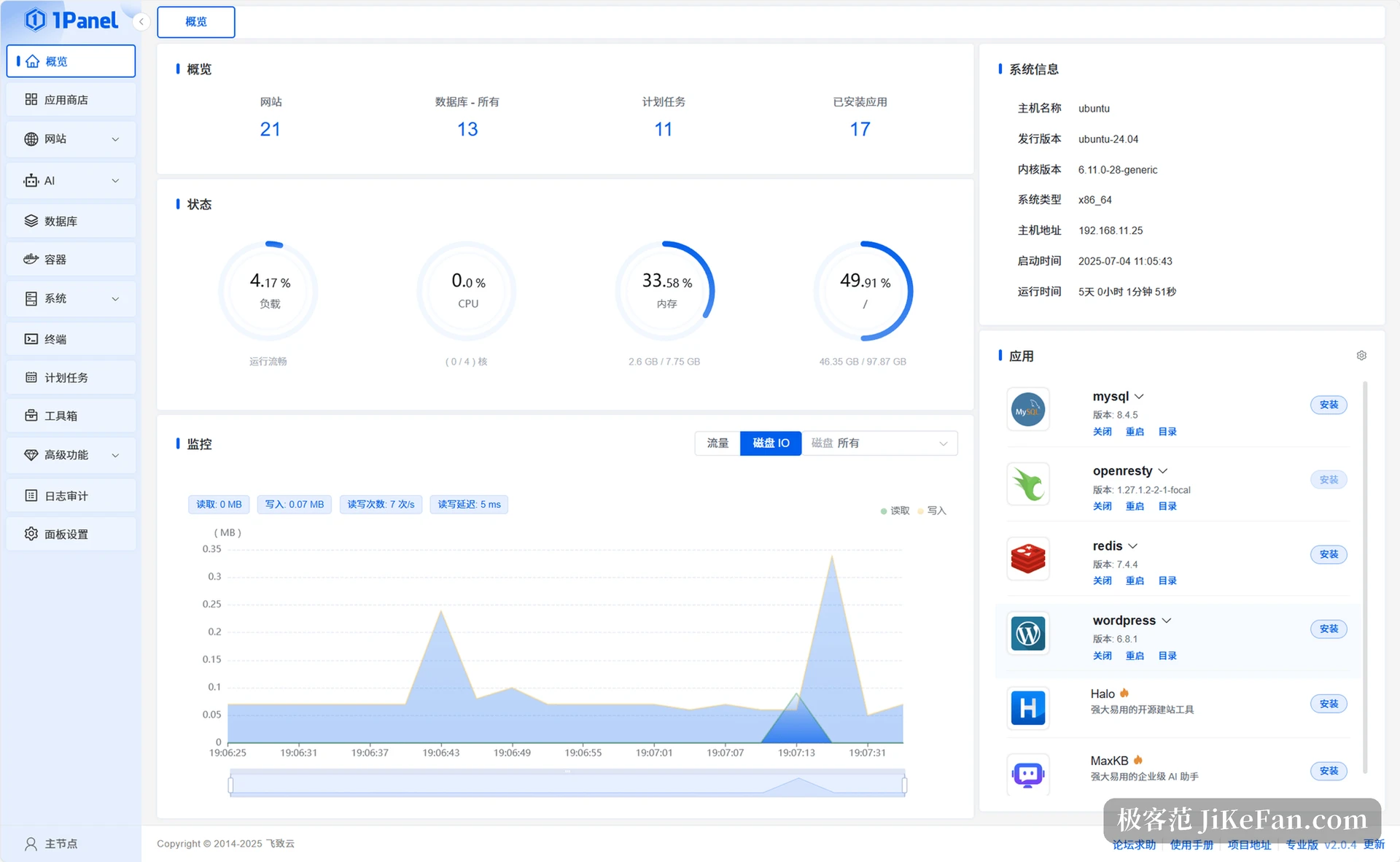
The app store: 234 open source applications, one click each
The official count is 234 applications, spread over a dozen or so categories: AI, website building, databases, web servers, runtimes, utilities, cloud storage, BI, CRM, security, developer tools, DevOps, middleware, media and mail. Installing a relational database or a web platform means choosing a version and a port; pulling the image, mounting the directories and mapping the ports is the panel's work.
The store is worth more than the commands it saves. Version upgrades, the location of configuration files and the conventions for data directories are unified by the panel, so a later migration or a scale-out does not stall on parameters typed by hand months earlier.
Sites and security
WordPress and Halo are integrated deeply: domain binding, SSL certificate issuance and renewal all happen in the interface. For someone running a personal site those are exactly the steps that go wrong, whether it is a wrong certificate path, a missing line in the reverse proxy configuration, or a redirect that never takes effect.
On security the vendor lists a WAF and log auditing. The first blocks the common injection and scanning requests, the second records who changed which setting and when. Backups run with one click and can be pointed at several kinds of cloud storage, so the archive lands in object storage instead of staying on the same disk.
From operations panel to model management
In its 2026 releases 1Panel describes itself as a lightweight AI management platform. The interface has grown an AI portal, an AI gateway, a Skills repository and model management, meant to bring several model providers under one roof and to administer the agents running on the machine or across a cluster.
One detail from the announcement: the AI gateway is open to community users, and teams of 10 or fewer can use it at no cost. For anyone already running local models on a server, this part shares its plumbing with the container management the panel already had, so a second scheduler is not needed.
Double 11: the licence price is what moves
1Panel comes in a community edition and a professional edition. The community edition is open source and free, covering the app store, website management, database management, container management, file management, server monitoring, firewall, scheduled tasks and log auditing. The professional edition adds multi-machine management, database primary-replica replication, website monitoring reports, tamper protection, custom themes and SMS alerts, sold as an annual subscription or as a version buyout.
Lingxia Software has published this year's Double 11 campaign, running from November 4 to November 18, and the licence price of the professional edition is the thing being cut.
The published terms: a buyout licence drops 40 percent on a single machine; renewal takes the form of a 199 yuan annual package; node expansion is half price and as low as 99 yuan; and a spend-based rebate of up to 1588 yuan can be stacked on top of those discounts. All of it between November 4 and November 18.
Buyout and subscription suit different situations. A one-time purchase fits a team whose server count is settled and unlikely to change soon; an annual subscription fits a fleet that grows and shrinks and wants to stay on the current release. Renewal customers should check which licence they hold: the 199 yuan package and the 40 percent buyout discount are two separate pools, and the wrong line means no discount at all.
Multi-node bundles also return during the campaign. According to the vendor's own channel, these are priced per node and come out cheaper per machine than buying one at a time. The fine print on the official campaign page governs; before ordering, confirm the licence type and the node count, then check the discounted total on the checkout page.
1Panel is worth as much as the way it turns scattered manual steps into one visual flow, not as much as the length of its feature list. The open source edition is free to use, and the professional discount only trims the cost for teams with a commercial need. Running the community edition first, and talking about licences once it proves sufficient, is the safer order.