
Fish Audio rebuilds a voice from ten seconds of audio, with 8000 credits free each month
Summary
No card at sign-up, 8000 credits a month on the free plan. Upload ten seconds of audio and the platform hands back a usable voice; during synthesis, more than 60 emotion tags steer the delivery.
Recommend- Name
- Fish Audio
- Version
- 20260917
- Pricing
- Free
- Open source
- Proprietary
- Operating system
- Web
- Website
- https://fish.audio/
- Updated
- 2026-10-06 17:54
Ten seconds of someone's voice is enough to rebuild it, and enough to make it speak 13 languages. That is the promise Fish Audio leads with. The company describes itself as an AI voice platform, with text to speech, voice cloning and speech to text sitting side by side, all of it running on its own S2 model family.
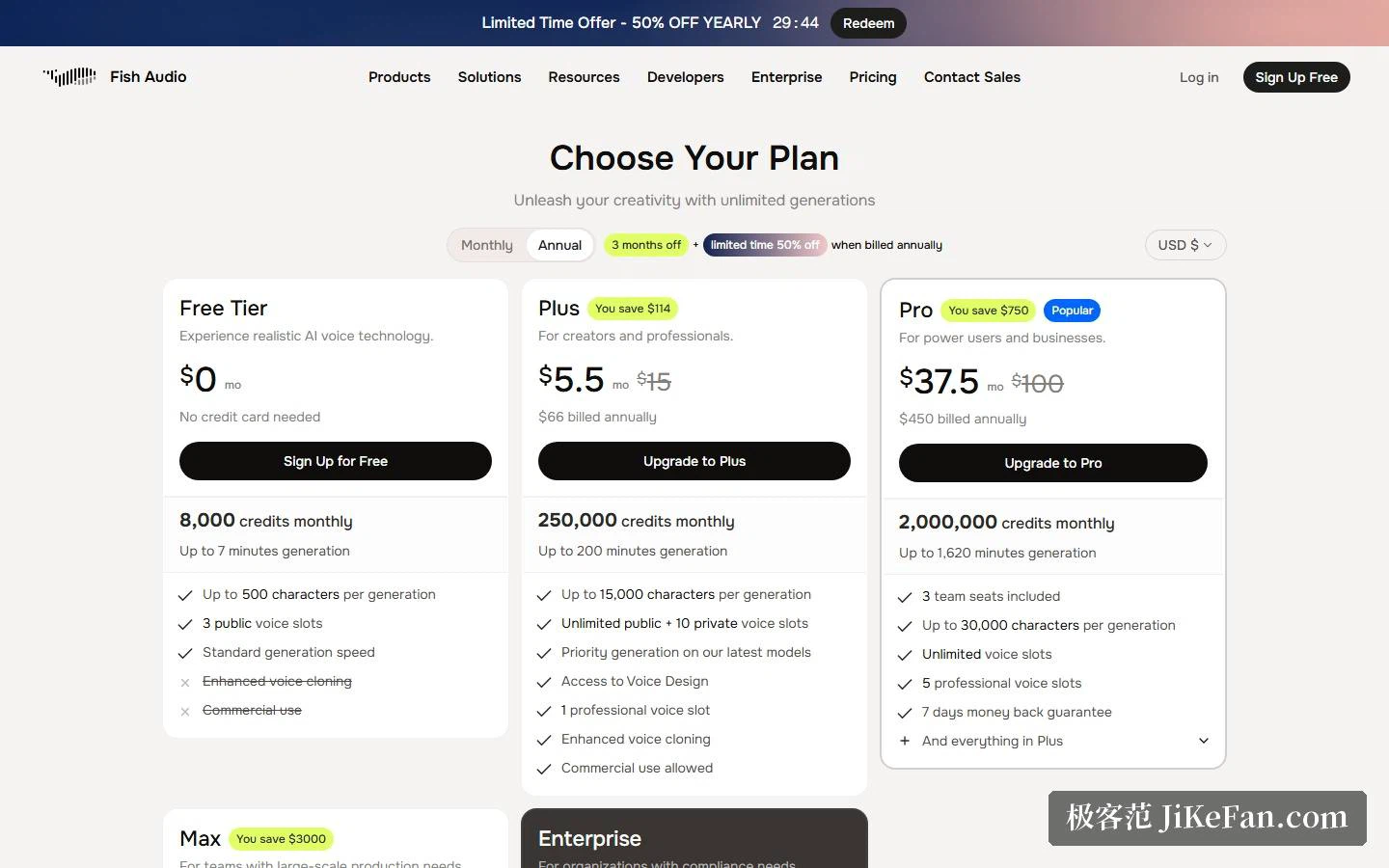
For anyone who wants to look before paying, the price list is frank about where to start: the free tier hands out 8000 credits every month, and signing up does not ask for a card.
What the free tier buys, and where it stops
The credits turn into something concrete once you convert them. 8000 credits come to roughly 7 minutes of generated audio; a single request is capped at 500 characters; the official conversion works out to about 600 to 625 credits per minute of output. The tier also includes 3 public voice slots and standard generation speed.
Two lines on that page deserve a second look. Enhanced voice cloning and commercial use are both struck through in the free column, which means neither is part of the offer. The official FAQ says the same thing in words: output from the free tier is meant for personal, non-commercial projects, and anything else needs an upgrade. If the audio is headed into content that earns money, plan for that early rather than discovering it at export.
Cloning out of ten seconds of audio
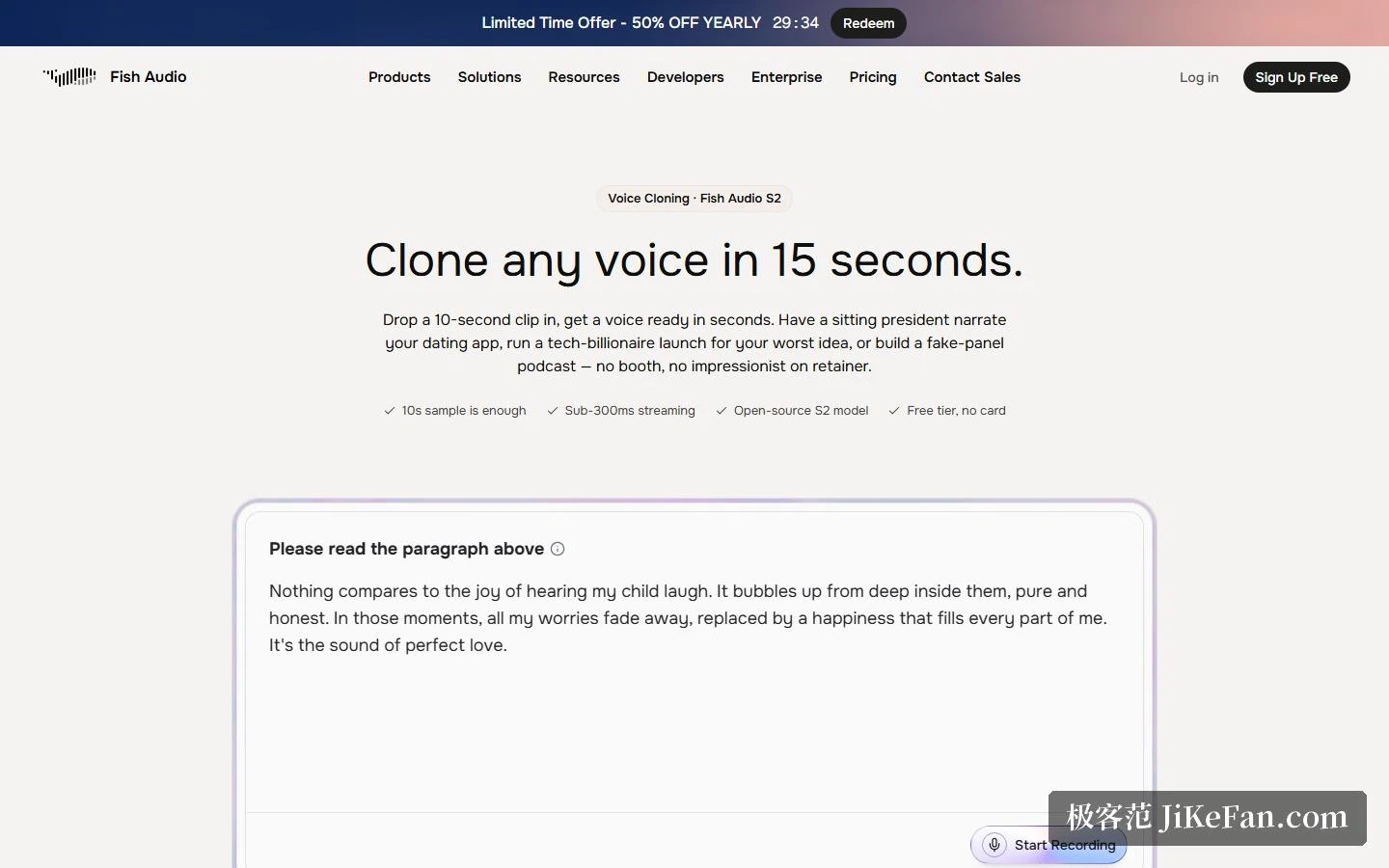
Cloning is the feature the product pushes hardest. The line on the page is that ten seconds is enough: drop in a short reference recording and a usable voice comes back within seconds, with no queue for model training. Three details sit alongside it. Streaming latency stays under 300 milliseconds. A single clone is portable across languages, and the official claim is zero-shot coverage of 13 languages, with no separate model or fresh recording for each one.
One more thing deserves separating out. The S2 model itself is open source, and self-hosting is a path the company supports openly. For privacy-sensitive work, or for anyone who wants the thing running locally, that is an option a pure cloud service never offers.
Emotion tags: giving synthetic speech a tone
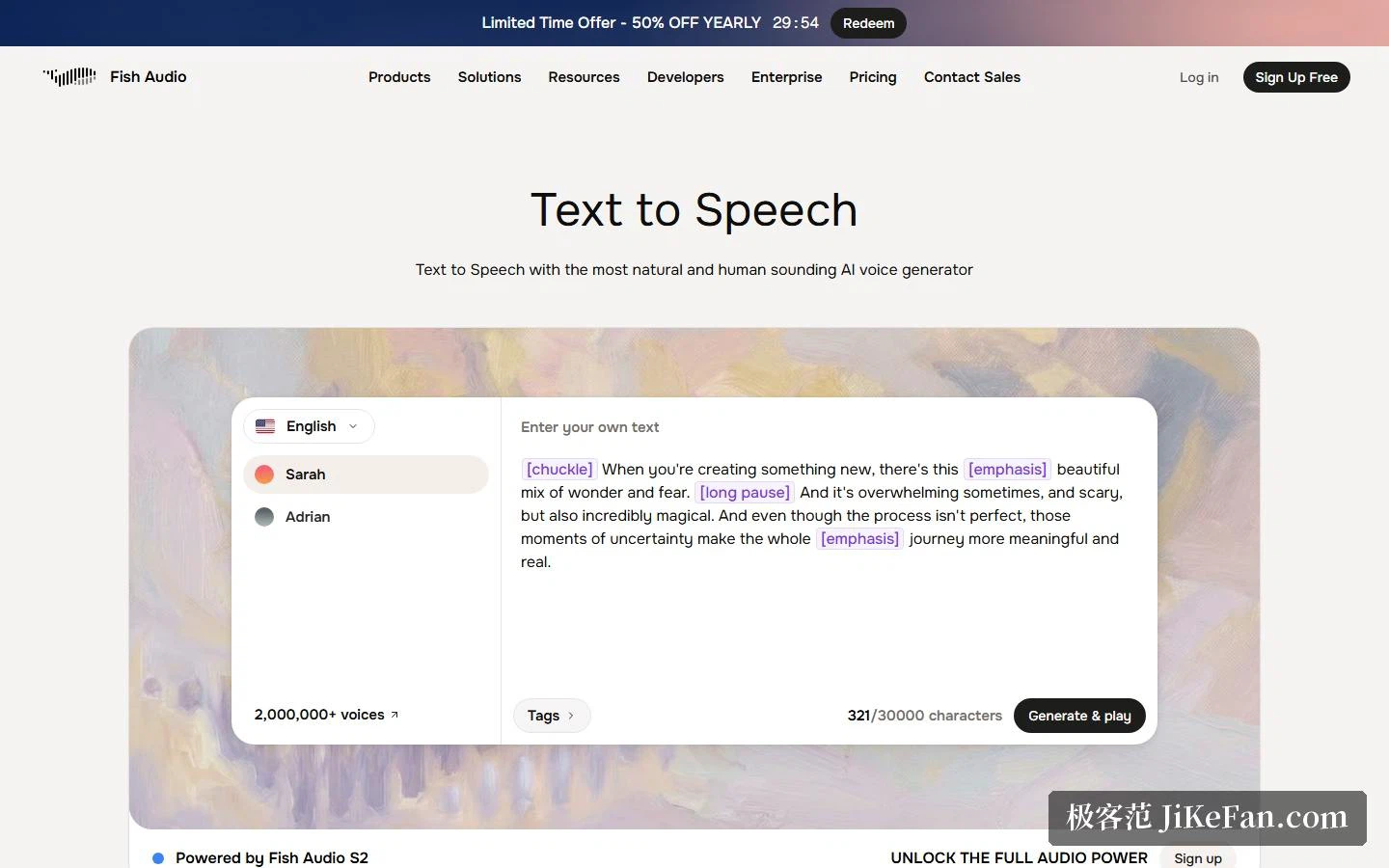
Anyone who has worked with speech synthesis has hit the same wall: the words come out correct and completely flat. Fish Audio's answer is to put the direction inside the text. The sample on the product page carries [chuckle], [emphasis] and [long pause] inline, and the model treats laughter, stress and silence accordingly.
The tag set runs past 60 entries and splits into two groups, Emotions and Special. The first holds states such as [angry], [sad] and [whispering]; the second holds reactions closer to the body, such as [laughing] and [sighing]. For narration or character work, typing the intent into the script costs far less than chasing it in post.
2,000,000 voices, 8 languages
If shaping a timbre yourself sounds like work, the library is there to browse. The official figure is over 2,000,000 voices, filterable by gender, age, pitch, energy, emotion and intended use, each with a preview before you commit a project to it. On the synthesis side the stated language coverage is 8: English, Japanese, Korean, Chinese, French, German, Arabic and Spanish.
Beyond dubbing: the rest of the audio toolbox
Text to speech is only the front of the product. The line also carries speech to text, voice conversion, vocal separation, audio translation and sound effect generation. On the transcription side the site promises live transcription with automatic sentence splitting, speaker labels and timestamps, exportable as SRT, VTT or JSON — and anyone who has built subtitles knows those three formats are the difference between retyping everything by hand and dropping a file straight into an editor. Coverage here is wider than on synthesis: the official number is over 80 languages.
How the tiers stack up
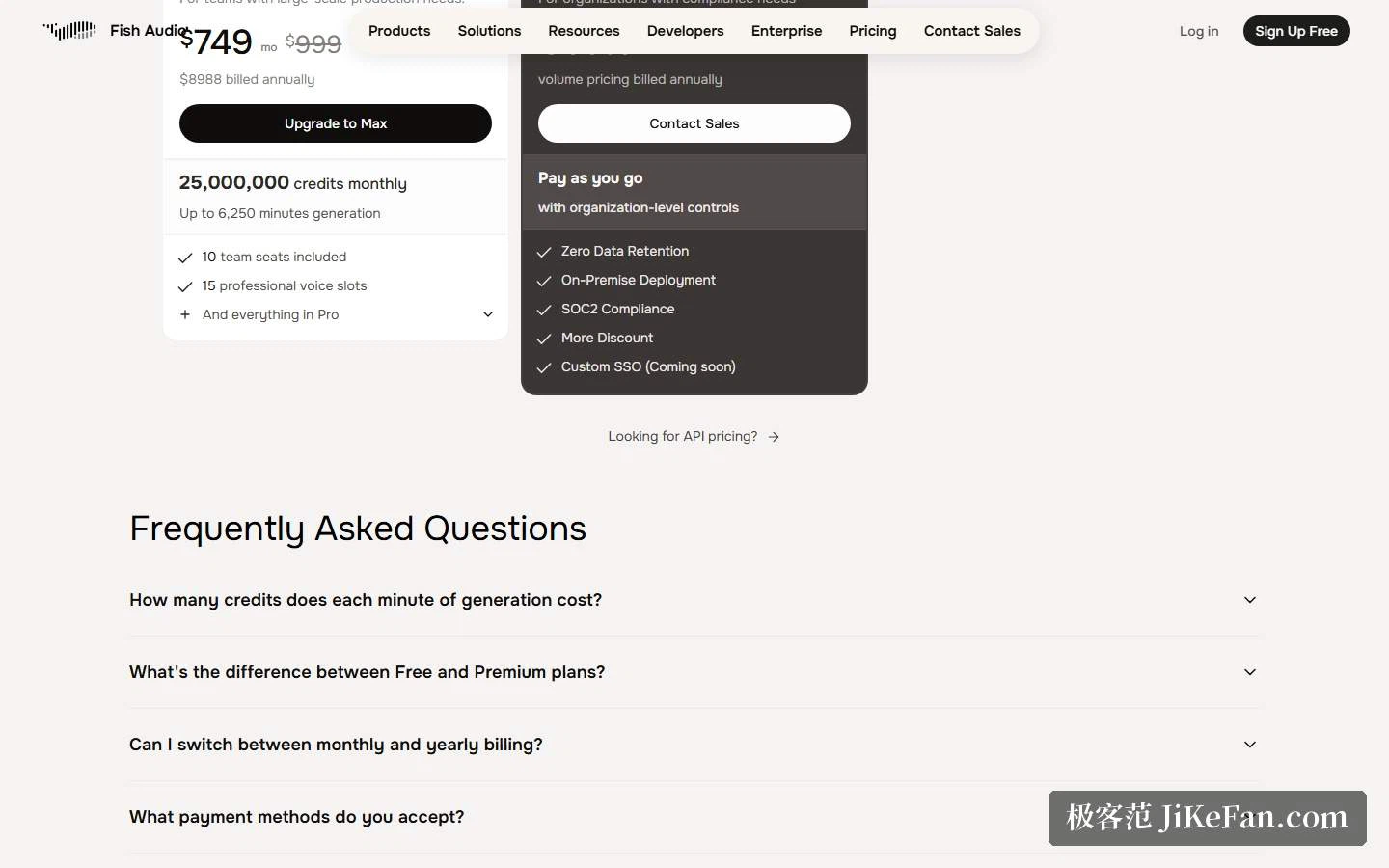
Above the free tier sit three paid levels. Plus runs 66 dollars a year for 250000 credits, about 200 minutes of generated audio, a per-request cap raised to 15000 characters, plus voice design and a commercial licence. Pro runs 450 dollars a year for 2000000 credits, roughly 1620 minutes, 3 team seats and a 30000 character ceiling per request. Above that sit Max and an Enterprise tier quoted on request, aimed at organisations with compliance requirements and offering things like zero data retention and on-premise deployment.
Who it fits
For video dubbing, audiobooks, or a full voice set for a cast of game characters, the path in is short: sign up, pick a voice or upload a ten-second sample, paste the script, add tags, export. The free allowance is enough to walk the whole workflow once before deciding whether the commercial licence and the larger quotas are worth paying for.
The boundary worth naming is the clone itself. The technical bar is low now, but putting someone else's voice into your own content touches personality and voice rights, and public figures are the sharpest case; the official FAQ flags it too. If you are unsure, start with a voice you hold the rights to, or use one of the licensed voices already sitting in the library.
A tool lowers the bar, but judgement stays where it was. Ten seconds is all it takes to copy a voice; the hard part is deciding whether that voice should be copied at all, and what it should be used for.