
HandyBot answers the phone for tradespeople and writes the job straight into the calendar
Summary
An AI phone answering service built for on-site trades in the United States: calls are picked up around the clock, the job is qualified, the appointment goes into the owner calendar, and follow ups and call records come with it, at 199 dollars a month with a seven day trial and no card.
Recommend- Name
- HandyBot
- Version
- 20261010
- Pricing
- Paid
- Open source
- Proprietary
- Operating system
- Web
- Website
- https://handy-bot.com/
- Updated
- 2026-10-10 12:03
Hand the business line to a receptionist that never rests, and it writes the job into the calendar while the call is still going on.
Work that gets done in someone else home has one trouble nobody escapes: the jobs arrive while the person is up a ladder, under a customer sink, or three blocks away at the next address. Both hands are on a drill and the phone in the pocket rings twice and stops. The caller usually leaves no voicemail; within a few minutes they dial the next name in the search results. For plumbers, electricians and roofers paid per job, losing two or three calls a day leaves a week with holes in it.
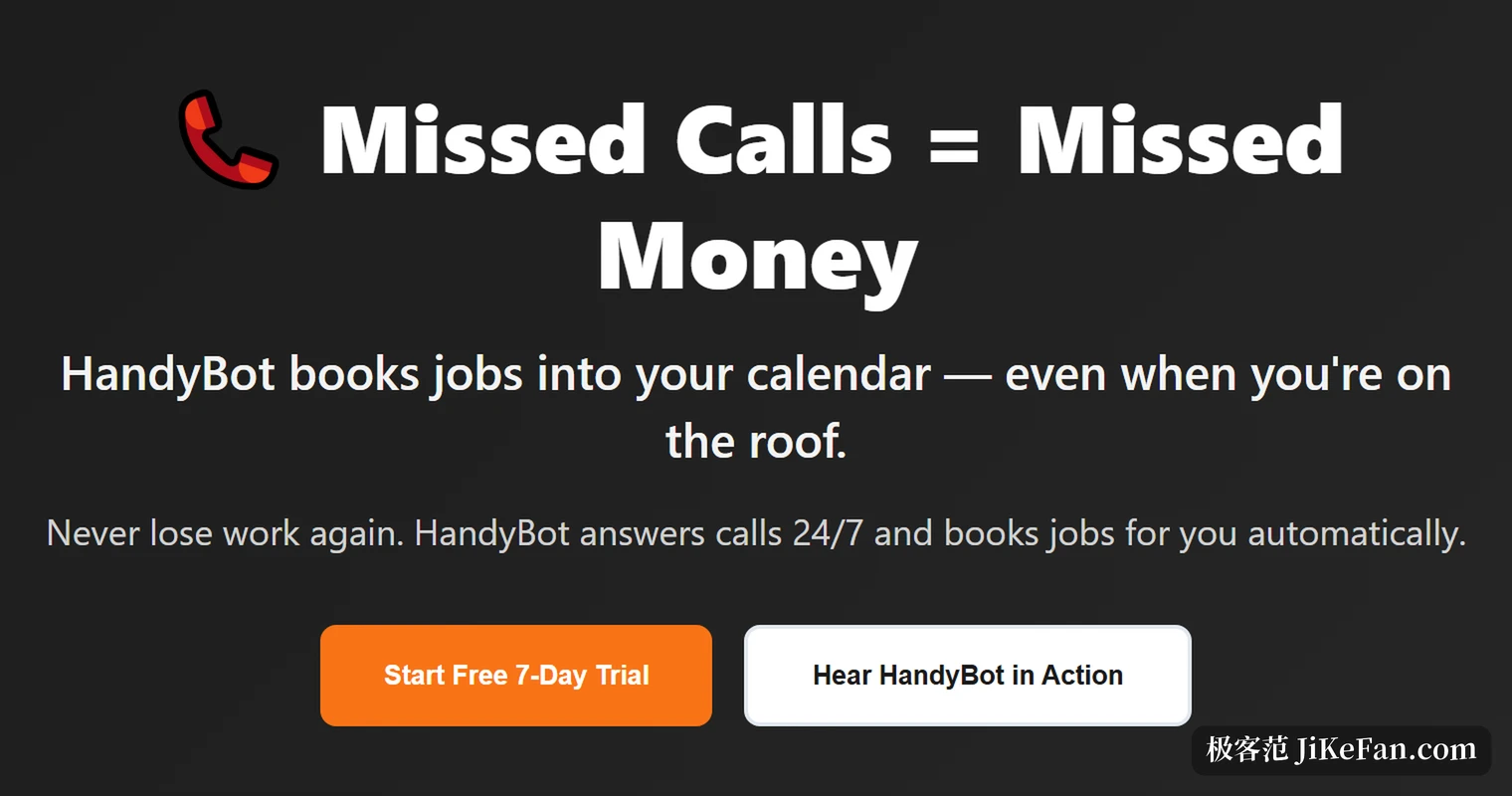
HandyBot aims at exactly that stretch. It is not scheduling software and not a customer management system, but an AI phone answering service: the owner forwards the business number, the AI picks up, works out what the job is, and writes the appointment into the owner calendar. The owner does not have to be present for any of it.
Missed calls, totted up as a bill first
The first thing on the home page is not a feature list but a calculator. Put in the average value of a job, put in how many calls go missing in a week, and the page returns the weekly and monthly loss on the spot. Behind the arithmetic sits a plain judgement: keep one more job and the monthly fee has already come back, and every job after that is clear gain.
The definitions in that sum are the vendor own, of course, but the sore point it hits is real. Most on-site work is not urgent, and a customer who meets a busy line or a voicemail box loses a little of the resolve; the job slides to later. The typical calls the site lists bear the logic out: a leak, a lock, something to hang on a wall, small jobs that could be booked the same day or the same week are precisely the ones that slip away at the telephone stage.
Eight things sitting behind one phone line
By the vendor own list, answering is only one of them. It keeps watch around the clock, so calls are taken while the owner is working in a customer house. When the call ends it books the job into the owner free slots. It runs the follow up on the owner behalf, so the customer knows how far things have moved. It writes the content of the call straight into the customer management system, which saves the after the fact data entry. It sends a reminder before the appointment, which pushes down the no show rate. It keeps sales calls and nuisance calls outside the door. And it answers the usual questions about what is covered and when someone can come. The vendor frames the last benefit as hours handed back every week, meaning the owner is pulled out of switchboard duty.
Put those together and the role is very specific: a receptionist who draws no wage and never goes home. That is exactly the comparison the vendor makes on its own page.
Once the call is answered, where the job lands
From the clues the site gives, it is wired into Google Calendar: the page embeds Google sign in and calendar interfaces, and once the owner authorises it, appointments the AI takes land straight in the calendar. The record of the call, the address and the description of the job stay with it, so the owner does not have to ring back and ask the basics again. Urgent calls can be forwarded to the owner phone by rule, and the rest are placed in the next suitable slot.
The vendor only describes the trunk line: find out the job, get the address, put it in the calendar. How urgency is judged and how jobs that straddle time slots are handled are not spelled out on the page, so a trial is the way to find out.
199 dollars a month, measured against a stack of salaries
The price is 199 dollars a month with a seven day trial that asks for no credit card and no long contract, and the vendor says setup is included. To make the money look sensible it sets out a comparison: a front desk at 3000 dollars a month, configuring a customer management system at 200, a scheduling assistant at 500, a follow up assistant at 300, plus more than a thousand dollars a month in lost jobs, which adds up to nearly 4800. HandyBot position is that it takes that whole stack over.
Those figures come from the vendor own arithmetic and have not been costed by a third party, so they are better read as a piece of persuasion. What can be confirmed independently is the 199 dollar price, the trial without a card and the absence of a contract, all of which are stated on the page.
It is aimed at on-site trades in the United States
The site is explicit about where it belongs; the footer line reads Built for U.S. Handymen. The trial form asks for a trade first, with plumber, electrician, roofer, general repair, heating and cooling, landscaping, pool service, locksmith, appliance repair, painting, carpentry, cleaning and pest control among a dozen options, then how many jobs come in each week, in four bands from one to five, six to ten, eleven to twenty, and more than twenty. The vendor also leaves a demo line that can be dialled so you can hear what an AI answering a call sounds like, and the interface switches between English, Spanish and Russian.
Those details draw the boundary. What it serves is a setting built on American phone numbers, American customer habits and American dispatch practice; the plumbing of the integration and the wording of the scripts are designed around that, and it does not carry over to the way on-site work is booked elsewhere.
What to know before signing up
It is a hosted service with no local version, so every call passes through its systems and the content of the conversation enters a third party platform. The site is currently a single marketing page with no public documentation centre, no description of data handling and no privacy terms; problems are raised by booking a call or leaving an email address. Anyone who cares where call data goes should ask that question before ordering.
Letting it take the phone saves more than those few minutes of talk: it saves the jobs that would have gone to someone else. The price is that calls pass through another company systems, and that it is built only for the way work is booked in the United States.