
Concepts Review: An Infinite Canvas Where Every Stroke Stays Editable
Summary
Concepts treats each line as a separate object, so a stroke can be re-weighted or recoloured long after it was drawn. Perspective grids, object libraries and a canvas with no edges make it a serious ideation tool.
Recommend- Name
- Concepts
- Version
- 20260923
- Pricing
- Free
- Open source
- Proprietary
- Operating system
- iOSAndroidWindowsChromeOS
- Website
- https://concepts.app/
- Updated
- 2026-10-07 21:26
Every stroke keeps an exit
On paper a wrong line is erased and redrawn. On a digital canvas most tools offer the same thing with a different word: delete, undo, start again. Concepts goes further by treating each stroke as its own object. Draw a rough curve, then decide it should be thicker, darker, or in a different colour, and the change applies to that line and to no other. Because the ink is vector based rather than pixels, a sketch can be re-proportioned hours later without the edges turning to mush, and a set of lines selected together can be nudged or scaled as a group.
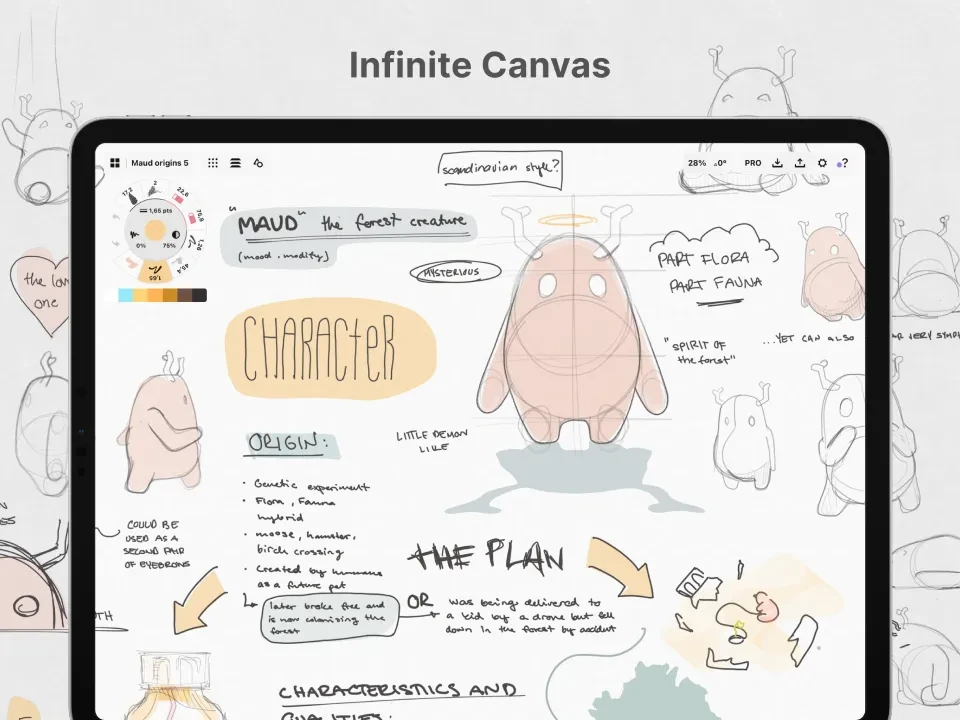
That single design decision changes what the early stage of a project feels like. The fear in sketching is committing too soon, drawing something that looks finished while the idea is still moving. Here the lines can be thrown down first and given a character afterwards, so the thinking is not blocked by the tool. The same freedom helps when a client asks for a variation: duplicate the layer, adjust, and both versions exist side by side.
Features that come from professional practice
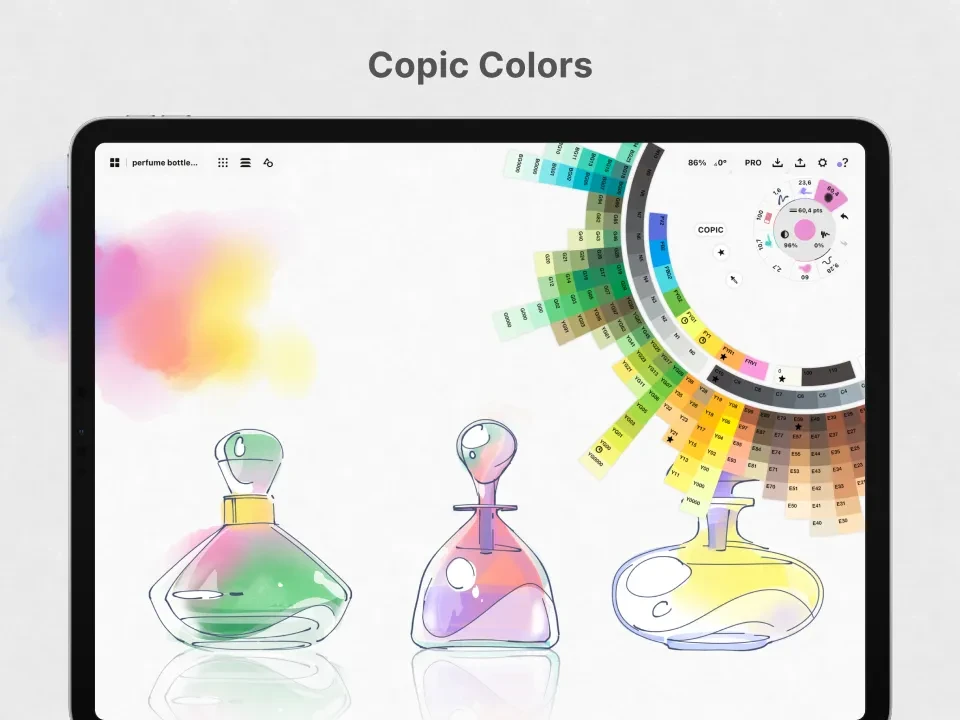
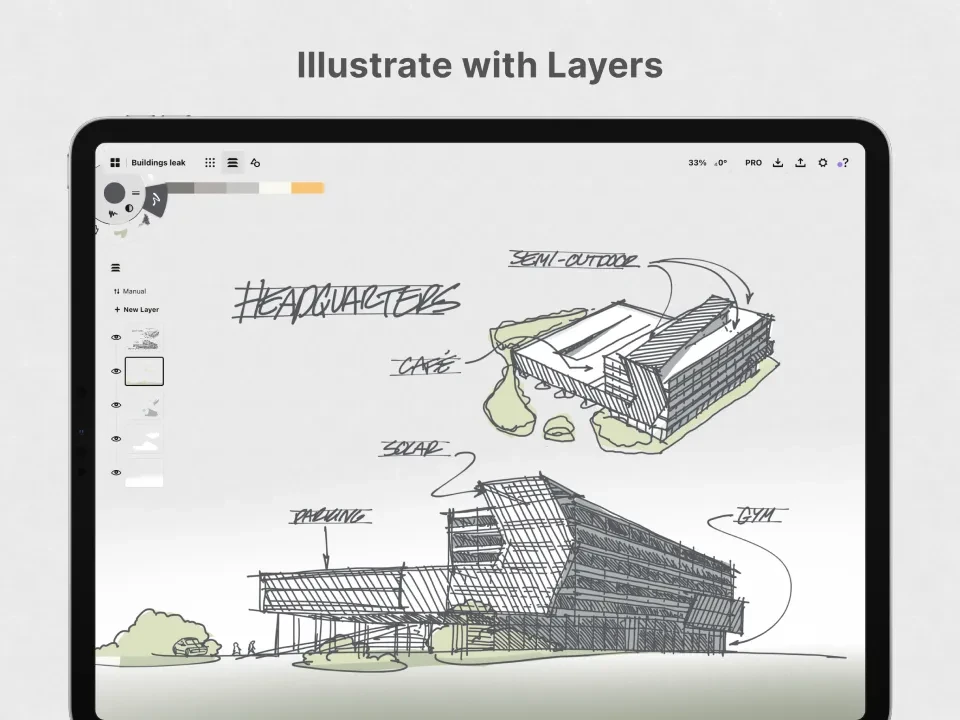
The toolset reads like it was assembled by people who sketch buildings and products for a living. Perspective grids place vanishing points and let lines snap to them, which turns a quick spatial idea into something with credible depth. An object library stores the shapes you draw repeatedly as stamps, so a chair, a bolt or a standard panel can be dropped in instead of redrawn. Imported PDF drawings can be marked up directly, which is how review sessions usually happen, and the export side writes vector formats so the sketch can continue in a heavier design application.
The canvas itself has no edges, so a project grows in whichever direction the thinking goes. One board can hold the first scribble, the refined elevation and the notes from a meeting, all reachable by panning rather than by hunting through files. Phones, tablets, computers and ChromeOS devices are covered, which matters for the moment an idea arrives on a commute: the phone comes out, the thought is captured, and the same drawing opens later on a larger screen with a stylus.
One workflow detail is worth stealing from people who use it daily: keep a single board per project rather than one per drawing. The canvas is cheap in the sense that empty space costs nothing, so the rough version, the corrected version and the three rejected alternatives can all stay in view. When a decision is questioned six weeks later, the reasoning is still on the board instead of in a folder of files with version numbers in their names.
Concepts redefines what a sketch is: not a rough draft on the way to a final answer, but a living line of thought. Every stroke is still growing until you decide it is done.
How to get value out of it quickly
The combination that pays off fastest is a pressure sensitive stylus on a tablet, because line weight then responds to how hard the pen is pressed rather than to a slider. Phone use is best kept for capture: a quick note, a proportion check, a photo reference with arrows drawn on top. Building a personal stamp library is the other high return habit, since the shapes you draw most are almost always the same dozen.
Free use covers the core experience, with additional brushes and object packs sold separately for people who need them, so evaluate the drawing feel before buying anything. Export the vector file before a review meeting rather than after, because the ability to hand someone a clean file is what separates a sketch from a doodle. And keep the first board messy: the value of an infinite canvas comes from seeing the whole path, including the wrong turns that led to the right one.