
AutoClaw: a desktop agent that hands over files, not answers
Summary
Instead of stopping at suggestions, AutoClaw ends a session with a file you can open: a general agent for Windows and macOS that runs locally, switches between two model families and takes tasks inside group chat.
Recommend- Name
- AutoClaw
- Version
- 20261103
- Open source
- Proprietary
- Operating system
- WindowsmacOSiOSAndroid
- Website
- https://autoclaw.zhipuai.cn
- Updated
- 2026-11-03 20:21
The last hundred metres is where talking stops and work starts
Anyone who has used an assistant knows the pattern. The plan comes together quickly, and then the rest of the afternoon goes into the part the tool could not do: turning conclusions into a document, arranging numbers into a chart, wiring a page into code that actually opens. That last stretch is where the handoff used to happen. AutoClaw, made by Zhipu, aims at exactly that stretch. Instead of describing what a good result would look like, it ends the session with a file you can open.
What arrives is a file, not a reply
AutoClaw is a general-purpose agent that runs as a desktop program, with clients for Windows 10 and above and for macOS; phones are handled separately. The vendor stresses that the agent works on your own machine, so the local files it reads and the operations it performs stay on your hardware. The model underneath is not fixed either: you can switch between the GLM family and the DeepSeek family, and when a job leans towards reasoning or towards generation you move a notch and try again.
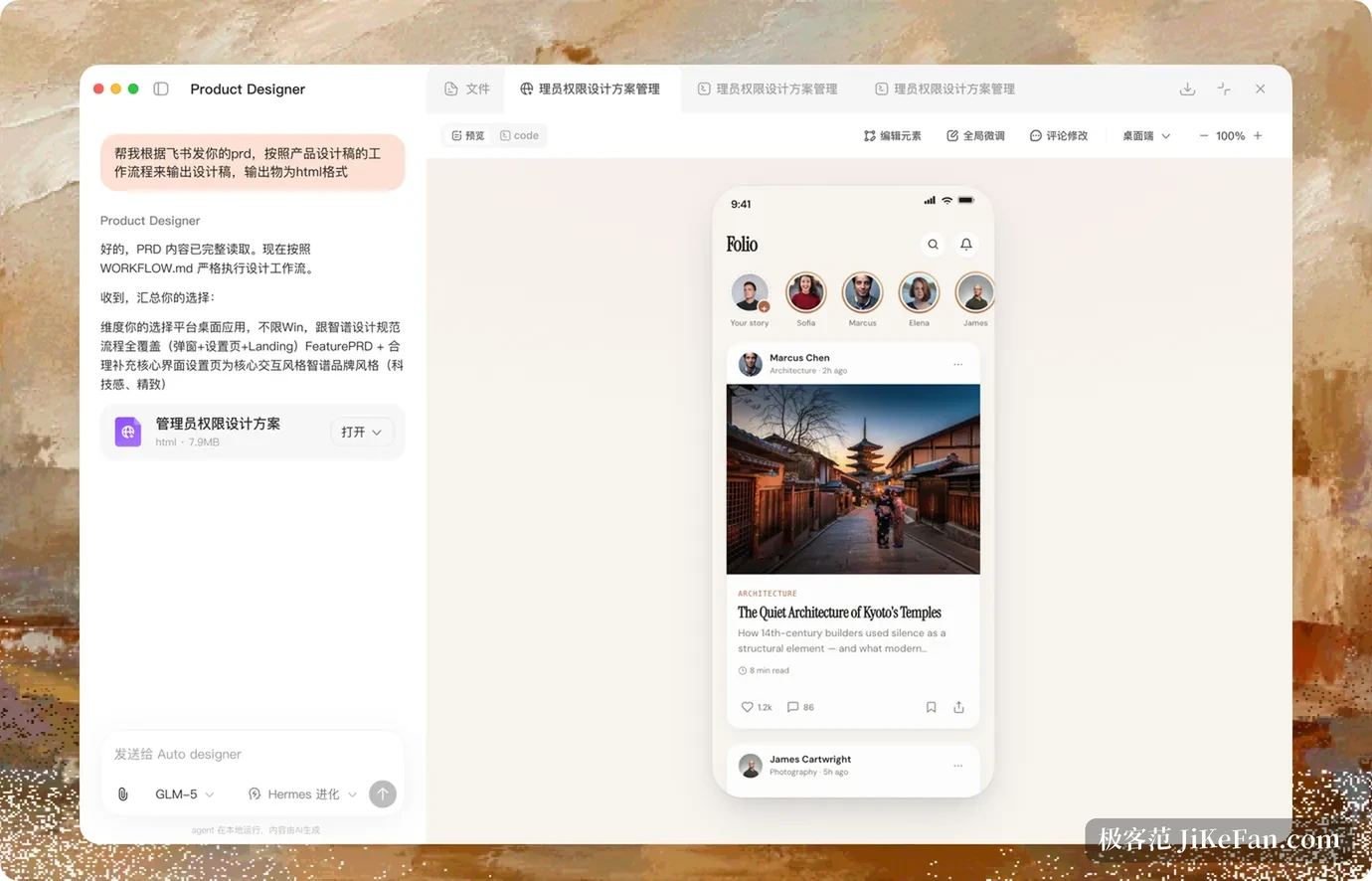
One of the chains shown on the product site runs like this. A product requirement sits in a Feishu document; the agent reads it, follows the design workflow the team already uses, and produces a mobile home page, which it exports as HTML. A preview opens on the right. If the result is not right, the conversation continues: swap the accent colour, soften the corner radius. The whole run takes a little over two minutes, and what you get is a web page a little over one megabyte rather than a paragraph describing a page. Other chains follow the same shape: scattered notes turned into a decision memo, a requirement turned into code that runs its own tests, one piece of content rewritten as a deck and as a spreadsheet.
Two ways to run a job: split it, or stare at the goal
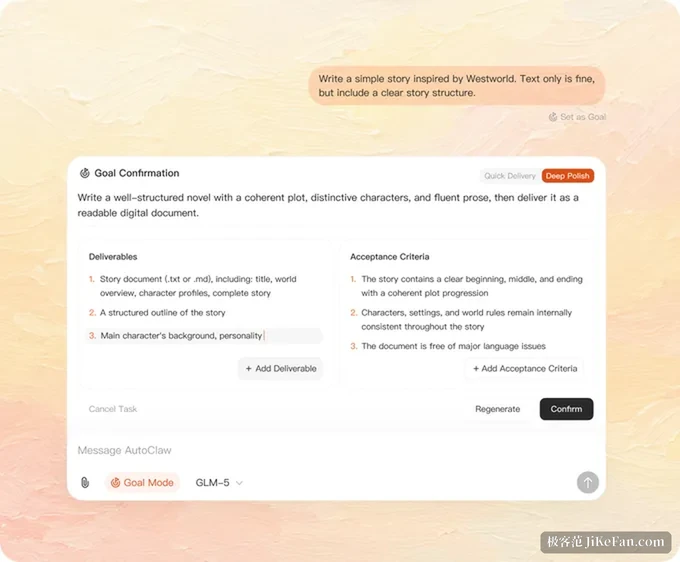
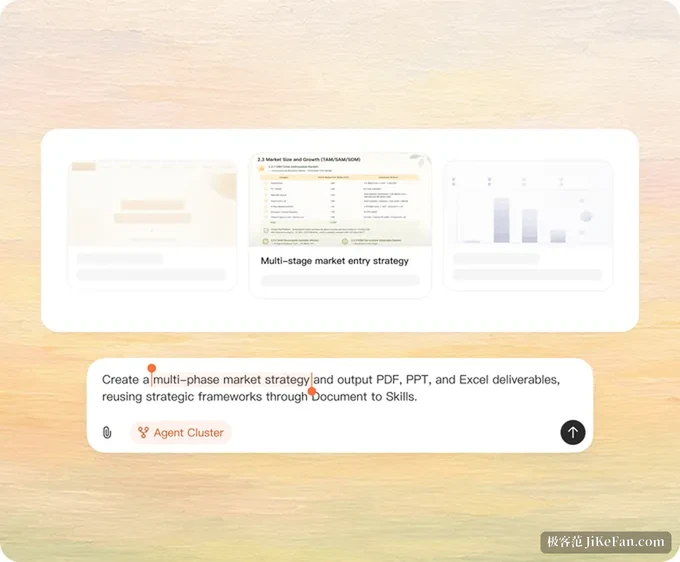
Complex work gets pushed forward in one of two ways. A cluster of agents suits anything that can be divided: a large goal is cut into subtasks that run in parallel, each handed to a specialised agent, and the results are merged into one deliverable, a market strategy pack delivered as PDF, deck and spreadsheet at the same time for instance. Goal mode suits work that does not divide: you state only the endpoint, and it loops through plan, act, verify and revise on its own, checking itself against the acceptance criteria as it goes.
Goal mode shows a confirmation page before it touches anything. The page lists the deliverables and the acceptance criteria, both sides can add or remove items, and the run only starts after you confirm. That step looks like bureaucracy, but it moves the cost of rework to the front: once the conditions are written down, a finished run has a better chance of surviving review.
Where its hands can reach
Whether an agent can work at all depends on what it can touch. AutoClaw ships connectors for platforms teams already live in, GitHub, Feishu, Notion and Figma among them, and more than fifty built-in skills spread across office work, data, the web, content and automation. It also joins group chat: dropped into Feishu, WeCom, WeChat or Lark, it can be named in a thread and pick up the task there, with the result coming back as a message. For anyone used to handing out work in a group chat, that feels far more natural than opening yet another client.
From late October the vendor bundled the pieces together. Choosing a model, pasting a key, hunting for skills, all of that was folded into a desktop program you start by double-clicking, with a Chinese interface and a sign-in to begin. That is a packaging achievement more than a technical one; how it feels in practice still depends on the task you give it.
The quota needs a straight answer
In early November several third-party channels, rounding up free allowances, mentioned a sign-in grant attached to AutoClaw: log into the client with a Zhipu account and a batch of tokens arrives. The domestic edition is advertised at fifty million, expiring at 23:59 on 8 November, forfeited rather than carried over, once per account per period, with no card and no tasks required. One caution matters here. The offer has no entry point on the homepage, it only becomes visible once you are inside the client, and no checkable announcement was published, so take the figure and the deadline shown in the client as the authority rather than credit already sitting in your account.
The second thing to keep straight is that an allowance of this kind is consumable. A single long task can eat a noticeable slice of it, so it is not the same as free use, it is the same as a trial run. For anything long-term, what matters is how credits are bought and how the unit price works out.
It is not a universal employee
Running locally is both the appeal and the ceiling. The program lives on your own computer, so when the machine is off nothing happens; round-the-clock operation depends on the group-chat route and on leaving the computer on. Coverage is broad, which means depth in any single area will not match a dedicated tool: for code it is no match for an editor refined over years, for design no match for professional software. Its real position is the middle stretch, taking over the jobs where you know what you want but would rather not move every piece yourself, and returning a file you can edit.
The audience is fairly specific. It suits people carrying a permanent load of cross-file, cross-tool chores who do not want a separate tool chain for each kind of job. Writing two paragraphs of copy now and then will probably not repay the learning curve. Spending the day moving material between documents, spreadsheets, web pages and chat is the case where a general agent of this kind starts to earn its place.