
Everything v1.5 beta: search files by their attributes, and a dark mode at last
Version 1.5.0.1424b
Summary
The Everything beta finally indexes file attributes, so clips can be filtered by capture time, length or author, and it adds a dark mode and tabs on top; the older stable release is still maintained, and both are offered side by side.
Recommend- Name
- Everything
- Version
- 1.5.0.1424b
- Pricing
- Free
- Open source
- Proprietary
- Operating system
- Windows
- Website
- https://www.voidtools.com
- Updated
- 2026-11-03 23:00
The tool that turned finding a file into an instant response, because it reads the NTFS index, finally picks up attribute indexing and a dark mode in the v1.5 beta. The first changes what you can search for, the second changes how the screen feels after a few hours.
Where it was already strong
Everything has always had a narrow brief: find a file by name, fast enough that the list is complete before your hands leave the keyboard. The method is simple and it works. It reads the NTFS file table directly, builds an index of names, paths, sizes and modification times, and answers queries from memory instead of from the disk. That is why the whole drive is searchable from the first second instead of after a few minutes of spinning.
A small resident footprint, a clean window and the ability to be called from the command line made it one of the first things many people install on a new machine. The cost was always clear as well: it knows names and a handful of basic attributes, and nothing about what sits inside a file, who wrote it, or how long an audio track runs.
The most substantial change in v1.5: attribute indexing
The v1.5 beta brings attribute indexing in, and does indexing, searching, display and sorting together. Attributes are collected while the index is built, so afterwards you filter by them and sort by them, instead of opening file after file to read the details.
A library of media is the case that gains most. Capture time on a photo, running time on a video, author on a document, bitrate on an audio file: things that used to need a separate tool are now a search condition. The range of attributes and the size of the index are tied together, since more attributes mean more upkeep, and the settings let you trade one against the other; the change list for v1.5 puts attribute indexing first.
Dark mode, and a pile of late infrastructure
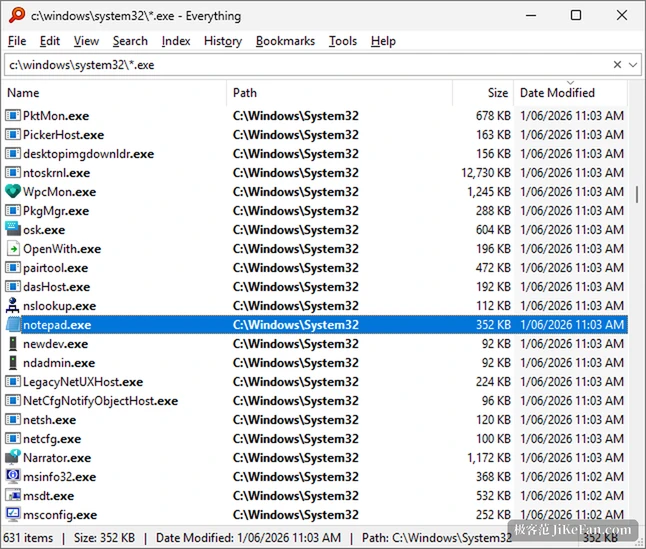
A dark mode showing up on the change list says something by itself: a tool in daily use for more than a decade has kept the plainest possible window the entire time. For anyone who spends hours in that window, this is more practical than plenty of new features.
The same batch carries things that sound unglamorous and come up every day. Updating in the background means rebuilding the index no longer freezes the window; faster search comes from work on the index structure and on the matching logic at once; natural sorting places file 2 ahead of file 10 instead of ordering them by character. An index log records what each change touched, so a problem at least leaves a trace.
One more is easy to overlook: undo. A file operation made by mistake can be taken back, and that is the safety net when renaming or moving in bulk.
The interface layer, rebuilt
According to the notes, the beta adds tabs, sessions and a folder sidebar, and rebuilds both filters and bookmarks. Tabs answer the question of watching several directories at once; a session stores the tabs that are open so the next start carries on; the sidebar pins frequent locations to the left and saves unfolding folder after folder.
Rebuilding filters and bookmarks looks more like paying off old debt. The pair used to lose state when filters nested deeply or when jumping between them, and the new version keeps navigation history apart from filter state. Build 1424b fixes exactly this kind of detail: switching a filter from a bookmark left one extra entry in the history.
Tools added along the way
Finding duplicate files is the visible one. It compares by name, size and content, drops the result into the list, and you can filter it further by attribute. Indexing virtual folders pulls unusual locations, network paths and mount points among them, into the index as well.
Others lean technical: weighted search lets the weight of matching different fields be tuned; a search preprocessor substitutes text before the query runs; hard link tracking stops one file referenced from several paths from appearing over and over; plugins, plus the import and export of settings, are there for moving machines and for deploying in bulk.
Where it stands, and whether to switch now
v1.5 is still labelled beta, with build 1424b as the current one, and the stable v1.4 release is still maintained; both are offered side by side. The official position is plain: stay on v1.4 for safety, move to v1.5 for attribute indexing and the rest.
My own reading splits by case. For finding files day to day, where instant search is all you need, v1.4 is enough and the marginal gain is small. With a large library sorted by attributes, or with a long-standing complaint about a bright window, the beta is worth trying. Note that attribute indexing costs extra index time and disk, and the first build on a mechanical drive will feel slower.
The value of Everything v1.5 is not that it is faster, since it was fast already. What changed is how much there is to search: from file names to file attributes, with a dark mode, tabs and duplicate finding on top. It is growing from a search box into a way into the file system.