
ZCode: a desktop agent environment where the goal, not the file, is the starting point
Summary
A desktop environment built around agents rather than around files. Give it a goal you can verify and it plans, edits, runs commands and tests, then judges for itself whether the goal is met. Sub-agents work in parallel, a phone can drive the same workspace, and long jobs can wait for spare capacity. The tool itself costs nothing; the AI capability is a subscription.
Recommend- Name
- ZCode
- Version
- v3.10.2
- Open source
- Proprietary
- Operating system
- macOSWindowsLinux
- Website
- https://zcode.z.ai/cn
- Updated
- 2026-10-06 18:57
Desktop coding assistants have spent two years moving from completing a line to carrying out a task, and the marketing has moved faster than the experience. Anyone who has actually handed over real work knows the shape of the disappointment. Asked to restructure a module, chase an old bug across several files or build a small full-stack application from nothing, the agent advances one step, waits for confirmation, advances again. A test fails and the reason has to be extracted from it. A piece of context is missing and has to be supplied. By lunchtime the repository holds a few more commits and the person feels less like an engineer than a prompt operator.
The problem is not that the model is insufficiently clever. It is that the long-range goal was never treated as a first-class object in the tool's logic. The other half of the problem is the shape of the tool: an integrated editor is designed around a human typing code, with AI inserted as an extension. You still hunt through a file tree, still type commands in a terminal, still switch to a browser to see what the change did. An agent that does not hold that context can only wait to be told.
A different starting point
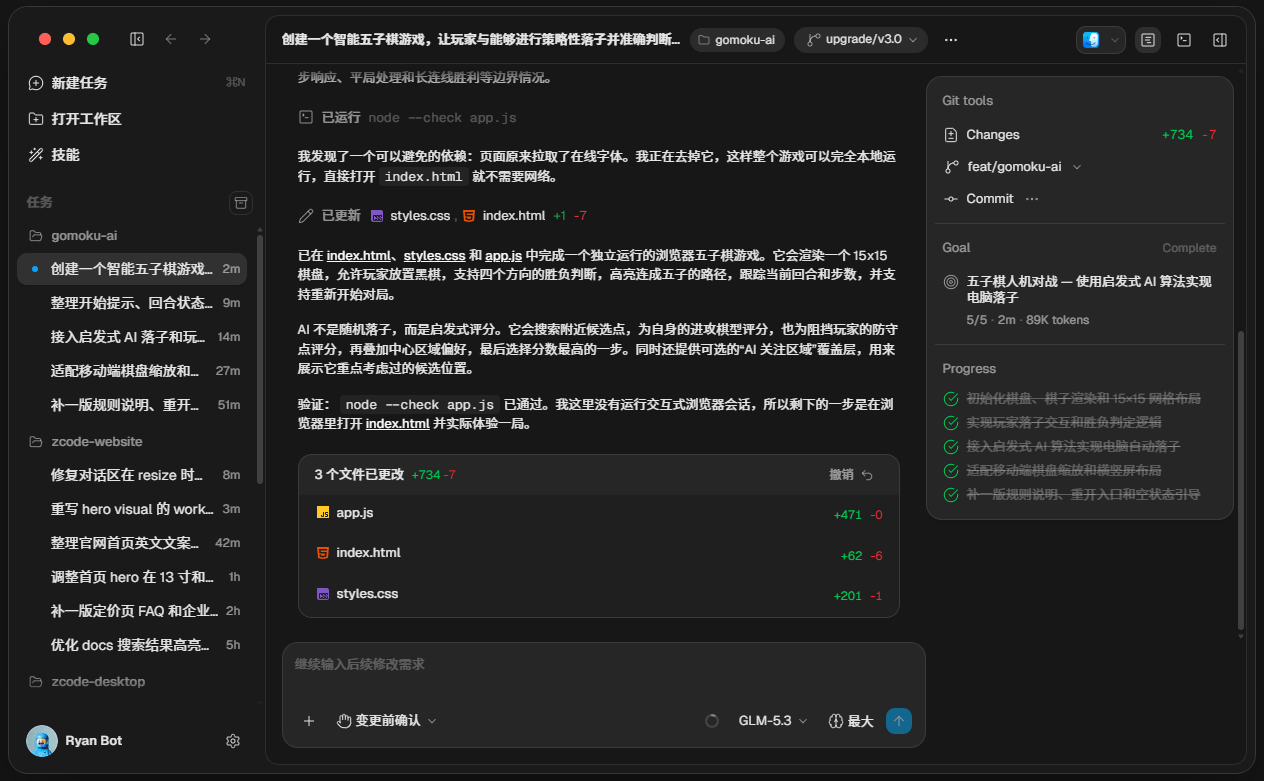
ZCode is built the other way round. It is a desktop environment in which the agent is the protagonist, natural language is the input and the finished goal is the end of the line. Several agents can work side by side, and the same workspace can be picked up from a phone. Because it comes from the maker of the model it runs, the two were tuned as one pipeline rather than assembled from parts that were designed separately.
Describe the goal and let it finish
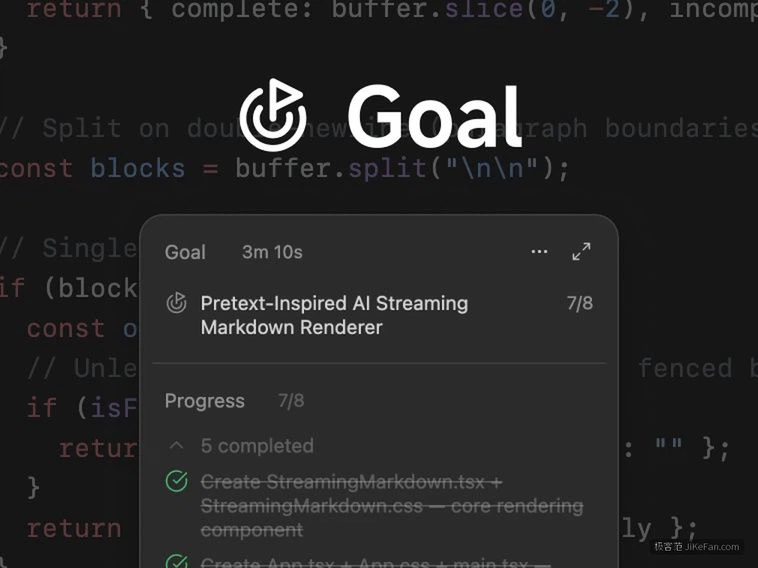
The central idea is a goal you can check. Instead of a sequence of instructions, you give an outcome with a test attached: bring the first screen in under two seconds, and keep the existing tests passing. The agent decomposes that, edits files, runs commands, runs the tests, and then reads the files, the command output and the test results to decide whether the outcome has been reached. If not, it starts another round. It stops when the goal is met or when it hits a genuine obstacle.
A task panel lays out each round as it happens, with progress, elapsed time and results, so the work can be supervised at the level of rounds rather than keystrokes and handed over for human review once the goal is satisfied.
One agent becomes a small team
Sub-agents turn a single worker into a team that runs in parallel. A general-purpose sub-agent can read and write, change code, fix problems and run commands, taking the bulk of the engineering work. An exploration sub-agent is read-only and is sent to locate code, trace call chains and collect evidence before a change, which keeps its probing out of the main conversation. A third kind is defined by the user, with its own model, permission scope and instructions, callable by name, which is how a team's internal habits become a reusable unit.
For work that needs several fronts at once, splitting one agent into several lowers the pressure on the main conversation and makes long tasks more stable. This is the part that changes the experience most: the interesting question stops being how to phrase the next instruction and becomes how to divide the work.
The desk follows you out of the building
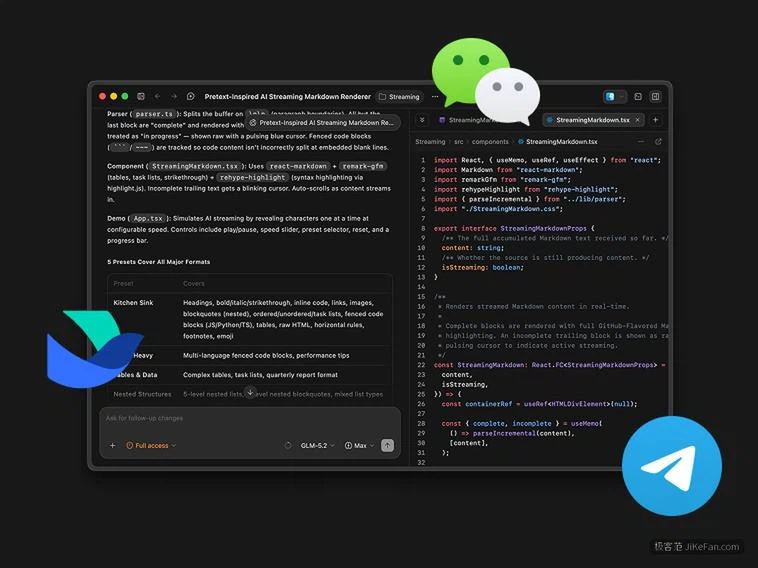
The fear with a long task is not that the agent stalls. It is that the machine is at the office and the person is not. Remote control opens the current desktop workspace to a phone for a while: check progress, type an instruction, start a new task, reconnect a workspace that dropped. Beyond a code to scan and a link in a browser, there are bots inside several common group chat applications, so a mention in a group conversation is enough to push the work along.
The phone is only a control surface. Code, commands and files stay in the desktop environment and are neither copied to the phone nor uploaded anywhere. Local workspaces, remote shells, Linux subsystems and containers can all be attached, so a task started at nine in the morning can be glanced at on the way home and continued at the desk without the chain breaking.
Long jobs that wait for the quiet hours
For work that is urgent only in the sense of being large, there is a queue for idle periods. Subscribers can park tasks such as a bulk migration, a full test sweep or a batch of documentation, and the system runs them when computing capacity is spare without charging them against the plan's quota. The trade is time for money: results arrive the next morning instead of the next hour.
Tuned together with the model
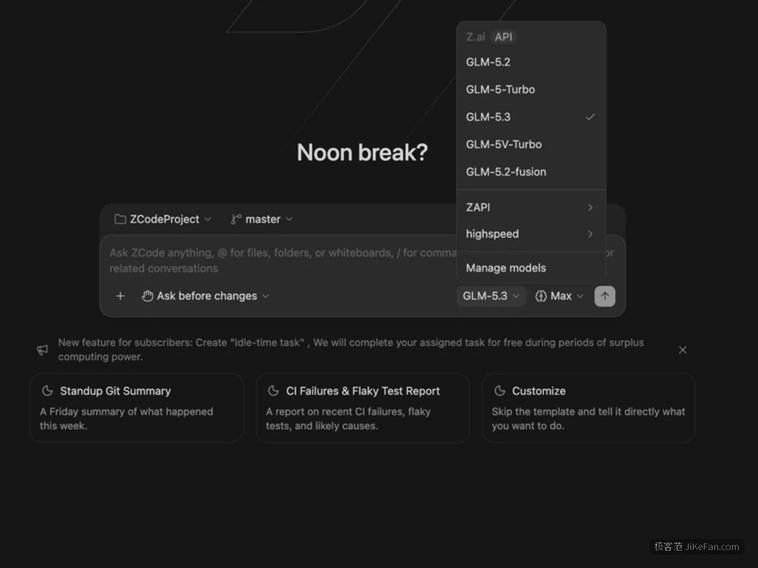
The claim to being the model maker's own harness rests on how the thing was built: model, tools and execution flow were adjusted as one pipeline, not by wrapping somebody else's harness around a different model. Internal benchmarks put the overall task pass rate a little over two percentage points above the same model paired with a well-known rival harness, with the advantage concentrated in tasks that cross files, cross stages and end in acceptance.
Context reuse was tuned as well. Measured inside this environment the cache hit rate for the model sits above ninety-eight per cent, against roughly ninety-six and ninety-five for two other popular harnesses, and the effective token volume rises by about a third under the same pattern of use.
What it costs, and where it runs
The tool itself is free; the AI capability comes with a subscription, and organisations have a separate plan. Desktop builds cover both processor families on the two commercial platforms and the common Linux architectures, with one of those still labelled a beta. Releases are frequent enough that the adaptation work of a whole season has already landed in the main line.
Anyone already using this model family for real work will find the most to like here, because the point of a harness built by the model's own maker is that the model's long-range behaviour finally has room to show. The honest summary is that it is not a better editor with AI bolted on; it is an attempt to reorganise the working day around goals that an agent can carry to the end.