
WTFast: a private network for game packets, and routing that picks the path itself
Summary
A private network built for game traffic alone: the client routes only the game packets onto a proprietary backbone, chooses a better path automatically, and leaves browsing and video on the original line.
Recommend- Name
- WTFast
- Version
- 5.5.42
- Pricing
- Paid
- Open source
- Proprietary
- Operating system
- Windows
- Website
- https://www.wtfast.com
- Updated
- 2026-10-06 22:02
A raid boss does not care how fast the line is. It cares whether the packets carrying the inputs reach the server before the mechanic resolves, and on the public internet that is decided by routing rather than by bandwidth. A game connection crosses a long chain of networks between a home line and a game server, and any congested or oddly detoured segment in that chain adds delay, drops packets, or makes the delay jump around. Skill does not compensate for that.
WTFast has been selling a fix for exactly this for years. As of 2026-09 it is one of the older names in what the company calls a Gamers Private Network: a private network built for game traffic rather than for everything else on the machine.

A private network for one kind of packet
The distinction that matters is scope. A general proxy or a whole-device tunnel takes every packet the machine sends and pushes it through a remote endpoint, which is a heavy-handed answer to a problem that lives in one application. WTFast does the opposite: the client recognises the traffic the game process generates, sends that traffic onto the company proprietary backbone, and lets the routing choose a better path to the game server. Downloads, browsing and video keep using the original line, neither taken over nor metered by the tool.
Two things follow. The optimisation is aimed at a single target, so the resources go into latency, packet loss and jitter on the game connection rather than into wrapping all traffic in an extra hop. And everyday use of the machine hardly changes, because nothing else about it does. The proprietary network is said to cover more than 1000 games, spanning the mainstream MMO, MOBA and FPS titles, and the list keeps growing.
Route selection learned rather than guessed
The other half of the product is where the choice of path comes from. The usual advice for a player with a bad connection is to switch nodes by hand and test until something improves, which turns network tuning into an evening of trial and error. WTFast instead measures the quality of the connection to the game server in real time and moves traffic onto a better path by itself. A panel in the client shows the packet journey from the machine to the server, including how the latency moves and where packets are lost.
Control is not taken away from anyone who wants it. Nodes and routing policy can be set manually, which matters to players who would rather understand a path than trust it. A live ping display shows average and peak latency at once, and the peak is usually the number that decides whether a fight feels smooth.
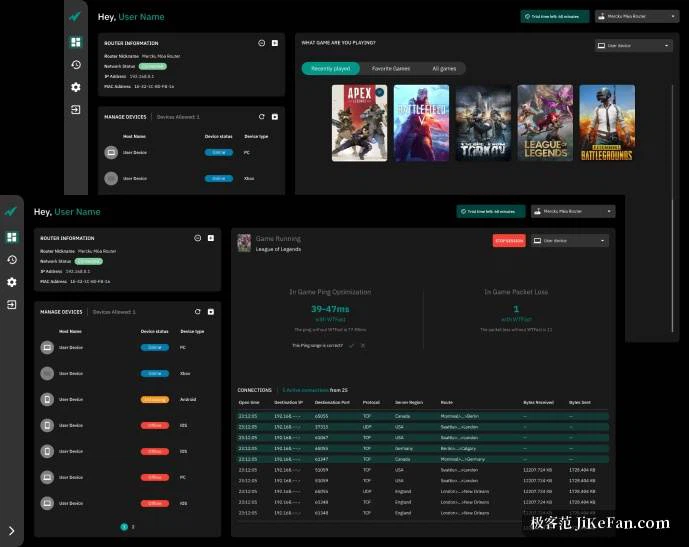
A subscription, and a trial that answers the question
WTFast is paid software sold as a subscription, and the pricing is the company business rather than the subject here. What matters more is the free trial, because this is a product whose worth cannot be read off a feature list. A player can measure latency and loss on the games they actually play, before and after, and decide on the difference. A subscription covers acceleration over the proprietary network, the client serves a single device by default, and more devices can be added separately.
Whether it pays off depends entirely on the route between the player and the server. Where that route is already good, the gain will be small, and an honest review should say so. Where latency is chronically high, packets are lost regularly and the delay spikes at peak hours, in cross-region play above all, the change is usually felt inside one match.
Who it is for
Three kinds of player, roughly. MMO players who have lived with latency and loss long enough to treat them as weather. Competitive FPS players for whom a stable connection is the difference between a fair fight and a lost one. And anyone playing on a server in another region, with friends in another country, where the distance itself is the problem. The client runs on Windows, and starting means creating an account and picking the game to optimise, which is a low bar.
The argument for a tool of this kind is not that it makes a connection faster in the abstract. It is that the specific path a game takes can be better than the one the internet happened to choose, and that the improvement can be measured before paying for it. Anyone worn down by a network failing at the worst possible moment has a way to check the claim with their own numbers.