
Special K: an open source toolkit that patches old games at the render stage
Summary
An open source framework for PC games that takes over rendering and input while a game runs. It offers a frame limiter tuned for variable refresh rate, adds high dynamic range to titles that never shipped it, and lets games designed for one controller recognise others.
Recommend- Name
- Special K
- Version
- 25.9.25
- Pricing
- Free
- Open source
- Open source
- Operating system
- Windows
- Website
- https://special-k.info/
- Updated
- 2026-10-12 11:24
An old game is not necessarily worn out; the environment it depended on has simply gone.
Starting from the rendering stage
Special K is an open source enhancement framework for PC games. The official description carries a touch of fondness: enthusiasts call it a toolbox for the PC gaming field, touching on many areas. What it is best known for is repairing and improving image output. Plenty of titles behaved correctly on the displays of their time and then showed misalignment, wrong colour or an unusable resolution on a new system and a new screen. This framework chooses to work at the rendering stage instead of staying with outer settings.
Around that, the project provides a large set of detailed performance analysis and correction modules, and the toolset keeps growing. The analytical modules quantify things that are normally invisible, such as the rhythm in which frames are produced; the correction modules act on specific symptoms. Together they form the main way the tool works.
The reason to work at that depth is simple. Outer settings can change what a game is told about the display, but when the game itself computes something wrongly for a modern screen, only something inside the render path can intervene. That is also why the tool is more invasive than a configuration tweak, and why the licence and the source matter in judging it.
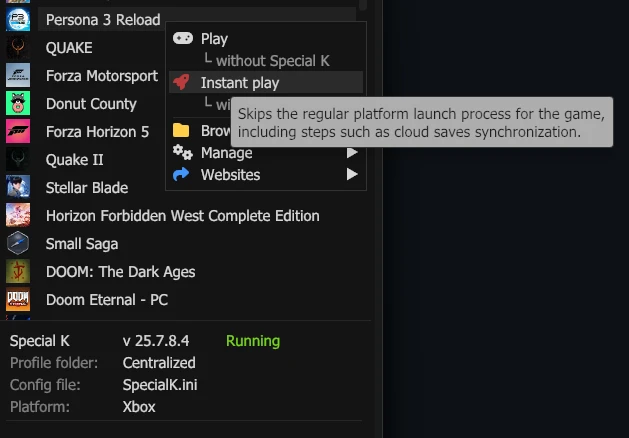
Frame rate, image and controllers
Frame rate control is among the most used parts. The project supplies an advanced frame limiter with automatic variable refresh rate optimisation, aimed at making the delivery of frames steadier. When the rhythm wobbles, the picture shows it as small stutters; tying the frame limit to what the screen can actually refresh is the usual way to settle that.
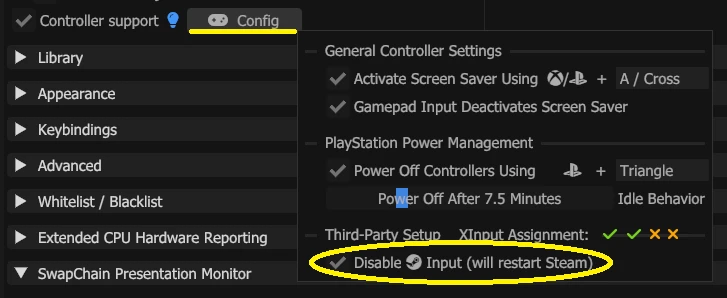
In image enhancement the best known piece is wider light and dark range for older titles. The official notes say the capability covers OpenGL, Vulkan and Direct3D 11 and 12, and targets games that never shipped such an effect. Input gets matching treatment: an emulation layer lets games that only understand one kind of controller recognise others, and the example the project gives is precisely an older title designed around an Xbox pad. An achievement tracker is built in as well, able to play a sound and take a screenshot when something unlocks.
There is a broader point in that combination. A game from fifteen years ago was written against a fixed idea of hardware, and every one of these modules relaxes one part of that assumption. None of them changes the game, which is why the results tend to look like the same title on better equipment rather than a remaster.
Item | Official notes |
|---|---|
Strength | known for repairing and enhancing image output |
Analysis | a large set of detailed analysis and correction modules |
Frame rate | advanced limiter with automatic variable refresh optimisation |
Image | high dynamic range for OpenGL, Vulkan and Direct3D 11 and 12 titles |
Input | a controller emulation layer |
Achievements | sound and automatic screenshot on unlock |
Platform, versions and licence
On platform, Windows remains the main target. The official notes say the project can run inside a compatibility layer alongside a graphics translation layer, but that a switch must be enabled in each game s profile for it to work on Linux. In other words Linux is a case of can run, with item by item configuration per the official notes.
Versions use a date based number, and the latest in the repository is 25.9.25, released on 25 September 2026, with even newer entries in the source history. On licensing, the project states the source is published under version 3 of the GNU General Public License and hosted in a public repository. That licence keeps derived versions open as well, and readable source lets the way it works be examined piece by piece, which matters a great deal for a tool that reaches deep into a game process.
Mending the seam between new hardware and an old title is what keeps the quality of the game itself from being diluted by its environment.
A few suggestions. Take a signed build from the official release page and avoid packages of unknown origin. Try it on a save you do not care about first, and confirm both picture and controls behave before pointing it at a long running one. After installing, enable features one at a time, because changing several at once leaves you unable to tell which one caused a problem.