
Vita3K is an open source PS Vita emulator in C++, with nightly builds on four platforms
Summary
Vita3K is an open source PS Vita emulator written in C++, shipping nightly builds for Windows, Linux, macOS and Android. More than half the tested titles are marked playable.
Recommend- Name
- Vita3K
- Version
- 4206
- Pricing
- Free
- Open source
- Open source
- Operating system
- WindowsLinuxmacOSAndroid
- Website
- https://vita3k.org/
- Updated
- 2026-10-21 12:46
Vita3K is an open source PS Vita emulator written in C++, with nightly builds for Windows, Linux, macOS and Android. It does not try to swallow the whole console at once; instead it turns which games run into a public compatibility table and pushes one cell at a time.
What it is
The project started in early 2018, the repository is C++, and the licence is GNU GPL version two. The site describes itself as the first PS Vita emulator that actually runs, with the word experimental placed at the front, which says it does not pretend to be finished. Front page, quick start, FAQ, compatibility table and blog sit on separate pages, and the weight clearly is not on presentation.
One thing belongs up front: the emulator carries no games. The footer states that this is an independent project with no affiliation to the console maker, and that no non-public material from that side was used as a basis. Making it run assumes you own the handheld yourself, with cartridges or a digital copy you bought, and that the game is exported from your own machine. All it does is rewrite the behaviour of that hardware in software; where the game comes from is the user s business.
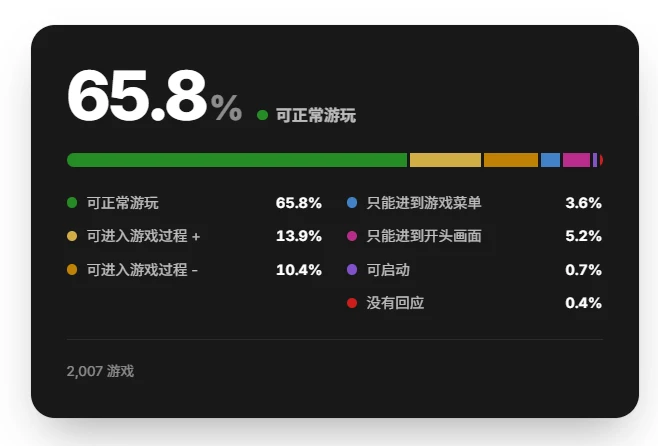
The compatibility table: more than half marked playable
Progress is accounted for on one table. The official FAQ is plain about it: more than half the tested games are currently marked playable, but not every one runs, so do not expect a perfect process; of the exclusive titles, most now reach gameplay or can be played from start to finish.
The table splits status into seven grades, from cannot start at all through a black screen, the opening movie, the menu, a game that seizes up early, and a game with faults that spoil the experience, up to finishing it. A progress report from July 2024 gave the distribution.
Status in the July 2024 report | Share of tested games |
|---|---|
Playable, finishable | 57 percent |
Runs, with faults that spoil the experience | 16 percent |
Runs, with many problems | 12 percent |
Menu, intro, boot only, or nothing | about 15 percent together |
The project admits the table cannot keep up with development. The top of the compatibility page says straight out that the backend is being reworked and the table no longer reflects the emulator as it stands, and asks people to retest their own games against the newest build every few weeks. The numbers are a floor, not a finish line.
The bar is a little higher than it looks
The minimum is a 64-bit x86-64 or ARM64 processor, a graphics card with OpenGL 4.4, and 4 GB of memory; the system wants Windows 8 or newer, macOS 13.3 or newer, or 64-bit Linux. On a phone it takes an AArch64 processor, Vulkan 1.0 support and system version 7.0 or above.
The recommended set is the real comfort zone: a card with Vulkan and shader interlock, a processor with AVX, and 8 GB of memory or more. The site points out that almost every compatibility report was measured on that recommended set, so a machine barely clearing the minimum cannot be promised the same behaviour.
What using it is like
The core is a screen of games laid out as cover tiles. A right click opens a menu carrying launch, check compatibility, copy application information, configure on its own, open the folder and details, so every game can hold its own settings rather than one global rule. The rear touch panel is simulated with the right mouse button, keyboard and mouse work directly, and SDL3 controllers are supported, with DualShock 4 and DualSense the ones the site recommends.
System-level features have arrived across the progress reports: saves, trophies and interface language switching were all filled in. The interface itself offers seven languages, traditional Chinese among them.
Online play is only half done
The site is clear about playing against a real console: that means going through the maker s official network service, which is technically obstructed and legally worse. Local play is partly done, and some commercial games can link a few devices into a small network through a tunnelling tool. So multiplayer is half a feature: a session among friends is feasible, connecting to real servers is not worth planning.
Rhythm: nightly builds, no version numbers
The project issues no stable release. The build repository carries consecutively numbered nightlies, the newest being 4206, dated 19 October 2026. The gain is fast fixes; the cost is that there is no stable version to point at, so you take the build of the day and step back a few numbers when something breaks.
The progress reports are casual as well: three in 2018, then one in 2021 and one in 2024, titled simply three year progress report. The pace is slow but it keeps moving, and the last commit to the main repository was on 19 October.
Who it suits
It suits people who still have the handheld and the cartridges, who are willing to tinker, and who will look up where their own title sits in the table. It does not suit anyone wanting to play out of the box: installing system firmware, exporting a game from a console you own, and tuning settings per title are all manual steps.
Seen from another angle, the value is not all in how many games run. Taking a handheld s hardware apart, rewriting it in software, and laying the result out as a public seven-grade ledger, which chip is still not understood and which game stops where, puts everything in the open. That habit of publishing progress is worth more than the percentage on the table.
Vita3K rewrites the running logic of a handheld in C++, ships nightly builds on four platforms, and marks more than half the tested games playable. It issues no stable release, publishes a progress report every few years, and moves forward on a public table and build numbers. Using it means accepting its premise first: the game has to come from hardware you hold.