
Work Review Answers the Question of What You Actually Did
Summary
A local-first recorder that watches which applications and pages you use, assembles them into one continuous timeline, and writes a structured daily report you can export, with optional AI assistance that can be switched off entirely.
Recommend- Name
- Work Review
- Version
- v1.0.48
- Pricing
- Free
- Open source
- Open source
- Operating system
- WindowsmacOSLinux
- Website
- https://aiqst.com
- Updated
- 2026-10-16 22:00
The end of a day with nothing to show for it
Writing a weekly report and being unable to remember what happened this week. Preparing a yearly review and finding no trace of what was finished six months ago. Being asked what you have been busy with and discovering that the honest answer is a shrug. These are not usually signs of idleness. They are signs that the evidence was never kept — work leaves traces while it is happening and then dissolves into a desktop with forty windows and no record of any of them. What this tool does is unremarkable and useful: it writes those traces down quietly in the background and hands them back as a single continuous line.
A timeline rather than a diary
The distinction matters. A diary requires an act of will at the end of the day, and the days when you most need the record are the days you least want to write it. A timeline requires nothing: from the moment the machine is unlocked, the recording has already started. The application in front of you is identified, the time spent in it is measured, its window title and its category are noted, and the result is appended to the day's sequence. Nothing needs to be remembered later because nothing was trusted to memory in the first place.
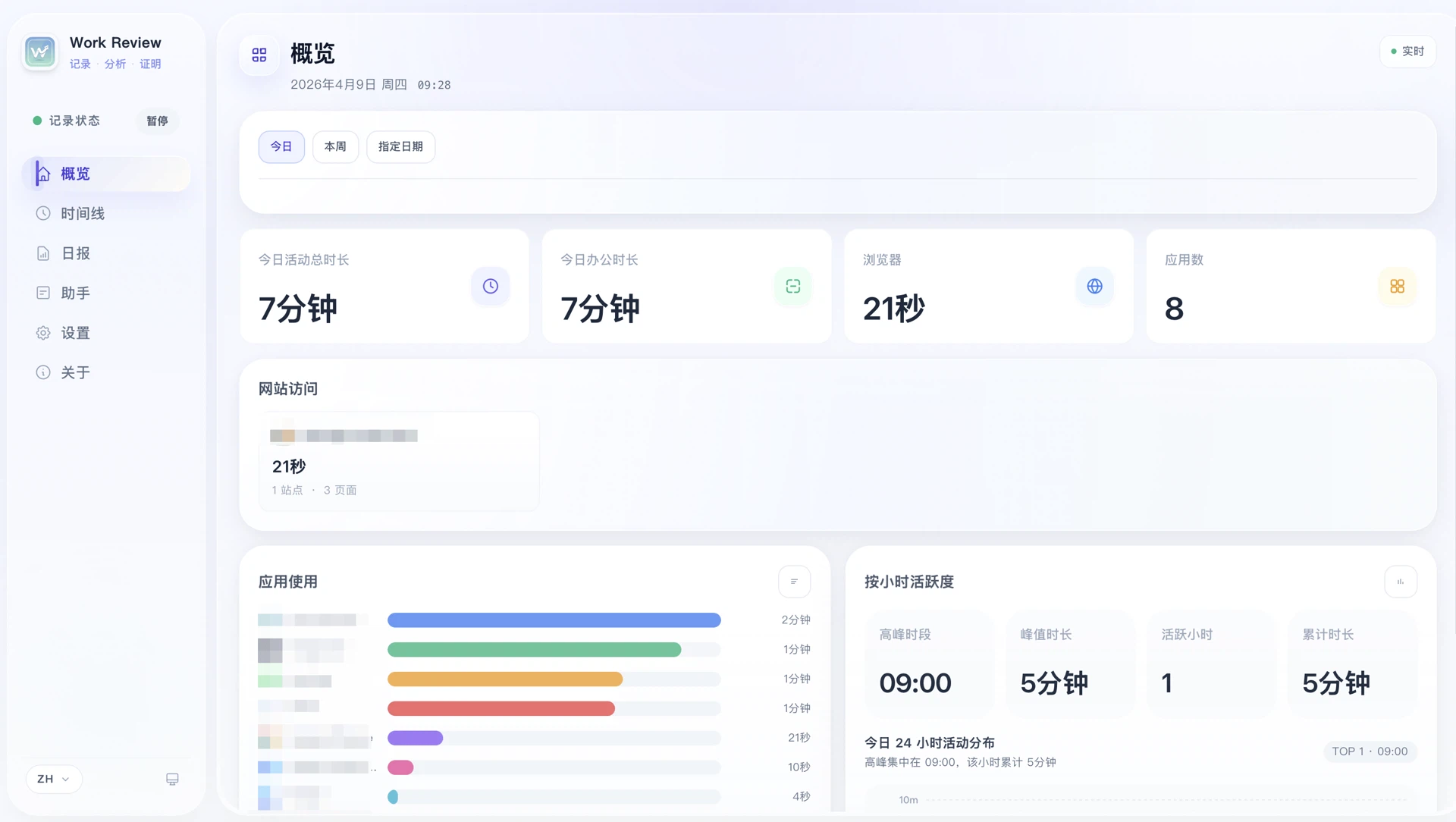
Browsing is treated the same way. The address bar is read, and visits are aggregated by browser, by site and by page, so an afternoon of research appears as an afternoon of research rather than as a list of typed addresses. Because applications and pages end up in the same sequence, the question people actually ask — what was open at nine, where did I switch at ten — has a direct answer instead of an archaeological one.
Local by default, and AI strictly optional
The recording lives in a local database on the machine and is not uploaded anywhere by default. For software that observes every window and every page, this is not a detail but the condition of using it at all: the argument for keeping a record of your own work is that the record belongs to you. Anyone who wants to keep it entirely offline can, and the recording functions do not depend on anything outside the machine.
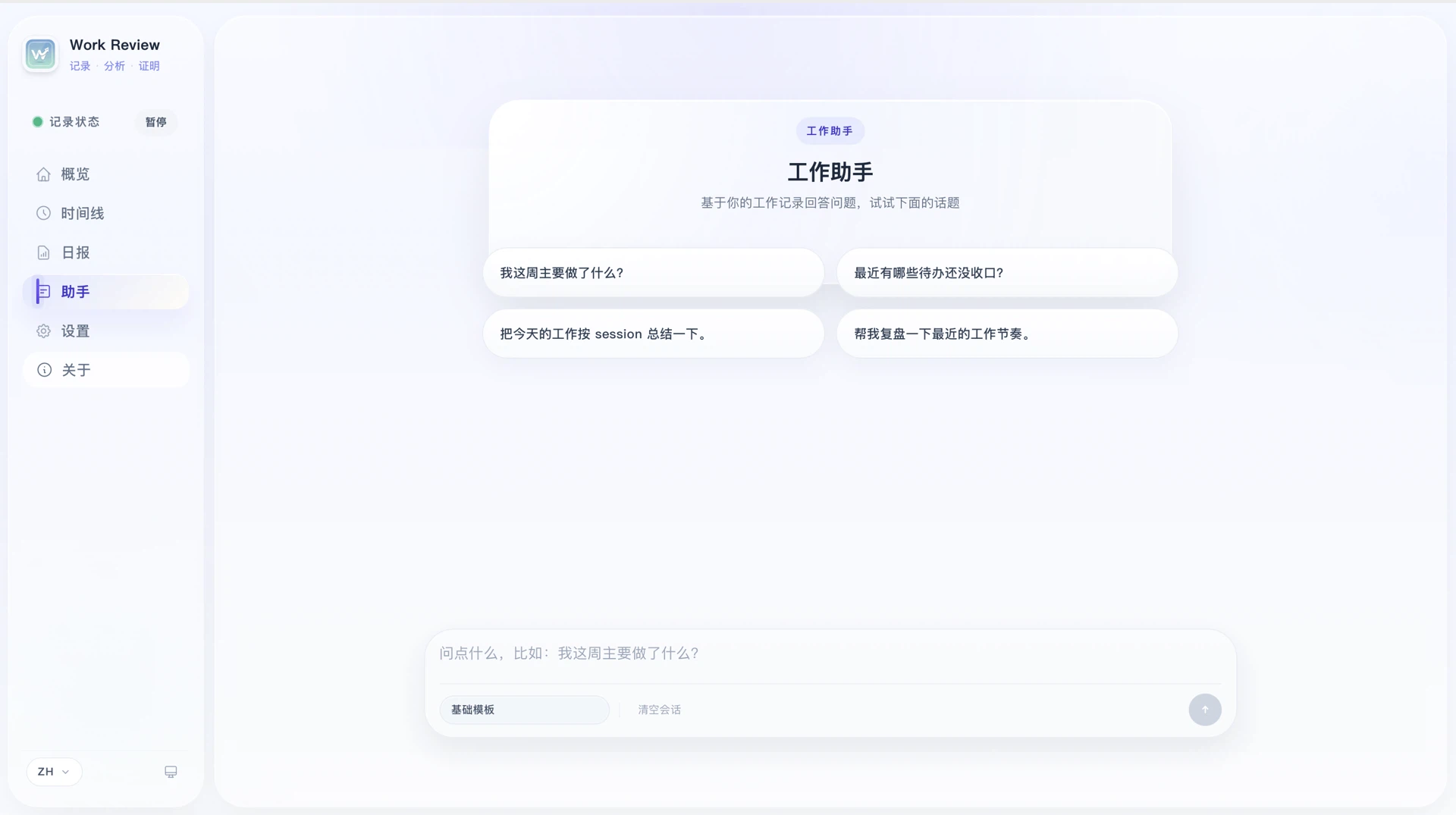
The assistant features are clearly marked as optional and can be turned off, and turning them off does not degrade the rest. That is a more honest arrangement than the usual one, where the intelligent part is the product and everything else is a funnel toward it. Here the timeline and the report stand on their own, and the assistant is an addition for people who want to ask their own records questions in words.
The report at the end of the day
Beyond looking back, the day can be summarised. A structured report is generated from the day's records, exportable as Markdown, and an automatic export location can be set so that finishing work produces a file rather than a task. For anyone who has to account for their time to someone else — a manager, a client, a timesheet — this converts an evening of reconstruction into an artefact that already exists.
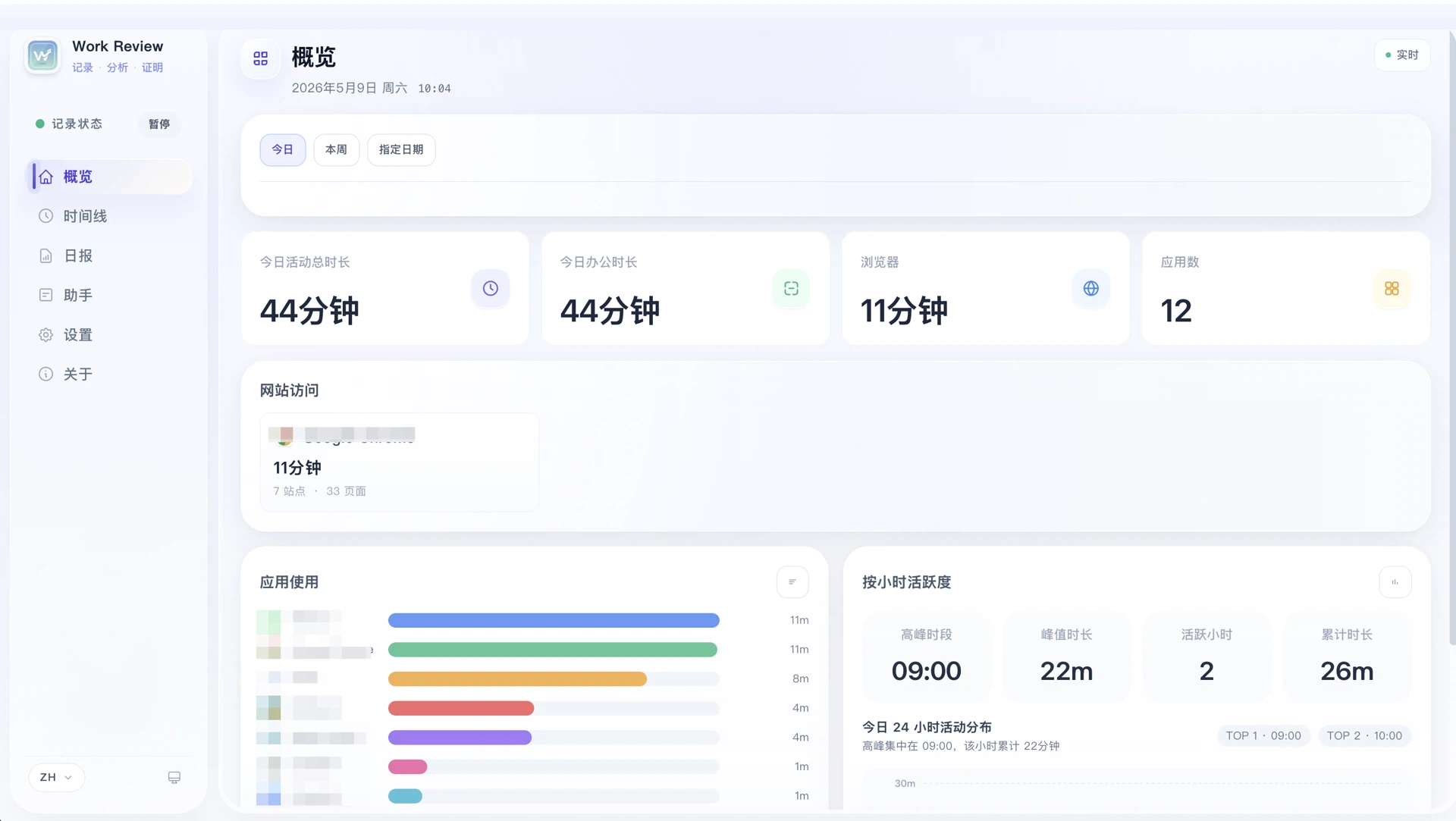
Three views carry the reading. The overview totals time by application category, which answers the question of where the hours went at a glance rather than by arithmetic. The timeline presents applications and pages in the order they occurred, which is what reconstructing a day actually requires. The assistant, when enabled, answers questions about the local records in ordinary language: what was used today, which application took the most time. Each answers a different question, and none of them requires the others.
A small cat in the corner
The most recent addition is a desktop companion: a small cat that sits in a corner of the screen and reacts to what you are doing. It is a trinket, and it is described as one, but it solves a real problem that every background recorder has — invisibility. Software that runs silently is easy to forget, and forgetting it is how people end up surprised by a record they did not know was being kept. A character that occasionally moves is a reminder that the thing is running, which is a more useful kind of presence than a notification.
Three systems, and what each one asks for
The platform situation is worth stating precisely, because a recorder is exactly the kind of program that needs permissions and therefore runs into differences. On Windows there is an installer, and it depends on the system's web runtime component being present. On macOS the packaged disk image requires two grants before it can do its job — screen recording and accessibility — which is the platform's normal requirement for anything that observes other windows. On Linux there are packages for both the ordinary and the ARM architecture; the screenshot capability depends on which kind of desktop session is running, and support under the newer display protocol is limited. None of it is surprising, and all of it is better known before installing than after.
For anyone who regularly cannot say what they did today, this keeps the evidence without asking for discipline. Local first, open, free, and available on the three desktop systems — for people who care about privacy and still need to review their own work periodically, it is a reasonable thing to try.
The honest summary
The idea is old — time tracking has existed as long as workplaces have — and what is new is the restraint. Nothing is gamified, nothing is scored, no productivity judgement is offered. It records, it assembles, it summarises, and it stays on your machine. That modesty is the reason it can be trusted with something as revealing as a full record of where your attention went, and it is also the reason the record is worth having: the point is not to be measured, but to be able to answer, honestly and without effort, what the last month actually consisted of.