
Udio review: extend, inpaint and remix, with three full songs a day for free
Summary
Udio treats generation as a starting point rather than the end: extend a sketch, inpaint one section, remix an existing track, or build from your own audio. The free tier gives 100 credits a month and three 130-second songs a day.
Recommend- Name
- Udio
- Version
- 20260917
- Open source
- Proprietary
- Operating system
- Web
- Website
- https://www.udio.com/
- Updated
- 2026-10-06 07:57
Most AI music tools end their story at generating a song. Udio frames itself differently on the official site — it calls generative music a starting point rather than a destination. The first version is the front half of the process; behind it sits a set of tools for taking the song apart, changing it and putting it back together.

First run: start from one description
The entrance is a single sentence: make any song, as long as you can imagine it. The actual path is not complicated either. Say what you want, with genre, mood, instruments and language all allowed in the description, and Udio returns a first draft with vocals and arrangement. If the direction is wrong, change the prompt and go again, and a failed attempt costs almost nothing. That is exactly where the process differs from writing by hand: overturning a direction used to cost days of work.
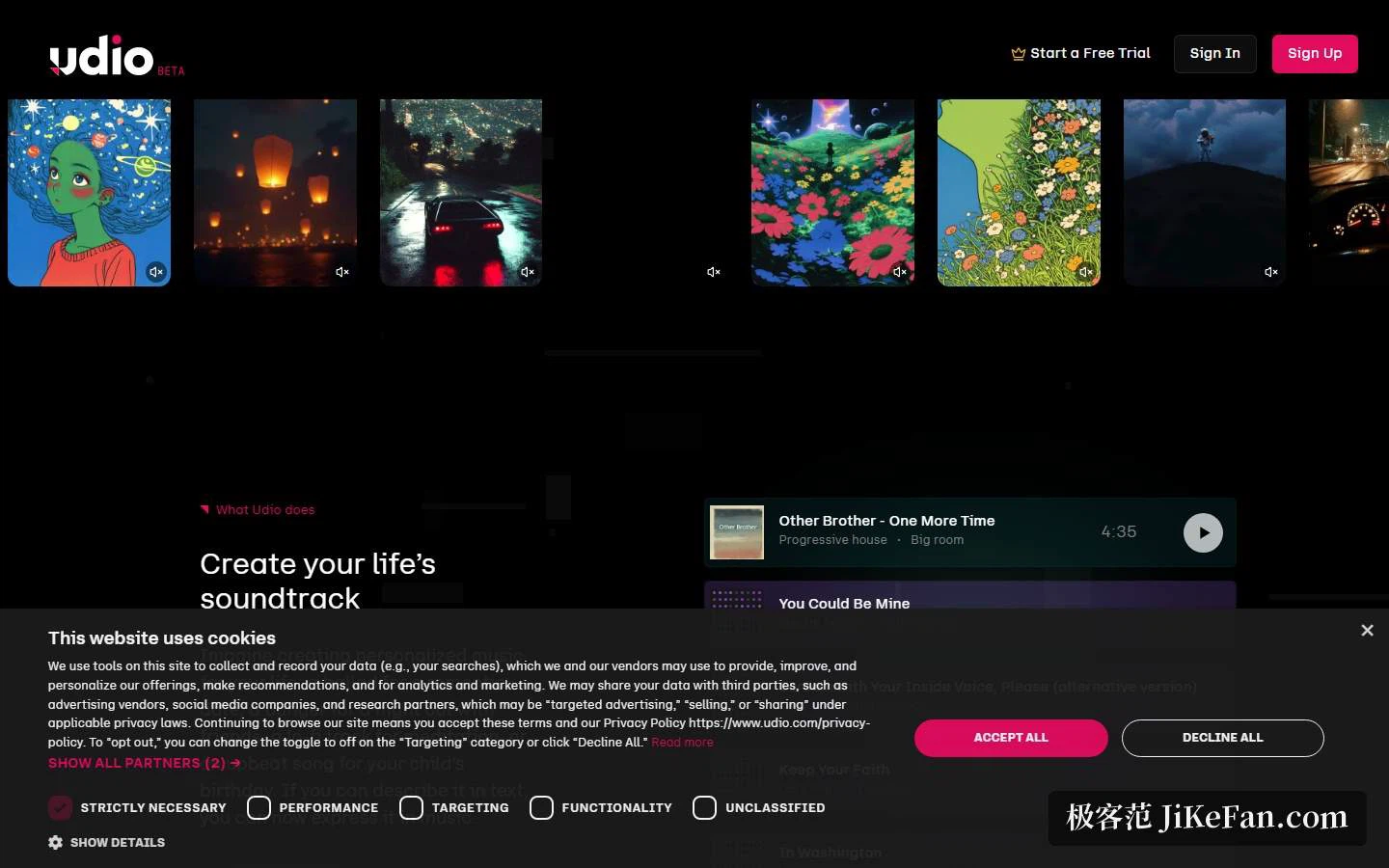
If the prompt is hard to write, listen to finished work on the home page first. The site tags tracks by style — progressive house, electro house, alternative rock, dark pop, synthwave and so on — and hearing what others made, then working backwards to your own description, gets you going faster than reading a guide.
What you can do after generating: extend, inpaint, remix
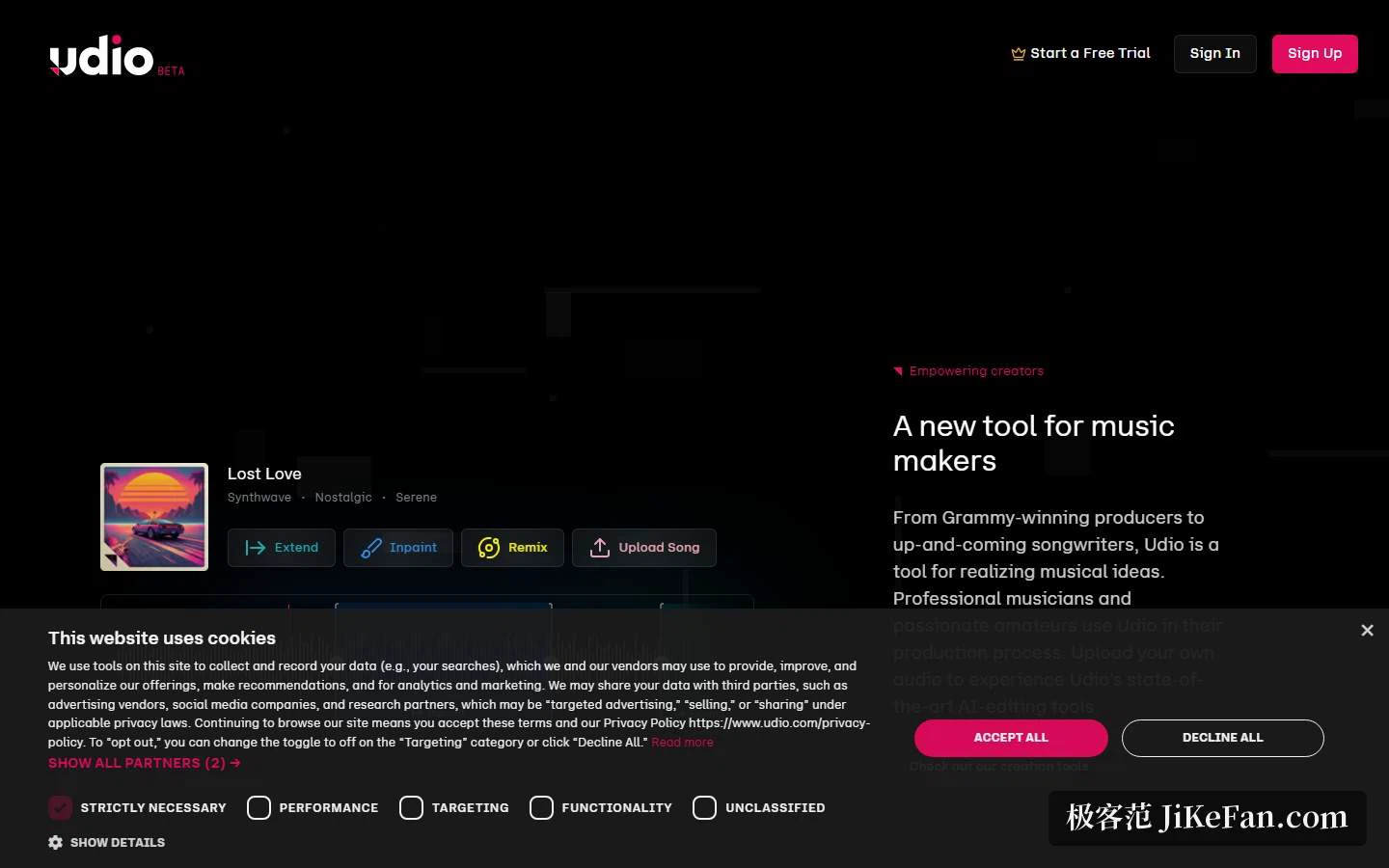
The site groups the creative tools into four entrances: extend, inpaint, remix and upload song. The first three carry real weight for people producing content.
Extend solves the song being too short: a 30-second idea can be continued into a full structure. Inpaint solves one section being wrong: instead of regenerating the whole track, redraw only the passage that needs it. Remix treats an existing piece as material and works from it, changing style, arrangement or delivery from the same starting song.
Material, voice and style: three levers you can hold
The first lever is voice. Udio ships its own voice library, and paid tiers let you save and reuse your own voice — meaning one timbre can recur across pieces so a series keeps its identity.
The second lever is style. The site calls this Styles, and the method is to take an existing piece of music as a style reference and steer a new song toward it. Paid tiers add finer operations such as artist style, style blending and style reduction. For anyone who struggles to describe music in words, a reference clip usually beats a long prompt.
The third lever is material. Udio accepts your own audio files as a starting point — drop in a vocal line, a guitar part or an ambient recording and let it grow onward. That step turns the tool from conjuring songs out of nothing into finishing what you already have.
The free tier's edge: enough to play, not enough to produce at volume

The site is candid about the free tier: 100 credits a month, at most 10 credits a day and they do not accumulate, up to three 130-second full songs a day, and at most four running at once. That is enough to try the tool, a style and a prompt, but continuous output hits the three-a-day ceiling quickly.
Standard unlocks exactly the levers described above: voice control, lyric and music editing, generation from uploaded audio, style reference and custom cover art, and it removes the three two-minute songs a day limit. Pro raises credits to 6000 and parallel generation to 10, positioned by the company as the fully loaded tier for high-frequency creators.
Credits do not roll over: what is unused in a month is lost, which matters when planning a budget. Once the allowance runs out they can be bought separately, at 3 dollars for 100 credits and 25 dollars for 1000 on the official page. Per credit the 1000 pack is much cheaper, so if long-term use is certain it is the better buy. There is also a student price worth checking if you qualify.
On the numbers: free is 0 dollars with 100 credits a month, 10 a day, four in parallel. Standard is 8 dollars a month, or 96 dollars billed yearly, with 2400 credits and six in parallel. Pro is 24 dollars a month, 288 yearly, with 6000 credits and 10 in parallel.
Afterwards: publish and be discovered
Sharing is built into the flow. A finished song can be published straight to the platform, where others can listen and follow you, and a creator community forms gradually. For listeners it doubles as a place to find new work. The site puts it as publishing so people hear it, following creators you like, and joining a community of creators, artists, musicians and music lovers. For someone starting out, that publish-and-be-heard path is far less work than building an audience alone.
Who it suits
Udio fits people who already have AI music in their workflow: short video that needs a set of background tracks, a podcast that needs a fixed intro and outro, a small game that needs several loops. Those needs are high in volume, steady in quality and not chasing artistry, and trading credits for time is the plain arithmetic.
If the goal is a song that is genuinely your own, the value sits mostly in the front half: use it to expand a motif into a full arrangement, then take the structure, harmony and instrumentation into your own audio workstation and rebuild it. What the AI hands back is closer to a sketch than a finished record.
One last warning: when publishing generated music, the scope of the licence, whether commercial use is allowed, and whether imitating a particular artist's voice or style is acceptable all need confirming in advance. These boundaries are judged differently from place to place, and reading the terms first is much easier than repairing things afterwards.
The most valuable part of a generative music tool is often not how good one attempt is, but that it presses the cost of trying down to almost nothing. You can hear ten directions before choosing one, which was unthinkable before.