
Transmission is a free open source BitTorrent client that will sit quietly on an old PC or a NAS
Summary
Transmission is a free open source BitTorrent client known for very low memory and processor use, with native interfaces on three platforms, a daemon of its own and web remote control; stable version 4.1.3 fixes security flaws.
Recommend- Name
- Transmission
- Version
- 4.1.3
- Pricing
- Free
- Open source
- Open source
- Operating system
- WindowsmacOSLinux
- Website
- https://transmissionbt.com/
- Updated
- 2026-10-10 19:09
Transmission is an open source BitTorrent client that has been going for twenty years, and it puts its weight on sitting quietly in the background: memory and processor use are among the lowest in the field, and it offers native interfaces on macOS, Windows and Linux.
Its position is very clear: it does not chase the longest feature list, it is a small machine that does downloading and seeding and nothing else. The home page puts Fast, Easy and Free in the heading and makes the lowest memory and resource use among mainstream BitTorrent clients the core selling point. The lightness is not a line of marketing either, it can be checked: the client carries a core library called libtransmission, written by the same team that maintains the project and shared with no other client, so a whole desktop toolkit or script runtime does not have to be dragged in and the package stays small. That is also why it turns up inside router firmware and network storage devices, why several storage and router makers ship it, and why more than one Linux distribution picked it as the default BitTorrent client.
On protocol ability, Transmission covers the most practical layer of the BitTorrent network. It fully supports magnet links and .torrent files, supports transfer encryption, and builds in three peer discovery mechanisms, PEX, DHT and LPD: PEX lets peers that already have a connection swap the lists of peers they know, so one peer in hand quickly leads to more; DHT goes through a distributed hash table, sometimes slower, but often still finds peers when PEX, LPD and the tracker have all failed; LPD is there to discover other peers quickly inside a local network. It also supports uTP, a transport that judges by latency and slows down by itself when latency rises, giving bandwidth back to ordinary browsing; from version 4.1 it added IPv6 and dual stack UDP tracker support, and support for BitTorrent v2 and hybrid torrents.
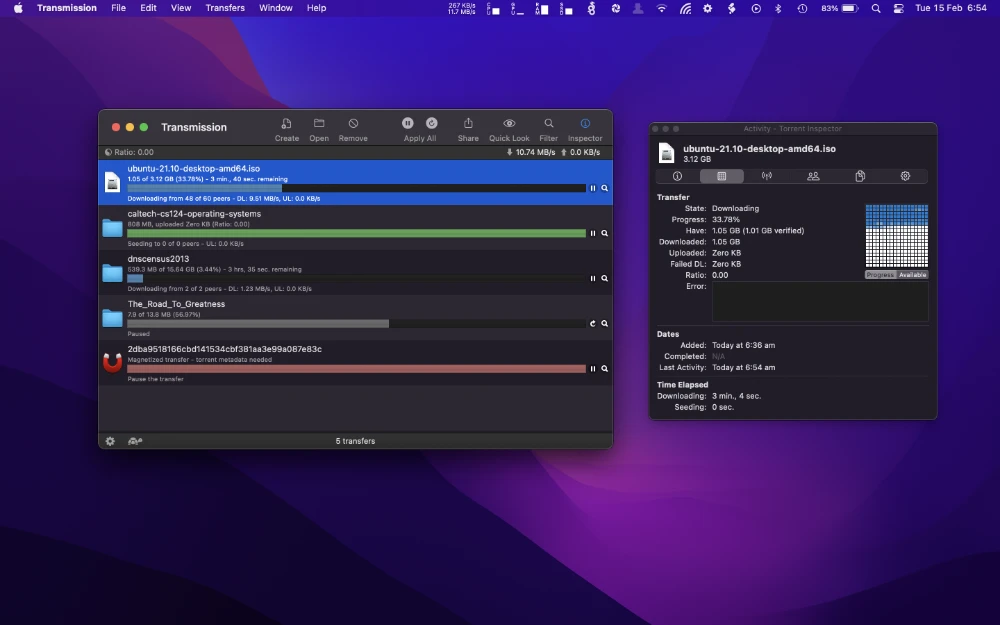
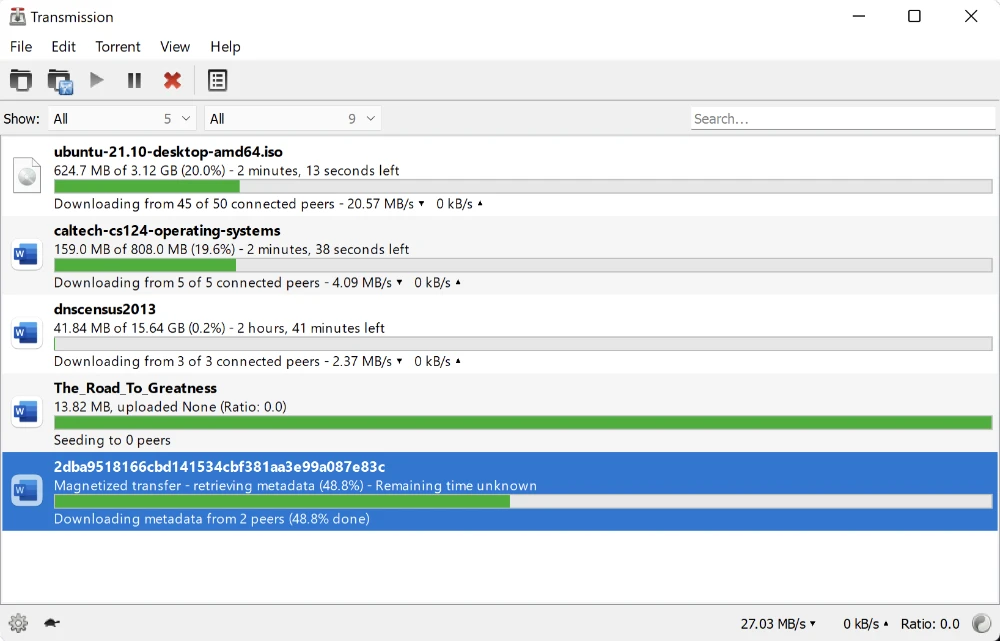
What really keeps it standing on small machines is the product shape. Transmission is not one program but a set of clients sharing one core: on macOS it is a native application, on Windows it uses a Qt interface adapted for newer systems, on Linux it offers both GTK and Qt interfaces, and on top of that there is a daemon needing no graphical desktop that runs straight on servers and routers. The daemon carries a web interface, so opening a browser is enough to change parameters, add jobs and watch progress, and to set the port, turn on username and password authentication, and restrict access to given addresses. On the command line side there is a full remote management tool plus several small utilities for inspecting, creating and editing torrent files. Put another way, one machine can take the downloads entirely in the background while another only looks in from time to time.
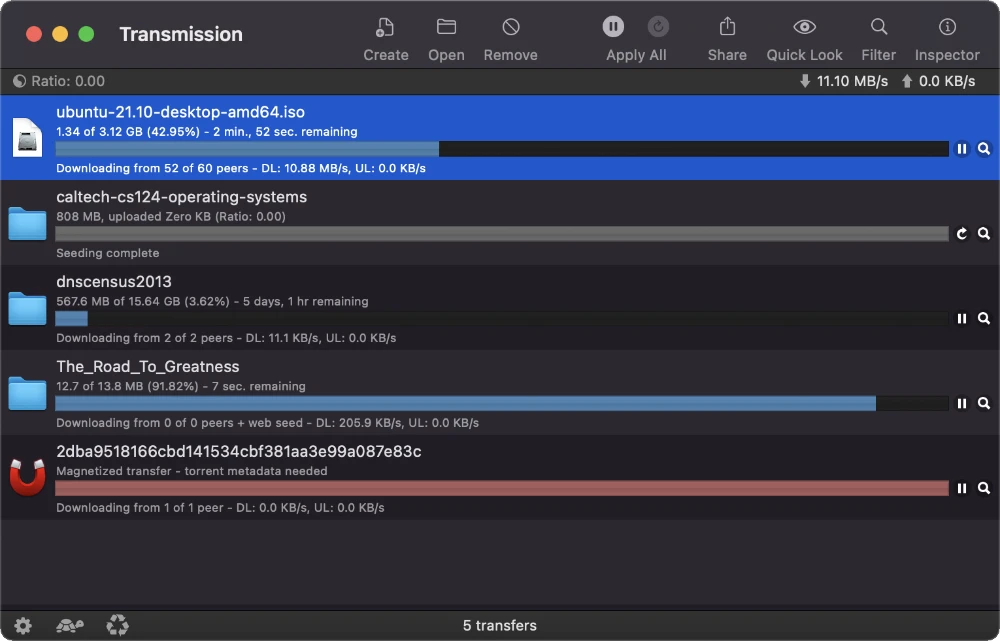
The interface itself takes the restrained road: the defaults are good enough to use, and nothing that needs fine tuning is missing. The main window has menus and a filter bar on top, and when several dozen jobs are open the filter narrows the field quickly; each job can be rate limited on its own and given its own maximum peer count, and limits can be set separately for the global and the per job level. It also supports bandwidth scheduling to put transfers in idle hours, directory watching so a torrent dropped into a folder joins the list by itself, and peer blocklist subscription with regular updates. Once jobs pile up, groups can colour different kinds of download so they are told apart at a glance.
The detail panel for a single job deserves a few sentences of its own. Double clicking any job opens its properties and inspector, which gathers the current state, completion, downloaded and uploaded volume, the ratio and the error log; below that it lists when the job was added, when it was last active, and how long it has been downloading and seeding. In a multi file torrent each file can be ticked for download or not, and given a high, normal or low priority of its own, so the files that are really wanted finish first. There is no fancy visualisation here, but every number that should be there is there.
The version line is clear as well. The 4.0 series in 2023 moved the core from C to C++ with a large refactor and began native support for Apple silicon; 4.1.0 in January 2026 was a major update more than a year in the making, with the vendor listing better uTP download performance, IPv6 and dual stack UDP tracker support, a remote control interface brought in line with JSON-RPC 2.0, optional sequential download, and a core that uses less processor and makes fewer unnecessary heap allocations. The clients on each platform followed: macOS improved its dark mode, the Windows Qt client took the system native icons and gained labels, the GTK client moved to the native file chooser, and the web client accepts torrents dropped onto it.
Version | Released | Main changes |
|---|---|---|
4.1.3 | June 2026 | Maintenance release, fixing a cross site request forgery nonce leak and a use after free in the peer code |
4.1.0 | January 2026 | Better uTP performance, IPv6 and dual stack UDP tracker, remote interface on JSON-RPC 2.0, sequential download added |
4.0 series | 2023 | Core moved from C to C++ with a refactor, native support for Apple silicon began |
On licensing, the agreement file at the root of the official repository states that it may be redistributed and modified under the terms of GNU GPLv2 or GNU GPLv3, and notes that some source files carry a more permissive licence. There is no paid edition, the installer carries no toolbar and no promotional pop up, and neither the site nor the community forum runs third party advertising or analytics. For software meant to sit on an old computer or a storage device for a year without attention, that character of needing nothing from you may be worth more than ten extra features.
Transmission trades the lowest resource use for the most worry free long run: native interfaces on three platforms, a daemon and web remote control of its own, encryption and PEX, DHT and uTP all present, and stable version 4.1.3 is a security maintenance update.