
Storj review: object storage that assumes the provider cannot be trusted
Summary
Files are encrypted on your machine, split into pieces and scattered across independent nodes, so no single operator holds a complete copy. The interface, conveniently, is ordinary S3.
Recommend- Name
- Storj
- Version
- 20260923
- Pricing
- Free
- Open source
- Proprietary
- Operating system
- WebWindowsmacOSLinux
- Website
- https://storj.io/
- Updated
- 2026-10-08 20:27
Trust is an architectural decision
Ordinary cloud storage asks you to accept a simple proposition: the provider holds your data, promises to encrypt it at rest, and is trusted not to look, not to lose it and not to hand it over. Most of the time that trust is well placed. The problem is that it is a promise rather than a property, and a promise can be broken by a policy change, an insider, a misconfigured bucket or a court order that nobody tells you about.
Storj treats that trust as the thing to design away. A file is encrypted on your machine before anything leaves it, split into pieces, run through an erasure code that adds redundancy, and then distributed across thousands of independently operated storage nodes. Any single node holds a fragment that is useless on its own. Recovering the file requires assembling enough of those fragments, and the provider cannot do it any more easily than anyone else.
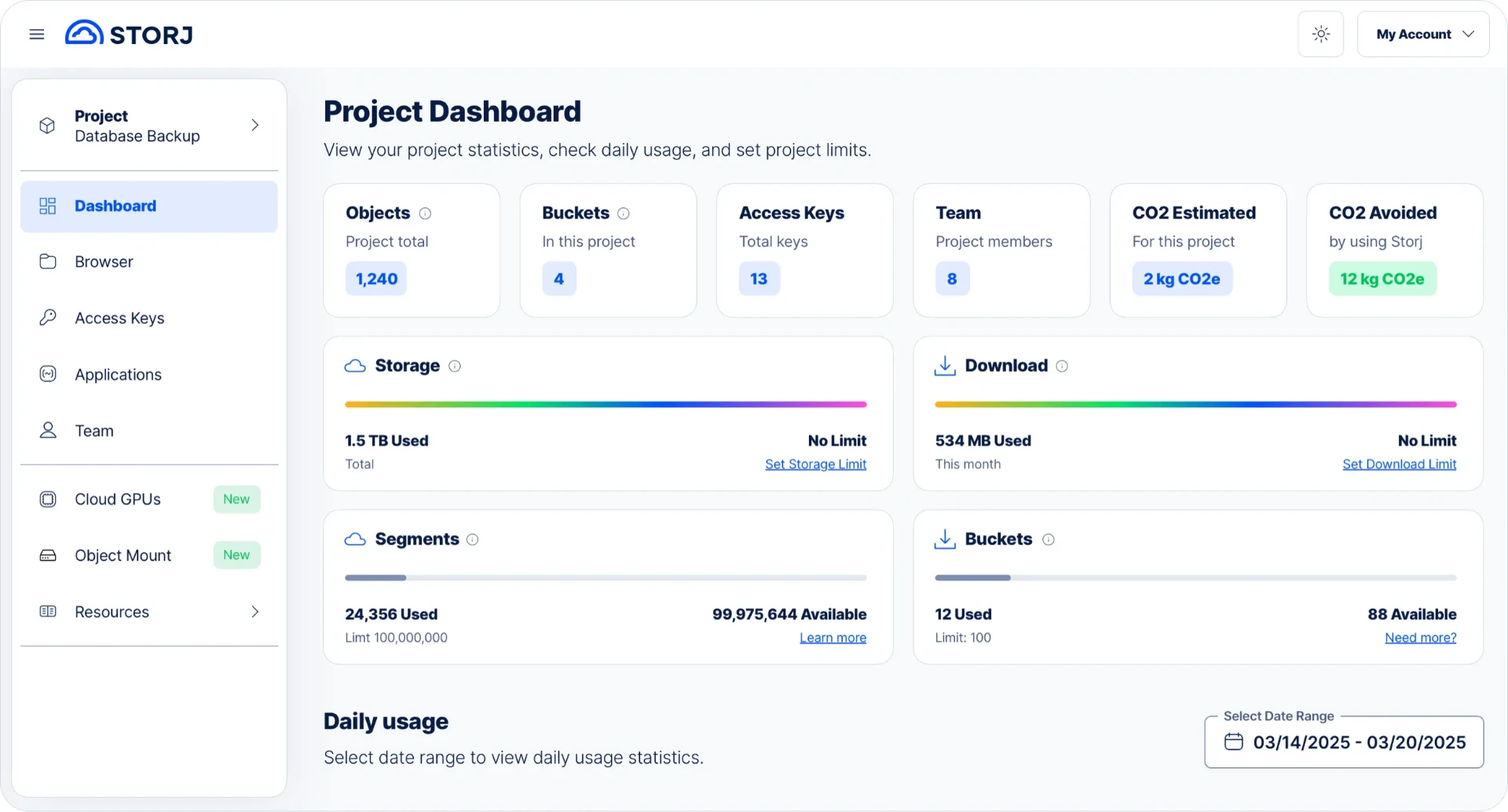
Why the split matters for reliability
The resilience argument is easier to grasp than the privacy one. Conventional object storage keeps several copies inside a data centre, which protects against a failed disk but not against a failed region, a billing dispute or a company that stops existing. Spreading fragments across thousands of unrelated operators means that a large fraction of them can go offline at once and the file is still reconstructible. That is a different failure model, and for archival data it is arguably a better one.
What makes it usable rather than merely interesting is the interface. The service presents a standard object storage API, so existing tools, libraries and scripts work with a changed endpoint and a different key. The command line synchroniser that many people already use supports it natively, which means an archive job can be repointed in one line of configuration. Standards compatibility is unglamorous and it is the reason the architecture is reachable by people who do not want to rewrite their tooling.
The economics and the honest limits
Pricing is split into storage and bandwidth, and the bandwidth side is where it competes: retrieval is cheap enough that the total cost of holding a media library and occasionally reading from it compares well. The free allowance is generous enough to run a real evaluation with actual data rather than a sample. Independent performance reviews have placed it in the leading group for this category, which is more than a marketing claim.
The limits are real too. It is object storage, not a file system, so it suits backups, static assets and archives rather than a database or a working directory. Latency for small random reads is worse than a local disk by design, since a request may touch nodes in several countries. And the governance model, while distributed, still has an organisation in the middle handling billing and coordination, so this is decentralised architecture rather than anarchy.
The value here is that it offers a genuinely different shape. When every cloud looks like every other cloud, someone has to rebuild the bottom layer before anything can improve at the level of principle.
Practical steps for an evaluation. Start with the free allowance and a real workload rather than a synthetic test, because the numbers that matter are yours. Manage keys with the minimum permissions each job needs, and keep a second copy elsewhere for anything you cannot afford to lose, since redundancy inside one provider is not the same as redundancy across providers. And read the pricing page for retrieval before migrating an archive, because storage cost is only half the bill and the other half arrives when you need the data back.