
SQLyog review: a client that speaks to one database, on purpose
Summary
Two decades of attention to a single engine buys a fast editor, a readable execution plan and a schema comparison that writes the change script for you, with a free community build underneath.
Recommend- Name
- SQLyog
- Version
- 20260923
- Pricing
- Free
- Open source
- Open source
- Operating system
- Windows
- Updated
- 2026-10-08 20:32
Specialists versus generalists
Database clients split into two schools. The generalist connects to everything, presents a uniform interface and behaves identically whether the target is relational, document or analytical. The specialist picks one engine and learns it thoroughly, which sounds like a limitation until you spend a working day inside an unusual feature that the generalist renders as a text field.
SQLyog is firmly in the second school: two decades of development aimed at a single engine. The result is speed in the parts you touch constantly. The query editor opens instantly, completion responds to the actual schema, and results render in a grid that stays responsive with a hundred thousand rows. Small advantages, repeated a thousand times a week, become the difference between a tool you use and a tool you fight.
Where the depth becomes visible
Two features carry most of the value. The first is the visual execution plan, which renders the query plan as a diagram with cost attached to each step, so a slow statement shows where the time goes instead of producing a table of internals that requires a reference to interpret. That single view shortens the distance between noticing a slow page and fixing it.
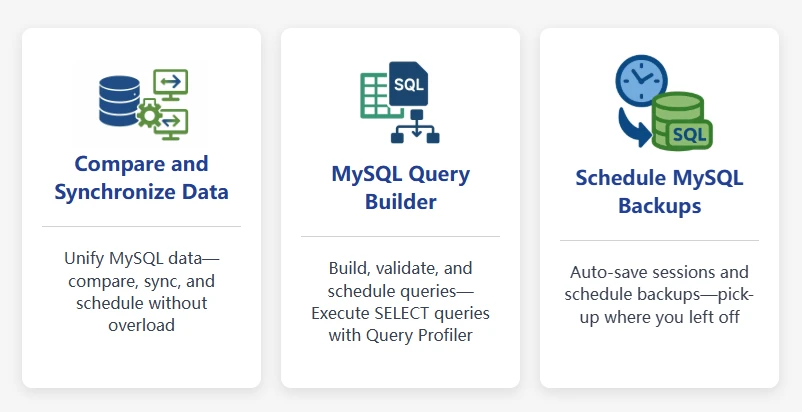
The second is schema comparison. Point it at two databases and it reads both definitions, lists every difference down to column types and index lengths, and generates the alteration script for review before anything executes. Anyone who has written those statements by hand across a dozen tables knows how much of a working afternoon that represents, and how many of the resulting errors were typos rather than design mistakes.
Free tier, paid tier, and the honest trade
The community edition is free and open, with source available in a public repository and builds ready to download, which makes it approachable for individuals and small teams at zero cost. Secure connection through a tunnel is included, so reaching an internal server does not require opening a hole in the firewall. An agent handles scheduled backups and batch jobs. The paid edition adds the enterprise conveniences: shared connection profiles, reporting, and support with a phone number attached.
The trade is honest. This is a Windows-first product, and the interface has the density of software built by people who use it daily rather than for people who will see it once. Nothing is hidden behind a wizard, which is efficient for an experienced administrator and slightly forbidding for a newcomer. It is also resolutely single-engine, which is exactly the point and also the reason not to choose it if your week spans three different systems.
One more practical detail: the editor keeps a history of executed statements per connection, which turns an afternoon of exploratory queries into something you can scroll back through when the schema finally makes sense. It is not a feature anyone advertises, and it is the one that gets used most on a day when the documentation is wrong and the data is the only source of truth.
The lesson in a product like this is simple: in an era of tools that do everything adequately, doing one thing exhaustively remains the sharpest form of differentiation available.
Practical notes. Route every remote connection through the tunnel rather than exposing the port, because the convenience of a direct connection is not worth the exposure. Rehearse structure comparisons against a staging copy before running them on production, since the generated script is only as safe as the review it receives. Schedule backups into the quiet hours and verify one restoration, because an untested backup is a document rather than a safeguard. And update the client alongside the server, since new engine features tend to arrive with syntax that older clients render awkwardly.