
Manus sells a colleague with a computer, and bills by the credit
Summary
Give it a task and it plans, executes and hands back a finished file, because it runs inside a networked virtual computer with a disk that survives between steps. Credits replace seats, and every tier keeps the same concurrent and scheduled task limits.
Recommend- Name
- Manus
- Version
- 1.0.7
- Open source
- Proprietary
- Operating system
- WebmacOSWindows
- Website
- https://manus.im/
- Updated
- 2026-10-06 18:36
Manus arrived with an argument attached. On one side, demonstrations of a sentence being turned into finished work. On the other, a debate about whether this really qualifies as an agent. Rather than settle that, it is more useful to look at what the product says about itself. The documentation defines it as an autonomous general agent that completes tasks and delivers results, closer to a virtual colleague with its own computer than to a chatbot answering one question at a time, and traces that from planning through execution to delivery. The homepage tagline states the thesis: less structure, more intelligence. A site-wide notice also announces that Manus has resumed operating independently, with a blog post on the road ahead.
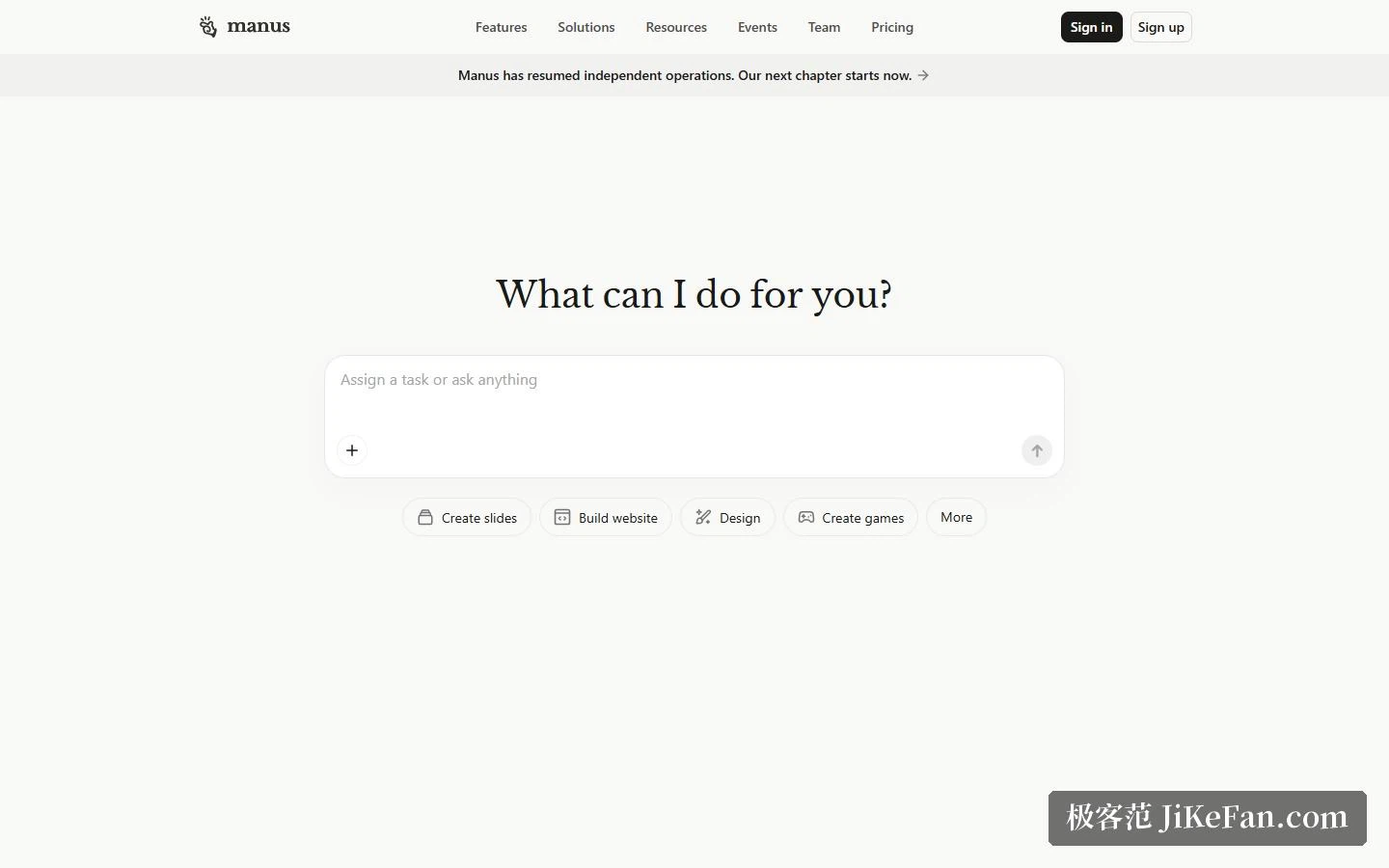
The foundation is a sandbox with a network connection
The documentation locates the difference in the environment rather than the model. Conventional tools, it argues, need you to guide each step and then assemble the result yourself. Manus runs inside a complete sandbox: a networked virtual computer with a persistent file system, able to install its own software and create custom tools. That is why it can carry a long task on its own, remember the intermediate context and the files produced along the way, and hand back something described as ready to use.
The claim sounds modest and explains almost everything else. A job that takes an hour or two is only possible if the files produced halfway through still exist at the end and the dependencies installed in the first ten minutes are still installed in the last. Most of the difference between a chat assistant and an agent is not intelligence; it is whether the disk persists.

The capabilities are split into products, not one universal box
The site divides the work into a product line rather than a single prompt field: web apps, AI design, AI slides, image generation, music generation, a browser operator, a deep research mode, an email assistant and a chat platform integration. The documentation groups its material into features, a website builder and integrations.
The blog makes the pace legible. Slides arrived on 14 July, auto-publishing on 13 July, branching into parallel paths within one context on 9 July, a hosted mode on 30 June, and a plan mode on 22 July, earlier still. The whole pace sits inside two months, 6 and 7. Integrations run as a second thread, wiring in outside services that cover voice, backends, meetings, design assets, commerce, customer records and mail.
Billing: credits in tiers, with identical task limits
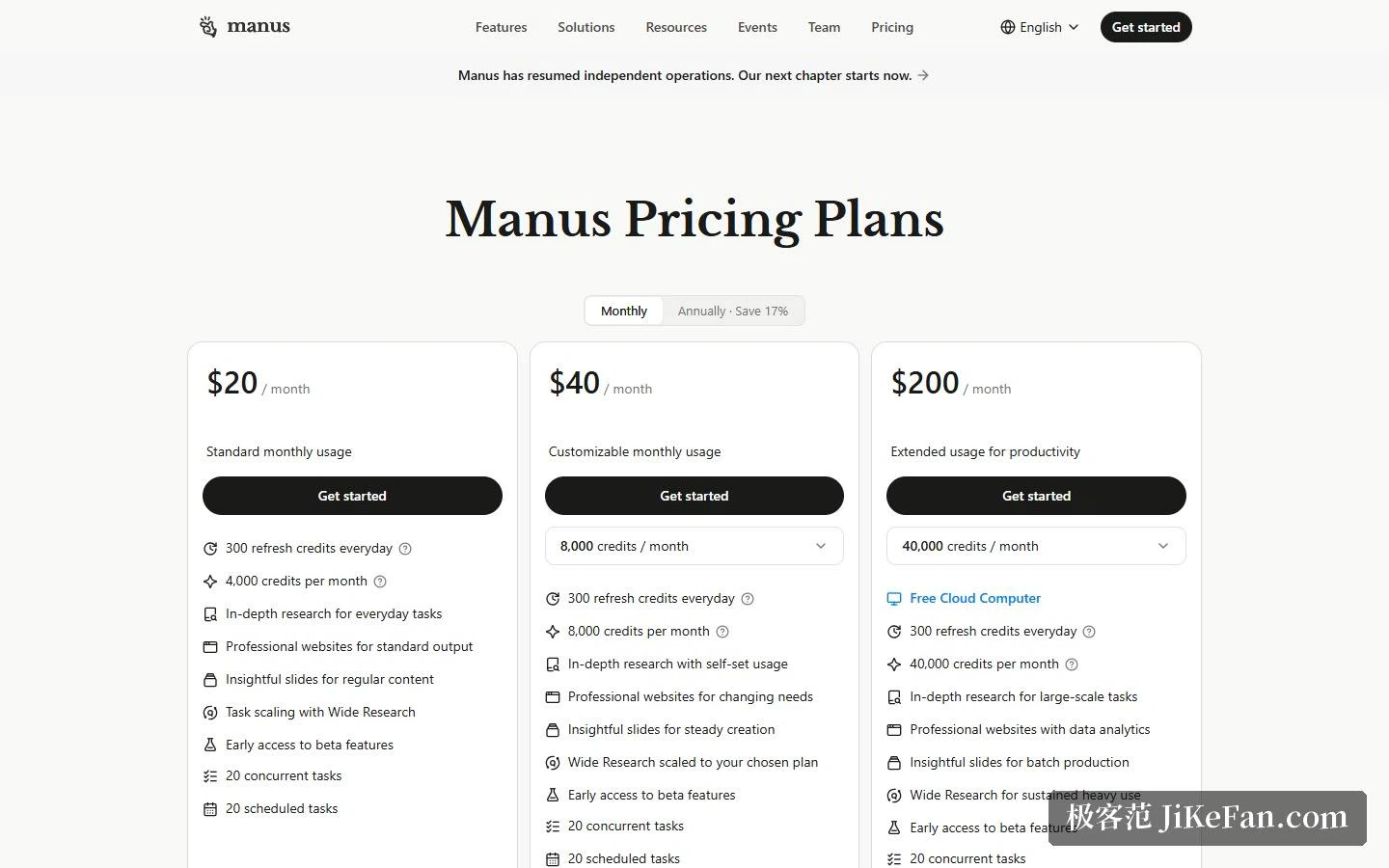
Pricing comes monthly or yearly, with the yearly option marked as 17 percent cheaper. All three tiers are measured in credits: the entry tier gives 300 credits refreshed daily plus 4000 a month, the middle tier 8000 a month, and the top tier 40000 a month with a cloud computer included. All three carry 20 concurrent tasks and 20 scheduled tasks, and all three get early access to beta features.
The positioning follows the credits. Entry covers daily deep research and standard websites and slides. The middle tier emphasises custom usage. The top tier targets mass production and data analysis. One thing to note: the price figures sit inside a scrolling animation and do not appear in the page text, so this article quotes the credit structure and task limits rather than amounts. Team and enterprise plans exist separately, and the footer mentions enterprise-grade security and industry certifications.
Who it suits
Three kinds of buyer. Individuals who want to outsource one complete small job as a package, whether that is slides, a website, a research round or querying data through an outside service. Small teams producing content on a weekly rhythm, since 20 scheduled tasks and 20 concurrent tasks is a batch-sized allowance. And business owners who would rather route web operations and external system queries through one entry point.
One warning belongs here: credit consumption tracks task complexity closely. The blog carries cases of output rising 90 times and of running 12000 learners with fewer than 20 people, but those cases are chosen by the company. Before committing to a tier, run one real task and watch how quickly the meter moves.
What a persistent sandbox actually buys you
The persistent disk changes the failure mode rather than the intelligence. On a stateless assistant, an error halfway through means starting over. In a sandbox, an interrupted job can be resumed, because the intermediate files and installed dependencies are still there. That is also why the honest test of a general agent is not how good the first output looks, but what happens on the second attempt after something went wrong: does it stop and ask, or change approach and continue.
The cost of that persistence is a different kind of mess. A working directory that survives between steps also accumulates debris, and a file produced an hour ago may no longer be the version you want. Anyone using this for real work needs a habit of naming and checking the artefacts, much as they would with a junior colleague who is fast and slightly careless.
Credits are a tax on learning
Because consumption follows complexity, the only reliable way to learn the price of a task is to attempt one and fail, which makes the first project expensive in a way no pricing table shows. The rational approach is to spend the entry tier's allowance on a single representative job, measure it, then extrapolate. Doing that also tells you whether the 20 concurrent tasks matter: for most individuals they will not, and for a content team they are the actual reason to move up.
Two honest notes
First, no price amounts are quoted here, because the page keeps them inside an animation component rather than in its text; check the console before budgeting. Second, the company says it has resumed independent operation, and the ownership and roadmap of a general agent platform matter more than usual when the product is meant to sit inside your workflow, so read the official announcements rather than inferring stability from the site.
Judge a general agent by what it does when something goes wrong halfway: does it stop and ask you, or find another route and keep going.