
Macrium Reflect X 10.0.8843: the image format has been open sourced
Version 10.0.8843
Summary
The official release notes put Macrium Reflect X at 10.0.8843 as of 2026-04-09. The previous Reflect 8 line reached end of life at the end of 2025, and the new generation moves to a subscription with an open sourced image format.
- Name
- Macrium Reflect X
- Version
- 10.0.8843
- Pricing
- Paid
- Open source
- Proprietary
- Operating system
- Windows
- Website
- https://www.macrium.com/
- Updated
- 2026-10-06 21:47
When a long established backup tool changes generation, the argument is rarely about features. It is about file formats and licensing. Macrium Reflect X changed both. The official release notes put the latest build at 10.0.8843, dated 2026-04-09, while the previous Reflect 8 line has run its course: the notice on the site sets the end of the home edition at 2025-12-31 and the commercial edition at 2026-02-27, after which security updates and technical support stop. The X generation itself arrived in 2024-10.
A new image format, and it is open source
The substantive change is in the file format. The official knowledge base states that Macrium Reflect X introduces .mrimgx for disk images and .mrbakx for file and folder backups. The next step is the more notable one: both formats have been published on a public code hosting service, together with the complete source code needed to restore all of the data. The site's wording is unusually direct, namely that your data stays freely accessible and no longer depends on proprietary software, because the data is yours and you own it.
Compatibility has not been cut off in the process. The documentation states that X is backward compatible with images and file backups created by Macrium Reflect 7 and Reflect 8, and that an existing backup set keeps using the .mrimg and .mrbak formats until a new set is created.
Why that matters is worth a sentence. An image format is the part of a backup tool that decides whether the archive can still be opened in ten years, and publishing the format plus the restore code moves that decision out of one vendor's roadmap. It also puts the old and the new side by side: existing sets keep working as they are, so nothing has to be re-created before the new format can be tried.
Resuming after a dropped connection or a power cut
Resumable imaging is the other card X plays. The knowledge base devotes a section to resumable images and write failure retry. A persistent VSS snapshot is created, and when a temporary or even a fairly serious error appears, the image carries on in the background, including across a system restart. On a write error it keeps retrying for a configured number of minutes; only after the backup completes are the temporary files cleaned up and the data file renamed to .mrimgx. One caveat is spelled out: the capability applies to X images only, and the older .mrimg format does not support it.
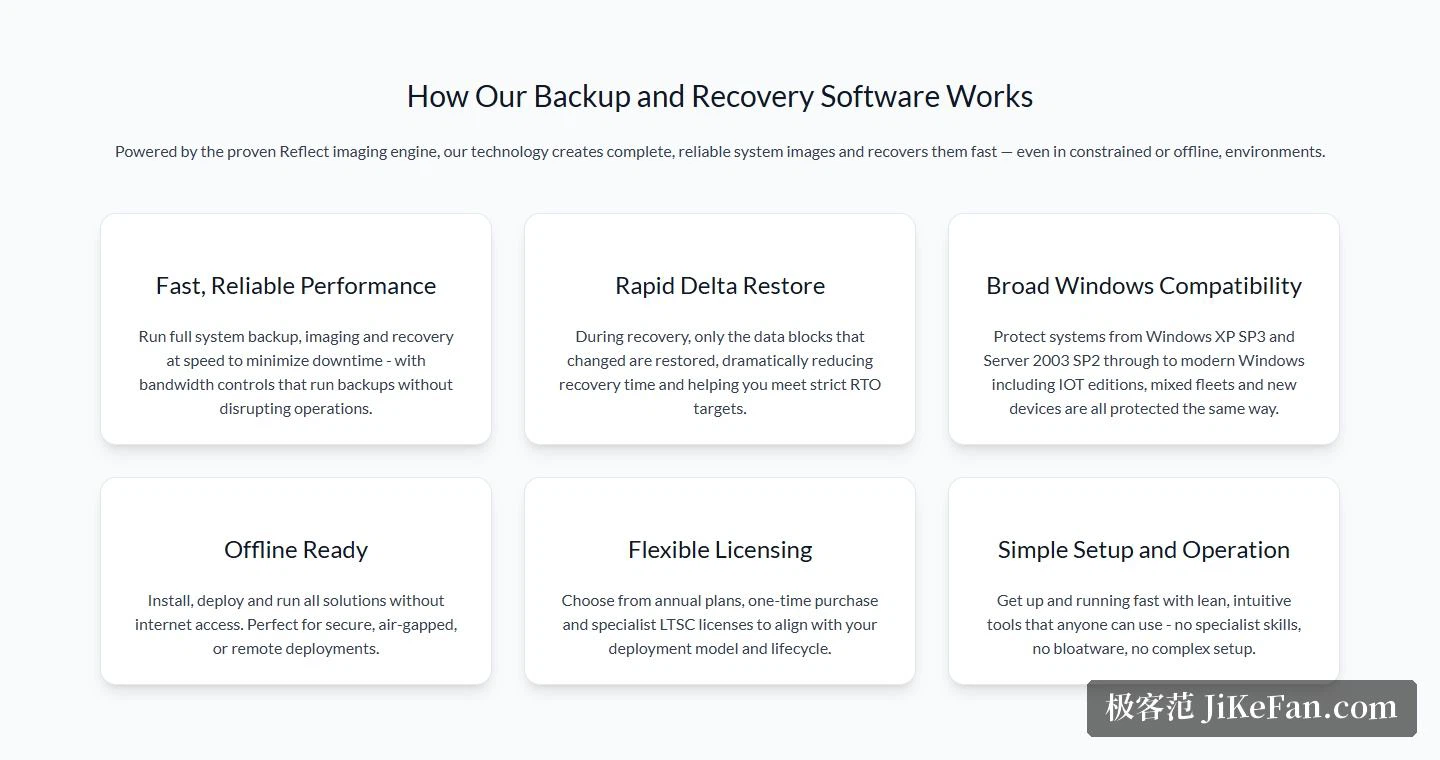
Recovery has its own acceleration. Rapid Delta Restore gets a section of its own on the site, and the mechanism is that only the data blocks that changed are written back during a restore, which shortens the operation noticeably. As for coverage, the documentation puts the protected range from Windows XP SP3 and Server 2003 SP2 all the way to current Windows, including IoT editions and mixed device environments. The ARM side has moved too: X supports backup and restore on Windows Copilot+ ARM machines through a Windows RE recovery medium, and the site describes bare metal recovery for Windows on ARM as a first.
How it is licensed
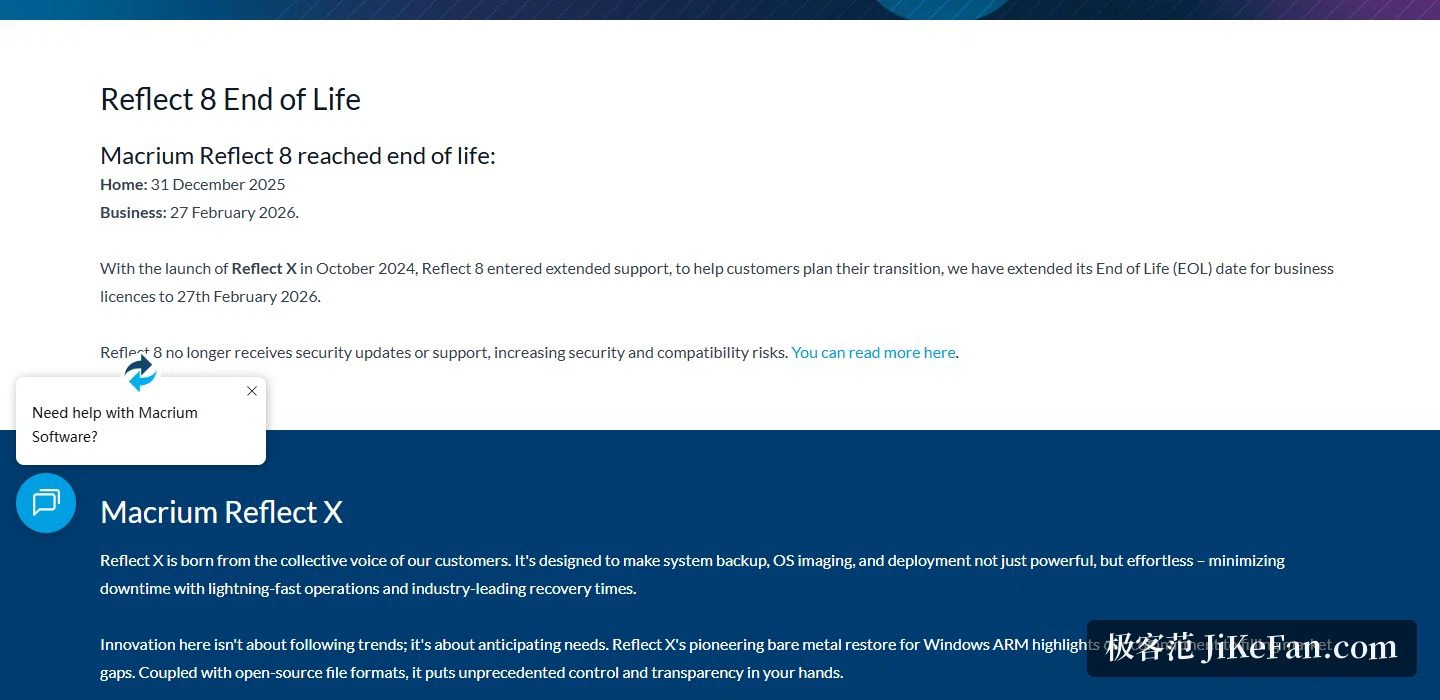
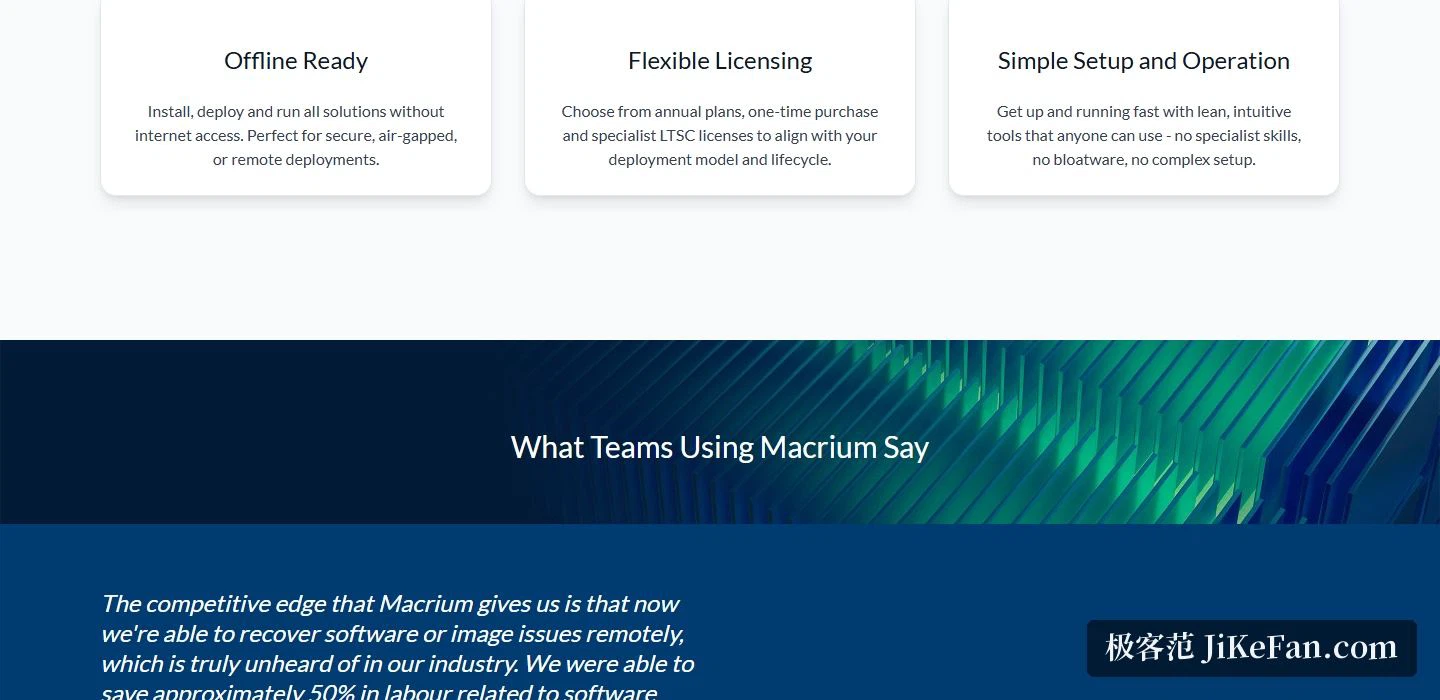
This generation moves to a subscription. The licensing note on the front page offers an annual plan, a one-time purchase, and an LTSC licence for special scenarios. For users coming from Reflect 8 the vendor had previously offered a discounted upgrade path, and according to the site, even after a licence expires the channel for restoring and recovering data remains, with only the creation of new backups stopping.
Version 10.0.8843 itself changes little, and the release notes list exactly one item: new licence keys are enabled, with existing users unaffected. The release before it, 10.0.8750 from 2025-12-03, fixed things with more presence, among them a calculation issue that could corrupt image files when a backup was uncompressed, a mounted drive icon left behind after unmounting, and an exit after creating rescue media in non-English languages.
Put next to each other, the two releases say something about where the work is going. A build that only swaps licence keys is a build whose feature surface has settled; a build that fixes a calculation issue which could damage an uncompressed image is a reminder that the arithmetic inside an imaging tool is the part nobody can check by eye, and that a version number one step higher is not a small thing when the file being written is the only copy.
Open sourcing the image format, letting a backup resume where it stopped, and writing back only the changed blocks on restore add up to one goal: fewer surprises on the day a restore actually has to happen. For anyone still on Reflect 8, the end of life has already passed, and the X generation is the road left to take.