
BorgBackup: Deduplicating, Encrypted Backups That Save Space
Summary
Running out of backup space? The deduplication in BorgBackup is the direct answer: identical chunks are stored once, incremental runs finish quickly, storage use drops by a wide margin, encryption and compression come together, and the open source command line approach has been trusted by server administrators for years.
Recommend- Name
- BorgBackup
- Version
- 1.4.5
- Pricing
- Free
- Open source
- Open source
- Operating system
- WindowsmacOSLinux
- Website
- https://www.borgbackup.org/
- Updated
- 2026-10-06 20:12
The Trouble With Backups: Big, Slow And Risky
Anyone who has taken backups seriously knows the three pains. A full backup eats storage until the disk is full. An incremental backup saves space but turns into a pile of directories nobody can reason about, where restoring last month means guessing which chain of files is intact. And the backup data itself often sits exposed, on a drive that travels, on a share with weak permissions, on a host that someone else administers.
BorgBackup answers all three at the level of a textbook example. Its core is chunk level deduplication: when it backs something up it cuts the files into small chunks, compares each one against the chunks already present in the repository, and stores identical content exactly once. A second backup therefore writes only what genuinely changed. A snapshot taken every day costs almost nothing in space, and keeping several dozen historical points stays within a reasonable budget.
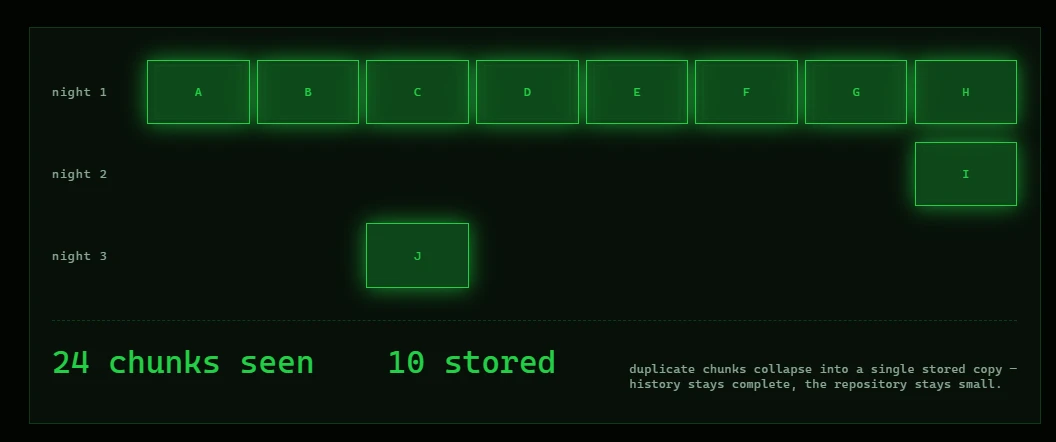
That single design decision changes the shape of a backup habit. Retention stops being a decision about money and becomes a decision about policy: keeping thirty days instead of three no longer requires thirty times the disk, so there is no reason to be stingy with history. The version you actually need is almost always the one from the day before yesterday, and it is the version that a tight retention window tends to discard first.
Encryption, Compression And Remote In One Step
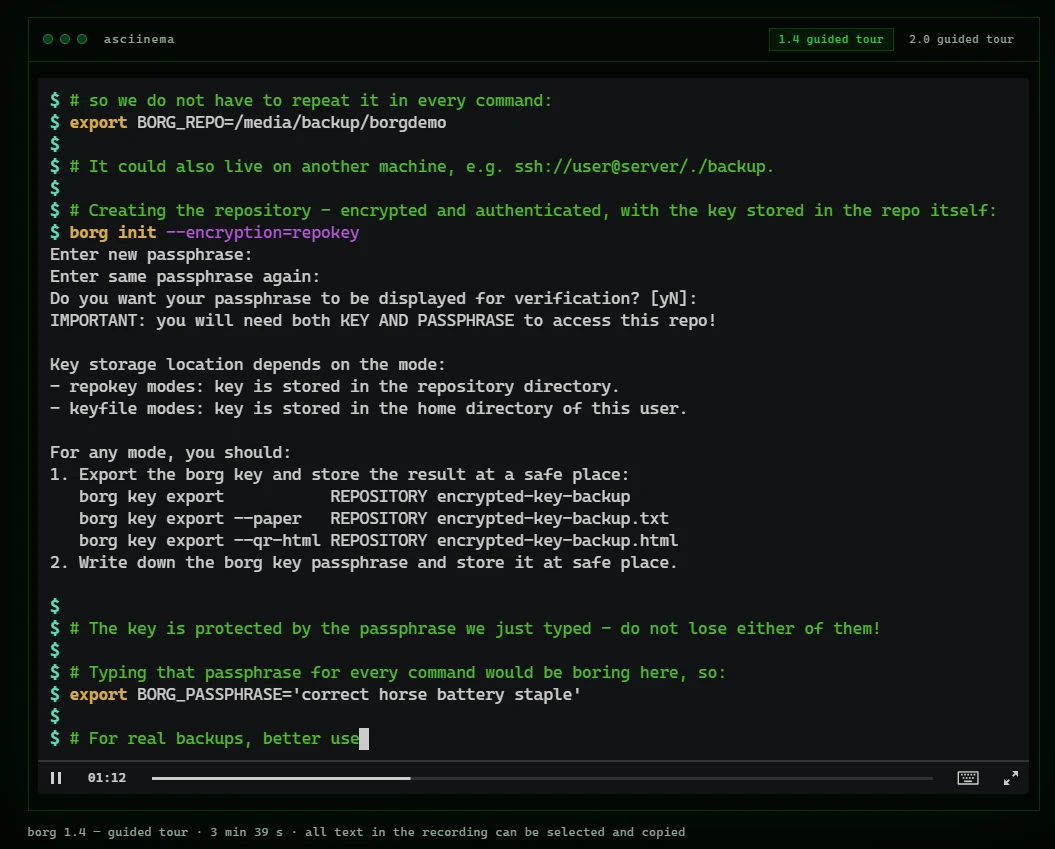
On the security side it does client side encryption, which means data is encrypted before it leaves the machine and the operator of a remote repository cannot see the contents even while holding the files. Compression happens before writing, so text and logs shrink by another round on top of the deduplication. Remote repositories travel over SSH: any Linux server with Borg installed can act as a repository, and the configuration is simple and legible rather than a maze of options.
The current stable release has been polished over a long period and is comfortable to use in production. The next major series is still on the test line, bringing a more modern shape for remote repository services. Paired with scheduled jobs and a retention policy that rotates snapshots by day, week and month, the whole arrangement, once built, mostly runs without further attention.
There is a second benefit that only shows up later. Because every snapshot shares its chunks with the ones before it, the repository behaves like one large pool of unique data with many entry points into it, rather than a set of independent copies. Reaching for a file from six weeks ago is the same operation as reaching for yesterday version, and it does not require keeping six weeks of full copies around. Confidence in a backup comes from that: the restore you need is a normal case, not an expedition.
The values behind BorgBackup are simple: make the correct way of backing up effortless. Deduplication turns frequent backups into a habit, and encryption makes it acceptable to put a backup anywhere. The essence of data safety is removing the cost from good habits.
The positioning should be stated plainly as well. This is a command line tool with no graphical interface, which for a server administrator who can write a few lines of shell is not a burden but a convenience. Desktop users can pair it with one of the graphical front ends maintained by the community. It runs on all three platforms, it is open source and free, and the documentation is thorough.
If a server or a workstation still has no dependable backup arrangement, starting with Borg is a widely recognised route with low cost and high return. The first run takes an afternoon of reading and a few configuration decisions; everything after that is a schedule doing its work quietly in the background.
Once it is running, the discipline required is small but not zero. Look at the log of the scheduled job now and then, because a backup that fails quietly is worse than no backup at all. Restore something on purpose once or twice a year, and pick an awkward file rather than an obvious one. Everything else is left to the schedule, which is the whole point of building the thing properly in the first place.